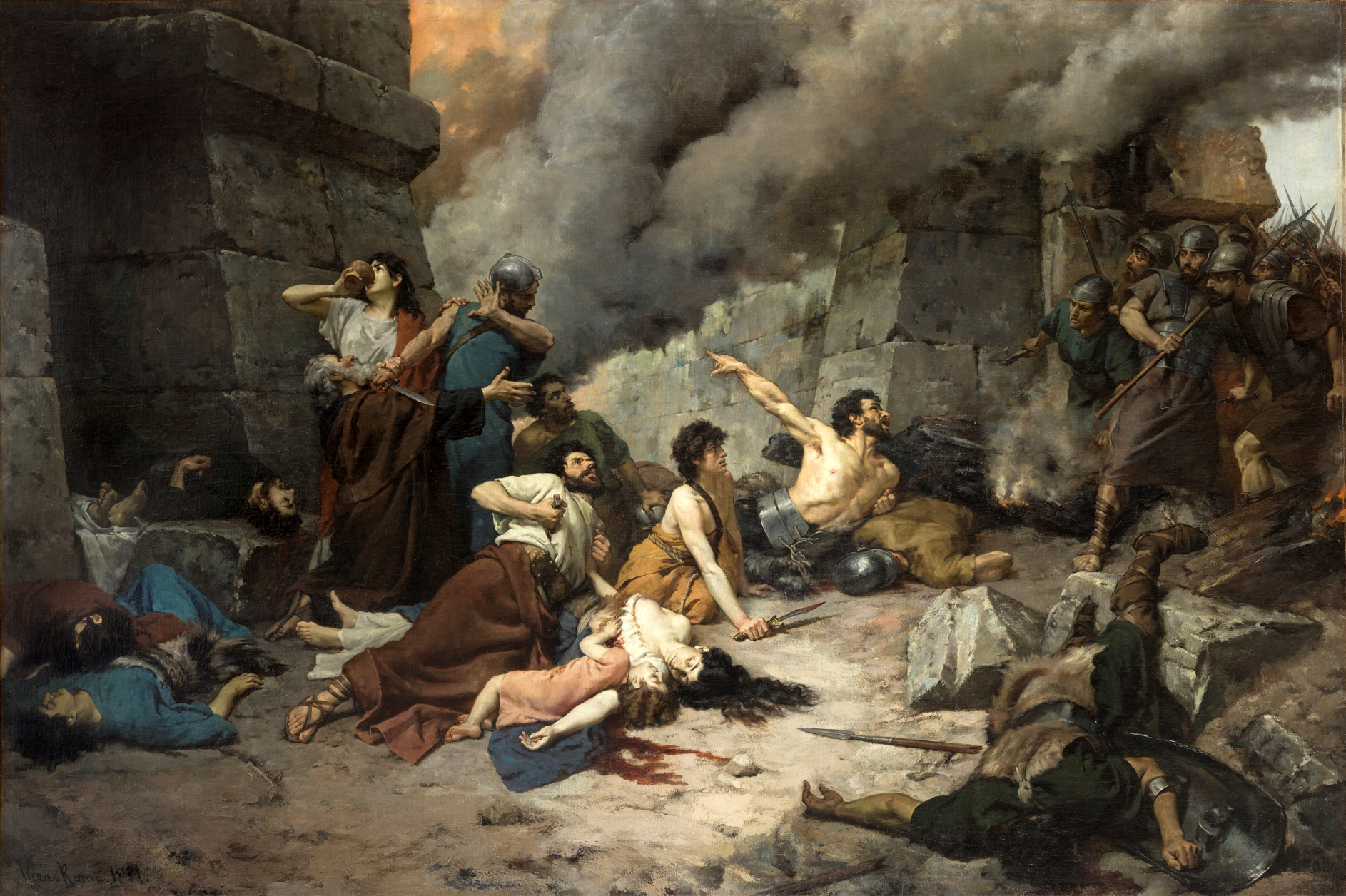
Siege of Numantia
Rather than submit to Rome, they ate their dead. When that was not enough, they set their city ablaze and took their own lives, entire families together. The fall of Numantia in the summer of 133 BC was the culmination of a twenty-year humiliation for the Roman Republic, a conflict in which the mightiest military power in the ancient world repeatedly failed to subdue a single Celtiberian hilltop city in what is now the province of Soria, Spain. It took Scipio Aemilianus Africanus, the man who had destroyed Carthage, to finally end the resistance -- and even he could not defeat Numantia in battle. He had to starve it to death.
The City Rome Could Not Take
The Numantine War was the third of the Celtiberian Wars, erupting in 143 BC when the indigenous peoples of Hispania Citerior rose against Roman expansion. For a decade, Rome sent general after general against Numantia, the principal city of the Celtiberian resistance. Each failed. The city was not large, but its defenders fought with a ferocity that Roman historians themselves acknowledged and admired. Morale among the Roman troops stationed in Iberia was terrible; the prospect of plunder was low, and the Celtiberians had proven their willingness to fight to the last. By 135 BC, the Roman Senate was desperate enough to reappoint Scipio Aemilianus, the hero of the Third Punic War, and send him to Hispania with a mandate to finish what lesser commanders could not.
The Siege Machine
Scipio arrived with 20,000 Roman troops and 40,000 allied and mercenary soldiers, including Numidian cavalry and twelve war elephants led by the young Jugurtha, who would later become a formidable enemy of Rome himself. But Scipio had no intention of storming the city. He planned to encircle it and let hunger do what swords could not. His army built a double wall of circumvallation around Numantia, punctuated by seven towers from which archers could fire into the city from ten feet above ground. He dammed a nearby swamp to create a lake between the city walls and his own fortifications, then engineered the blockade of the Duero River by stringing cables fitted with blades across the water at the points where it entered and exited the city, preventing boats or swimmers from passing.
Rhetogenes and the Severed Hands
Desperation drove the Numantines to attempt breakouts. Their greatest warrior, Rhetogenes, led a small band of men down the river past the Roman blockade in one of the siege's most daring episodes. He reached the Arevaci tribe first, but his pleas for help were ignored. At Lutia, the young men rallied to his cause, but the tribal elders betrayed them, warning Scipio of the alliance. The Roman general marched from Numantia, arrested 400 Lutian youths, and had their hands cut off as punishment. It was a brutal message to any tribe considering intervention: Rome would not merely defeat its enemies but mutilate them as a warning. After Scipio returned, the Numantine leader Avarus attempted negotiations, but the path to any compromise had long since closed.
Fire and Legacy
When Numantia's first ambassadors asked for liberty in exchange for surrender, Scipio refused. The ambassadors were killed upon their return by their own people, who believed they had secretly bargained with Rome. Starvation consumed the city. Cannibalism followed. Families began taking their own lives together. When the surviving population finally surrendered, they did so only after setting their city on fire. Scipio had the ruins leveled. The story of Numantia became a touchstone for Spanish identity, celebrated as a symbol of resistance against overwhelming force. Miguel de Cervantes, author of Don Quixote, wrote the play La Numancia about the siege, his most acclaimed dramatic work. Three ships of the Spanish Navy have carried the name Numancia. In 2017, Spain marked the 2,150th anniversary of the siege with a national commemoration, honoring the people who chose annihilation over submission.
From the Air
Located at 41.81N, 2.44W near modern Garray in the province of Soria, north-central Spain. The archaeological site of Numantia occupies a hill at the confluence of the Duero and Merdancho rivers, with the outlines of the Roman siege works still partially visible in the landscape from aerial perspectives. The terrain is high meseta, sparse and semi-arid. Nearest airport is Soria (not ICAO-coded; small). Valladolid (LEVD) approximately 200 km west. Recommended viewing altitude: 3,000-5,000 feet AGL to see the confluence of rivers and traces of Roman earthworks.