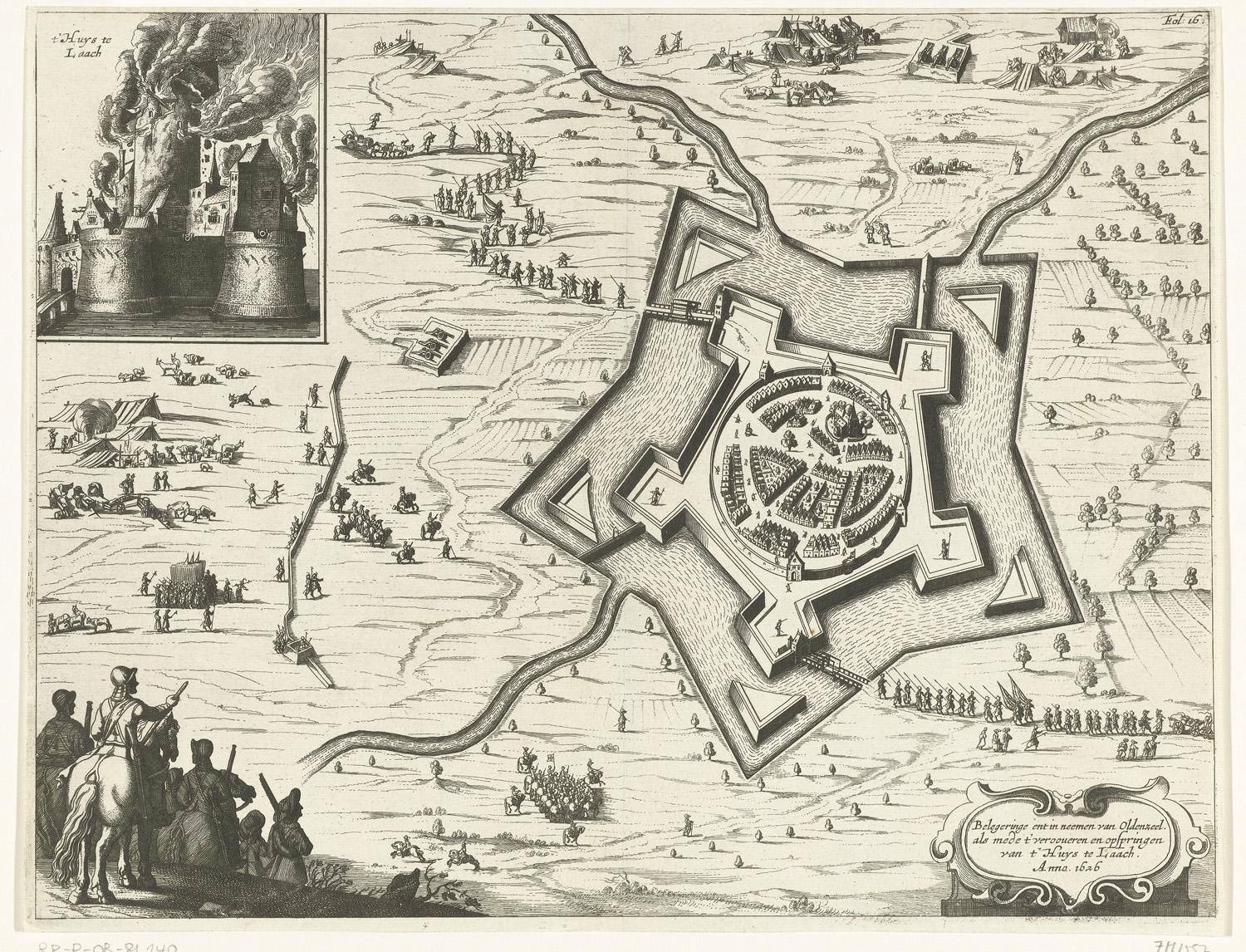
Siege of Oldenzaal (1626)
Two sluice gates were all that stood between the Spanish garrison and defeat. They controlled the canals that ringed Oldenzaal, the moat-like waters that made the town defensible. Ernest Casimir studied the gates from his siege lines and pointed his guns at them. The batteries opened fire on the timbers and ironwork. When the gates finally collapsed under the bombardment, the canals drained into the surrounding fields, and the Spanish position drained with them. Within days, the commander Verdugo sent out a flag of truce.
A Spanish Foothold in Twente
For two decades, Oldenzaal had been a thorn in the side of the Dutch Republic. The Genoese general Ambrogio Spinola had taken the town in 1605, capturing Groenlo the following year, and from these strongholds in the eastern Twente region Spanish raiding parties harried the Protestant provinces. By May 1626, the Dutch had decided to settle the matter. Frederick Henry, Prince of Orange, marshalled two armies to clear the Spanish from the area for good. Joining him was an English contingent, raised because Charles I's England was at war with Spain too. The Eighty Years' War and the Anglo-Spanish War were converging on a single small Dutch town.
The Engineer's War
On July 23, the Anglo-Dutch force closed in. The terrain favored the besiegers so completely that Ernest Casimir, leading the operation, didn't bother with a circumvallation line, the secondary wall normally built to fend off a relief army. He could see anyone coming. His pioneers were skilled men, and they set to work the way pioneers always did in this age of siegecraft: trenches snaked forward, batteries crept closer, gabions filled with earth absorbed the defenders' fire. The Broeckhuise castle on the outskirts posed a problem and a few English companies were detached to take it. They did, within two days. Then everyone turned their attention to the sluice gates.
An Honourable End
Once the canals drained, the besieged had no real hope. No Spanish relief force was coming. The bombardment had lasted perhaps ten days when Verdugo asked for terms. He was granted what soldiers of the period called the honours of war: the garrison marched out fully armed, drums beating, colors flying, free to rejoin the Spanish field army elsewhere. It was the conventional courtesy extended to a defeated commander who had fought well. On August 1, after eight days of formal siege, Oldenzaal was Dutch again. Casimir entered the town in triumph, and Protestant defectors who had welcomed the Spanish were promptly arrested.
Walls Down, Town Standing
The republic now had to decide what to do with the prize. Oldenzaal sat at a strategic crossroads, and the temptation to keep its fortifications intact must have been strong. But fortified towns could be lost again, or held against the central government by mutinous troops. The decision came down: the great fortress walls were demolished, despite vigorous protests from the city's burghers who saw their protection being torn away. Some of the medieval circuit survived, along with parts of the canal system, retained as defense against rogue garrisons rather than foreign armies. The following year, Groenlo fell after a two-month siege, and the Spanish presence in Twente was finished.
From the Air
Oldenzaal sits at 52.31N, 6.93E in the Twente region of the eastern Netherlands, just six kilometers from the German border. Cruise overhead at 4,000 to 6,000 feet for a clear look at the compact medieval street pattern, still visible inside the line of the demolished fortifications. The nearest airport is Enschede Airport Twente (EHTW), about fifteen kilometers southwest; Lelystad (EHLE) and Groningen (EHGG) are within easy range for general aviation. The flat farmland that once let Casimir's army see every approach still spreads out below.