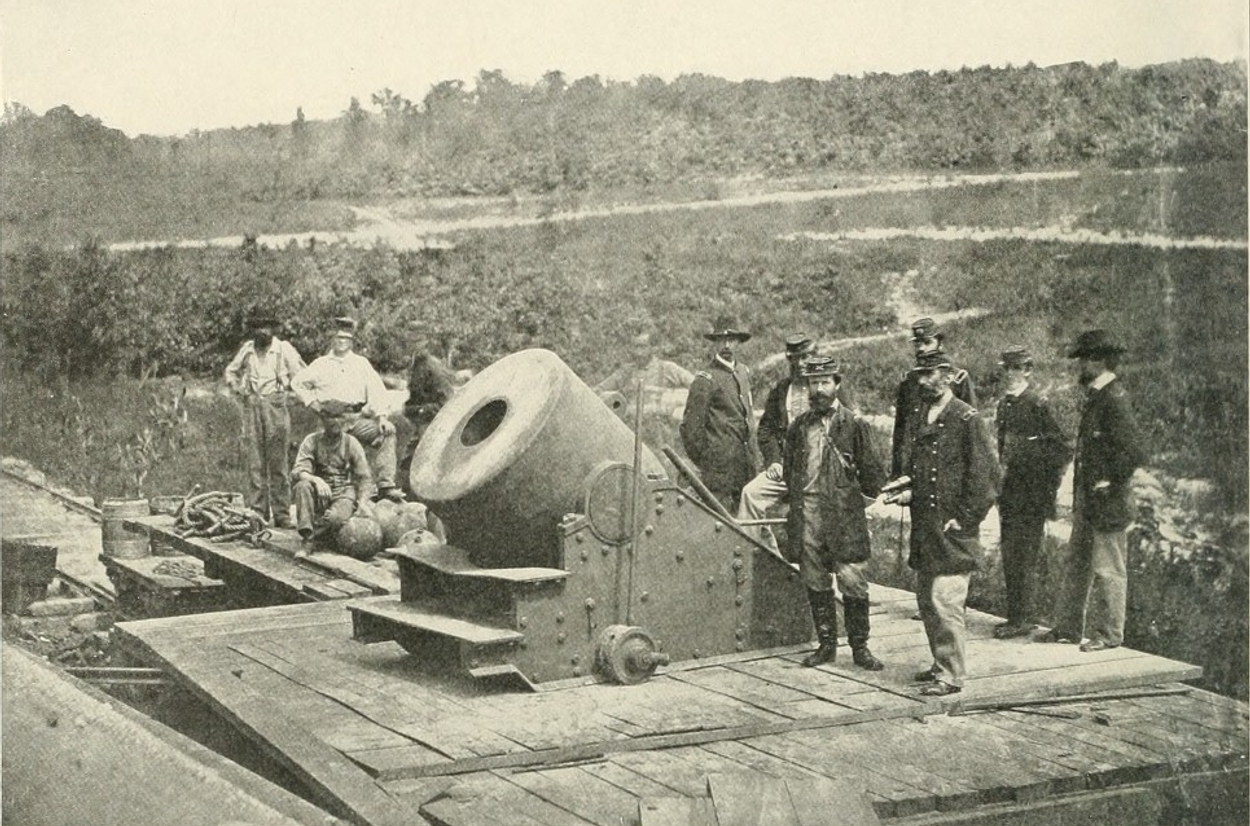
Siege of Petersburg
The 1st Maine Heavy Artillery lost 632 of its 900 men in a single assault on June 18, 1864 -- the heaviest single-battle loss of any regiment in the entire Civil War. That carnage was just day four of what would become a nine-month ordeal around Petersburg, Virginia. Not a true siege in the classical sense, the Richmond-Petersburg campaign from June 9, 1864, to March 25, 1865, was something military history had rarely seen: industrialized trench warfare on a massive scale, with fortified lines stretching over 30 miles from eastern Richmond to southern Petersburg. It would not be seen again until the Western Front fifty years later.
The Noose Tightens
Ulysses S. Grant's strategy was brutally simple. Petersburg, a prosperous city of 18,000, was the junction for five railroads that fed supplies to Robert E. Lee's army and the Confederate capital at Richmond. Cut those railroads, and both the army and the capital would starve. On the night of June 12, 1864, Grant executed one of the war's boldest maneuvers, marching his army to the James River and constructing a 2,100-foot pontoon bridge to cross it. Lee, convinced Grant's target was Richmond, devoted only minimal troops under General P.G.T. Beauregard to Petersburg's defense. When 15,000 Federal troops arrived on June 15, they faced just 5,400 Confederates stretched thin along the Dimmock line, a ten-mile ring of earthworks built in 1862 using freedmen and enslaved labor. Beauregard later wrote that Petersburg "at that hour was clearly at the mercy of the Federal commander." But hesitation by Union General William "Baldy" Smith squandered the chance.
Into the Crater
With frontal assaults failing at a staggering cost -- 11,386 Union casualties in just four days of fighting June 15-18 -- Grant's forces dug in for a prolonged campaign. The most audacious attempt to break the stalemate came from Lieutenant Colonel Henry Pleasants, a mining engineer commanding the 48th Pennsylvania Infantry. His men tunneled beneath the Confederate lines and packed the shaft with gunpowder. At 4:44 a.m. on July 30, the explosion created a crater still visible today, instantly killing 250 to 350 Confederate soldiers. But the assault devolved into catastrophe. The lead division, selected by lottery just the day before, stumbled into the crater instead of around it. Confederate General William Mahone assembled a counterattacking force and turned the pit into what he called a "turkey shoot." Grant called it "the saddest affair I have witnessed in the war." Union casualties reached 3,798, many from the United States Colored Troops division sent in after the initial attack had already failed.
The Railroad War
The campaign's true battlefield was the railroad network. Grant methodically targeted Petersburg's three remaining supply lines: the Richmond and Petersburg Railroad, the South Side Railroad reaching west to Lynchburg, and the Weldon Railroad running south to Wilmington, North Carolina, the Confederacy's last major port. Cavalry raids, infantry assaults, and flanking maneuvers ground on month after month. At Globe Tavern in August 1864, Warren's V Corps finally secured a stretch of the Weldon Railroad -- the campaign's first Union victory -- forcing Confederates to haul supplies by wagon from Stony Creek, miles to the south. In one of the war's most colorful episodes, Confederate cavalry under Wade Hampton rode behind Union lines in September 1864 and captured 2,486 beef cattle in the Beefsteak Raid. When a visitor asked Grant when he expected to starve out Lee, the general replied, "Never, if our armies continue to supply him with beef cattle."
Black Soldiers at the Front
The Siege of Petersburg featured the Civil War's largest concentration of African American troops. United States Colored Troops participated in six major engagements during the campaign and earned 15 of the 25 total Medals of Honor awarded to African American soldiers in the entire war. On the Confederate side, freedmen and enslaved workers were essential to constructing the Dimmock defensive line. The role of Black soldiers was complex and consequential: at the Battle of the Crater, the USCT division under Brigadier General Edward Ferrero had been specifically trained for the assault but was pulled from the lead role the day before the attack. When finally sent in after the plan had already collapsed, they suffered devastating casualties. At the Battle of New Market Heights in September 1864, Black troops helped spearhead Butler's assault on the Richmond defenses north of the James River. By December 1864, the army reorganized its integrated corps into the all-white XXIV Corps and the all-Black XXV Corps.
The Last Desperate Gamble
By March 1865, Lee's army was weakened by desertion, disease, and shortage of supplies, outnumbered roughly 125,000 to 50,000. His final gamble came at Fort Stedman on March 25, when Confederate Major General John B. Gordon launched a predawn attack with nearly half of Lee's infantry. The assault initially succeeded beyond "most sanguine expectations," seizing the fort and opening a gap nearly a mile long in Union lines. But Gordon's men, many of them starving, stopped to eat captured Federal rations. Union Brigadier General John F. Hartranft organized a counterattack, ringing the penetration with 4,000 troops by 7:45 a.m. Confederate casualties reached 4,000 against 1,044 Union losses. Lee had weakened his own right flank to mount the attack, and Union forces seized much of the Confederate picket line southwest of Petersburg. Eight days later, Lee abandoned Petersburg and Richmond, retreating west to his surrender at Appomattox Court House on April 9, 1865.
From the Air
The Siege of Petersburg battlefield complex is centered at 37.218°N, 77.378°W, spread across a vast area around Petersburg, Virginia. The Petersburg National Battlefield features 13 separate sites on a 33-mile driving tour. The Crater is visible from the air on the eastern front. Best viewed at 3,000-5,000 feet AGL to appreciate the full extent of the trench lines. Petersburg Municipal Airport (KPTB) is nearby. Richmond International Airport (KRIC) is approximately 25 miles north. The Appomattox River and the city's railroad corridors provide strong visual references. Grant's headquarters at City Point (now Hopewell) is visible along the James River to the northeast.