Siege of Petropavlovsk
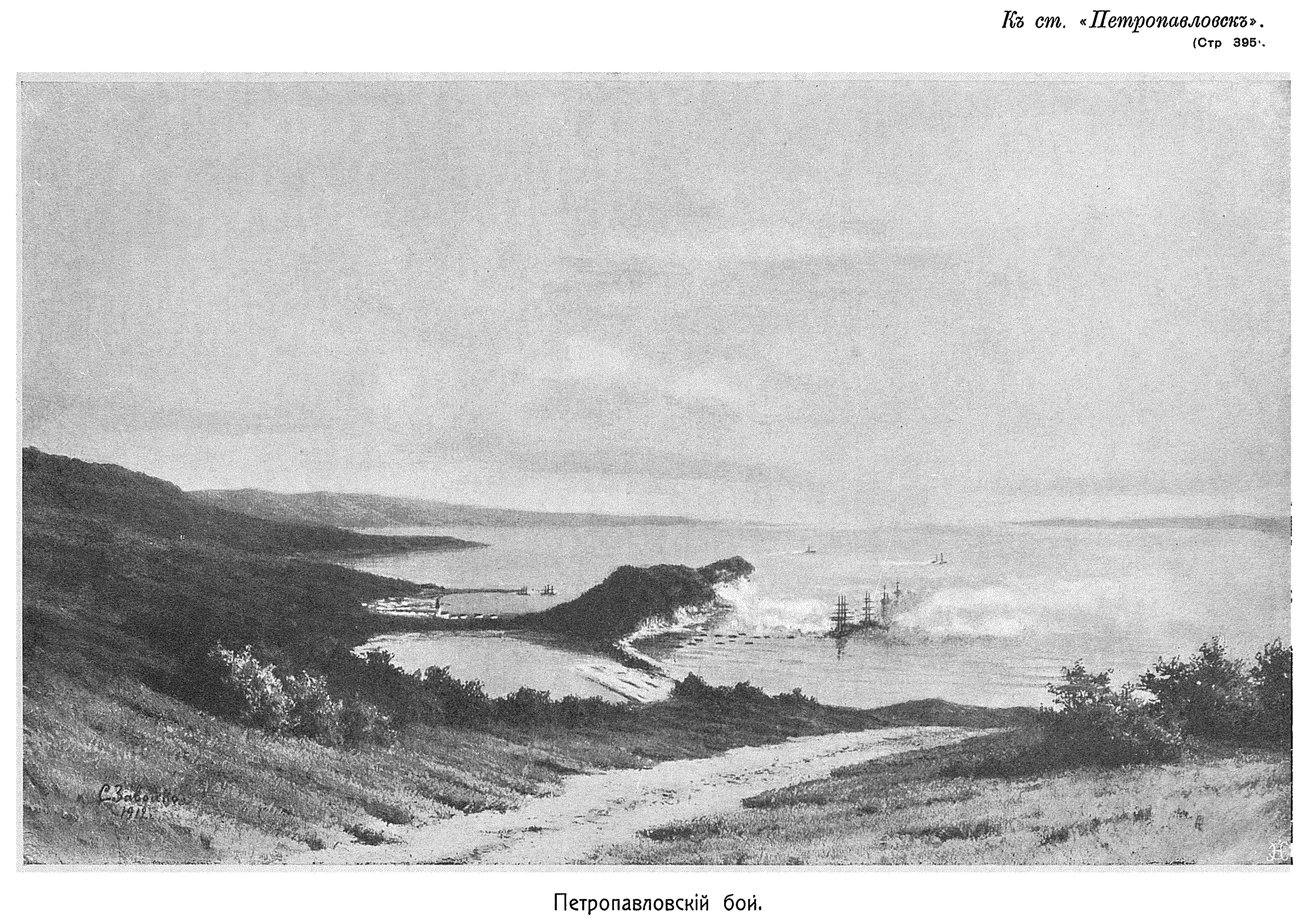
On the morning the allied fleet was to attack, the British admiral shot himself in his cabin. This was not the most chaotic thing that would happen at Petropavlovsk. In August 1854, six British and French warships carrying 1,700 men and 200 guns sailed into Avacha Bay on the Kamchatka Peninsula, intent on capturing Russia's largest Pacific port. What they found was a garrison of barely 920 defenders, a single damaged frigate, and a series of earthwork batteries manned by Siberian soldiers, Cossacks, and Kamchadal volunteers. Over four days of bombardment, landing, and brutal hand-to-hand fighting on a forested hillside, the world's two greatest naval powers would fail to take a settlement most Europeans could not find on a map.
A War at the End of the Earth
The Crimean War is remembered for Sevastopol, the Charge of the Light Brigade, and Florence Nightingale. Its Pacific theatre barely registers. Yet the strategic logic was real: British and French commanders feared that Russian cruisers operating from Pacific bases would raid allied merchant shipping, threatening lucrative trade routes with California and Asia. In May 1854, the allied squadron gathered at Callao, Peru, received their orders, and began hunting Russian warships across the largest ocean on Earth. They checked Novo-Arkhangelsk in Russian America, modern-day Sitka, Alaska, and found nothing. They turned west toward Kamchatka. Meanwhile, Russian Vice-Admiral Yevfimiy Putyatin, knowing he could not fight the allies on open water, concentrated his meager forces at Petropavlovsk. He had one frigate, the 44-gun Aurora, and a handful of smaller vessels. The Okhotsk garrison was transferred by ship. Earthwork batteries were thrown up around Avacha Bay. It was a desperate improvisation at the very edge of empire.
The Admiral's Last Morning
The allied fleet arrived on 28 August. Rear-Admiral David Price, the British commander who had waited 39 years for his flag rank, took the steamer Virago forward to scout the defenses. The Russians had withdrawn their ships behind a fortified spit, protected by multiple gun batteries. Price devised a sound plan: suppress the outer batteries in sequence, then edge around the spit to engage the Aurora directly. On 30 August, as the fleet moved into position, Price retired to his cabin aboard the President and suffered a fatal gunshot wound. Whether it was suicide born of anxiety or an accident remains debated, but the timing could not have been worse. Captain Nicholson of the Pique assumed command and delayed the attack twenty-four hours. When it finally came on 31 August, the bombardment succeeded in silencing several batteries and severely damaging the Aurora. But the French frigate Forte signaled to withdraw, and the momentum was lost.
Friendly Fire on Nikalski Hill
The decisive assault came on 4 September. Four American whalers camped across the bay had told the allies about a path through the forest that could turn the Russian defenses. Some 700 men were landed in two waves to storm Nikalski Hill from multiple directions while the ships suppressed the coastal batteries. The plan unraveled almost immediately. British Royal Marines under Captain Parker reached the hilltop quickly, but the French naval column under Captain de la Grandiere could not find the promised path for his artillery. He stayed on the beach, trying to recall the British columns that had already achieved their objectives. When the French sailors finally climbed the hill, they mistook the red jackets of the Royal Marines for the red shirts of Russian Navy sailors and opened fire on their own allies. For ninety chaotic minutes, British, French, and Russian forces fought in the forest, the defenders reinforced by hundreds of sailors streaming up from the batteries and the town. The retreat became a rout. Russian infantry, Cossacks, and sailors pursued the allies at bayonet point down to the beach, where riflemen on the heights above picked off men as they scrambled into their boats.
A Colour Lost and a Victory Unsung
The allies left 52 dead and wounded on the hill, abandoned seven officers' swords, and lost the Royal Marine colour when its bearer was shot and the flag tumbled into the sea. The Russians fished it out the next day. Total allied casualties reached 209, including Price's death. The Russian garrison lost 37 dead and 78 seriously wounded. The defeated fleet limped away, the British to Vancouver Island, the French to San Francisco. They returned in spring 1855, only to find Petropavlovsk abandoned. Governor Nikolay Muravyov, knowing reinforcements were impossible, had evacuated the entire garrison under cover of snow. The Aurora had slipped away. In Russia, the defense of Petropavlovsk became a point of national pride, celebrated as proof that courage and terrain could overcome superior firepower. In Britain and France, the debacle was quietly forgotten, overshadowed by the far bloodier events unfolding around the Black Sea thousands of miles to the west.
Avacha Bay from Above
From the air, the geography of the battle makes immediate sense. Avacha Bay is a near-perfect natural harbor, one of the largest in the world, enclosed by volcanic ridges and entered through a narrow channel. The spit where the Russians anchored the Aurora is visible as a thin finger of land extending into the harbor. Nikalski Hill rises steeply behind the old town site, its forested slopes still dense enough to imagine marines struggling through the undergrowth. The volcanoes Avachinsky and Koryaksky loom to the north, the same peaks that watched over the battle nearly two centuries ago. Modern Petropavlovsk-Kamchatsky has grown around the bay, but the terrain that shaped the 1854 battle remains fundamentally unchanged.
From the Air
Located at 53.02N, 158.65E on Avacha Bay, Kamchatka Peninsula. Nearest airport is Yelizovo (UHPP), approximately 25 km northwest. The bay is a dramatic natural harbor visible from high altitude, flanked by Avachinsky and Koryaksky volcanoes. Best viewed at 5,000-8,000 ft for harbor detail. Weather can be severe with fog common in summer months.