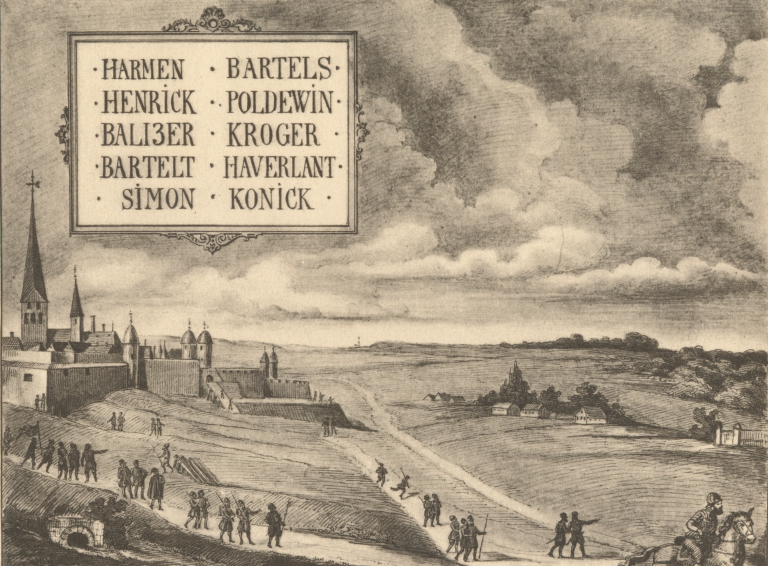
Siege of Reval (1570–1571)
On 21 August 1570 a thirty-five-year-old Danish prince named Magnus of Holstein arrived under the walls of Reval with an army that no one could quite agree on. Some chroniclers said twenty-five thousand. Some said twenty thousand. Modern historians, looking at what Russia could actually field that summer, suggest a thousand to four thousand five hundred. Whatever the truth, it was nowhere near enough to take a fortified Hanseatic port whose German-Estonian citizens had heard what had happened to other towns when Ivan IV's vassals took them. The defenders, perhaps four thousand to five thousand strong including six hundred and fifty knights, looked down from the medieval walls and refused. The siege would last thirty weeks. By the time it ended, plague had killed more besiegers than swords had.
Magnus the King Without a Kingdom
Duke Magnus of Holstein had been promised a throne. Ivan the Terrible, prosecuting the long Livonian War in the wreckage of the old Teutonic Order, had set up Magnus as titular King of Livonia, a Danish-born vassal who could in theory unite the Baltic Germans under Russian protection. The fall of Reval, the Hanseatic capital of Swedish-controlled Estonia, would have ended Swedish power in the eastern Baltic in a single stroke. Magnus rode toward the city in August 1570 in the role he had been given. Outside Reval, however, the Russian troops with him began to plunder and burn the surrounding villages. Magnus could see what the Livonian nobility he was supposed to win over would think. He tried to restrain his Russian commanders. The argument escalated until two of them, Ivan and Vasilii, were arrested and sent back to Moscow in chains by Ivan IV's order. The siege paused while Magnus waited for reinforcements that did not come for months.
Inside the Walls
Reval in 1570 was already what its survivors would remember: a tightly packed medieval town of high gabled merchants' houses, a city wall studded with round towers, the cathedral hill of Toompea looking down over the harbor where the Hanseatic ships came in. The garrison was modest, perhaps six hundred and fifty Swedish knights and the city militia. The civilian population was substantial. They were promised by Magnus's heralds that they could surrender to a benevolent Tsar's vassal and trade freely throughout Russia. They saw the burning villages and refused. When the second Russian force under Prince Yuri Tokmakov finally arrived on 2 January 1571, the besiegers tried to bring up cannon in the depths of a Baltic winter and could not get them close enough through the frozen ground. A month and a half of bombardment achieved little. In early February, a letter shot over the wall by a sympathizer brought the news that Denmark and Sweden had signed peace; the defenders sortied the same night to celebrate, and routed a section of the Russian camp.
Plague in the Besiegers' Camp
It was disease, not steel, that ended the siege. Plague broke out in the Russian camp through the late winter of 1571. Soldiers died in their tents. Officers fell sick. By 16 March 1571, Tokmakov had given the order to withdraw to Pskov. Magnus burned his own camp and retreated. The defenders, watching from the walls as the besieging army packed up and turned away, mounted a final counterstroke. Carl Henriksson Horn led three hundred knights out of Reval and surprised a Russian rearguard at Ubagall, near Weissenstein, killing the entire force and capturing the supply train. Later that year, news reached the Baltic that the Crimean Tatars had burned Moscow itself. Ivan IV had bigger problems. The siege of Reval, the first of two that would fail before the war ended, settled into the silence of an unwon objective.
Tallinn Today
Reval is the German name. The city is now Tallinn, capital of Estonia, and the medieval Old Town the defenders held in 1570-71 is among the best-preserved in Northern Europe, a UNESCO World Heritage Site. The walls still rise around the lower town. Toompea Hill still looks down on the same harbor. The round towers the besiegers tried to break, towers like Kiek in de Kok and Fat Margaret, are now museums or restaurants. The Hanseatic merchants' houses on Pikk Street still stand where Magnus's heralds called for surrender. The siege of 1570-71 is one of two failed Russian attempts on the city; another, in 1577, also failed. Estonia would not fall to Russia until the eighteenth century, and would emerge again as an independent state in 1991, after the long Soviet decades. The walls that held in 1571 still hold the shape of the city today.
From the Air
Tallinn lies at 59.44°N, 24.75°E on the southern shore of the Gulf of Finland, opposite Helsinki. The principal airport is EETN (Tallinn Lennart Meri), about 4 km southeast of the Old Town. From altitude, look for the small medieval Old Town pressed up against the harbor on the Gulf of Finland's southern coast, with Toompea's limestone bluff distinct from the lower medieval town to its east. Recommended viewing altitude FL250–FL340; the Gulf is often clear in summer, with frequent low cloud and sea-fog in winter. Helsinki sits 80 km north across open water, often visible on the same approach.