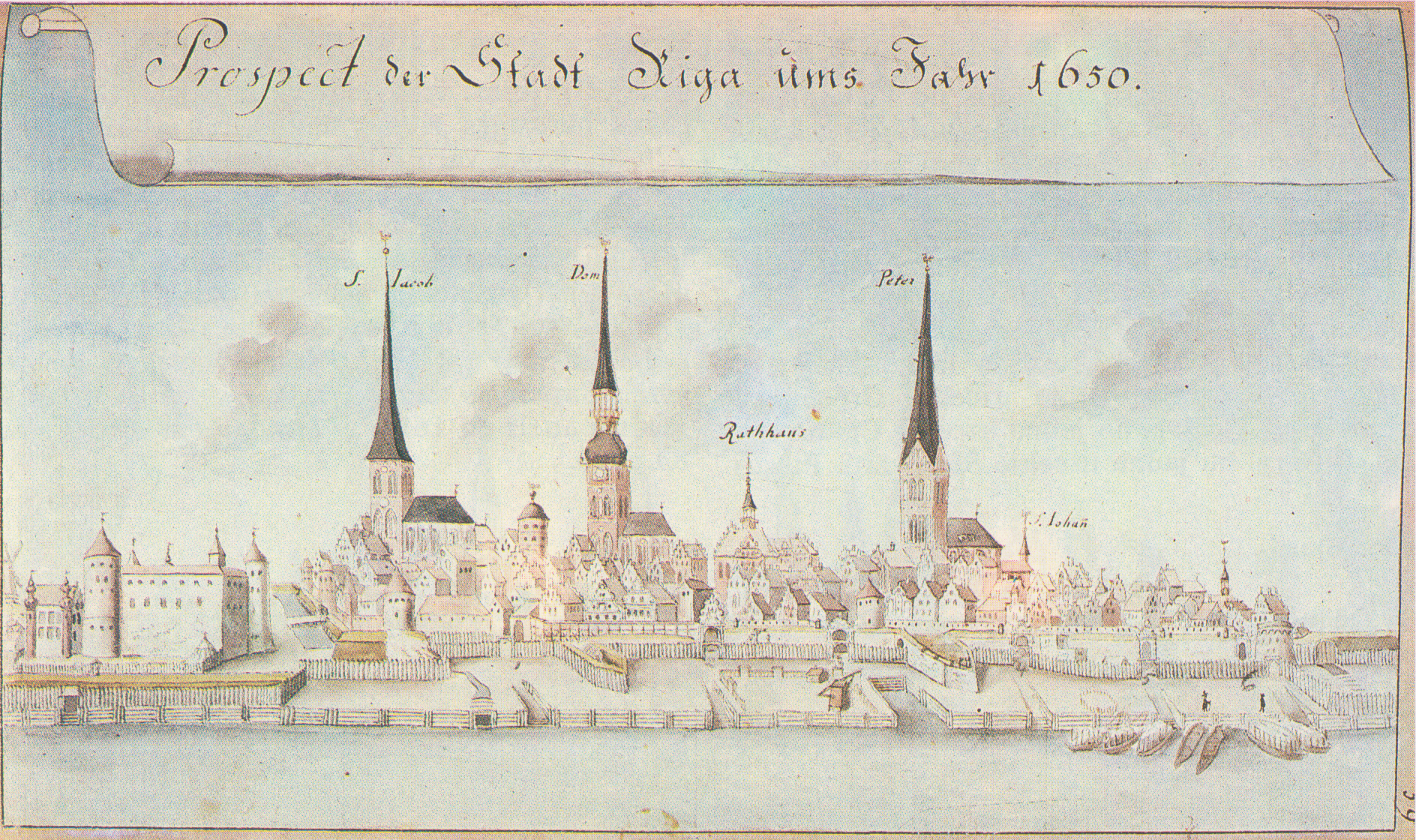
Siege of Riga (1656)
Of all the Russian tsars who looked west and saw a port, Alexei Mikhailovich was the cautious one. His son Peter would, half a century later, batter through to the Baltic with the brutal patience of a man who would not stop. Alexei in the late summer of 1656 came down the Daugava River with a real army and a real plan, took up position outside Riga's pentagonal star fortifications, and spent six weeks discovering that Russia in his lifetime did not yet have the navy, the engineers, or the certainty of allies to hold a major Baltic city. By 6 October he had ordered the retreat. He came home in triumph anyway. The Russian army marched through Polotsk, Smolensk, and Moscow as victors, having lost a siege that nobody back home was eager to call a defeat.
The Great Game on the Daugava
The 1650s in Eastern Europe were a season of cascading wars. The Khmelnytsky Uprising had broken Polish-Lithuanian control of Ukraine. Russia, by the Treaty of Pereyaslav in 1654, had taken the eastern Cossacks under tsarist protection and gone to war with Poland. By the end of 1655, much of Poland-Lithuania was Russian-occupied. Then Sweden, fearing Russia would soon control the entire eastern Baltic, invaded Poland with fifty thousand men. The Russo-Swedish War of 1656-1658 began as Russia's response: a war to keep Sweden from absorbing the Polish ruin and inheriting all the Baltic ports. Alexei Mikhailovich's target was the largest of those ports. Riga in the seventeenth century was a city of thirty thousand people, larger than Stockholm itself, the keystone of Sweden's Baltic empire. If Riga fell, the Daugava became a Russian river all the way to its mouth.
The Vanguard at the Walls
On 20 August 1656, the Russian vanguard under Vladimir Vizin arrived at Riga's outer defenses and routed the Swedish forces under Count Heinrich von Thurn-Valsassina. Von Thurn was either killed or captured in the action; the chronicles disagree. The Swedes pulled back into the old town, abandoning the suburbs they had begun to fortify with twelve new bastions in 1652 but had not finished. Alexei Mikhailovich himself arrived a few days later with the main army, sailing down the Daugava with infantry and artillery, and made camp on both banks of the river, with a corps under the diplomat-general Afanasy Ordin-Nashchokin on the west bank opposite the Kobron entrenchment. The Swedish governor of the city, Magnus Gabriel De la Gardie, had defied his own staff to try to defend the unfinished outer works; that gamble had collapsed within a night, and the Swedes were now back inside the medieval walls of the inner town.
What the Russians Could Not Do
Riga sat on the river, but its lifeline was the sea. Russia in 1656 had no Baltic fleet to speak of, and Alexei's Danish allies could not enforce a naval blockade. Through August and September, Swedish reinforcements trickled in from Stockholm by ship, and the besieging army watched them arrive without being able to stop them. The Russian siege works themselves were uncoordinated, the trenches clumsily aligned, the bombardment doing real damage to the city's morale but not its walls. Defectors from inside the city told the Russians that Riga's citizens were demanding capitulation while the Swedish military officers, waiting for that next sail on the horizon, refused. On 12 September a Swedish convoy brought 1,400 fresh troops into the harbor. The Tsar called a war council. His commanders, almost unanimously, told him that storming the fortress was unlikely to succeed.
Retreat as Triumph
Two factors decided the question. The first was the plague rumored to be spreading inside Riga. The second was the changing diplomatic landscape: the original threat that Sweden and Poland might unite into a single power had evaporated, and the war's original purpose with it. To storm Riga unsuccessfully would humiliate the Tsar at the very moment when Brandenburg, Courland, Denmark, and Poland were all open to negotiation. Alexei lifted the siege on 6 October 1656. Swedish reports later claimed fourteen thousand Russian dead, an obvious exaggeration since no real assault was ever attempted. The Russian army marched home through the towns it had taken upriver: Dünaburg, Kokenhusen, Polotsk. Riga survived. Sweden held the city for another fifty-four years, until Peter the Great's siege of 1709-1710 finally took it. Today the medieval inner town that resisted Alexei in 1656 is the historic core of Riga, capital of independent Latvia, a UNESCO World Heritage Site whose Hanseatic merchant houses, the Three Brothers and the Cat House and the long range of warehouses on Vecpilsetas iela, still trace the perimeter of the seventeenth-century walls the Russian guns could not breach.
From the Air
Riga lies at 56.95°N, 24.11°E along the Daugava River, about 15 km from the river's mouth at the Gulf of Riga. The principal airport is EVRA (Riga International), about 10 km west of the Old Town. From altitude, look for the wide brown ribbon of the Daugava cutting through forest and bog to the Gulf of Riga, with the medieval Old Town on the river's right (eastern) bank. The spire of St. Peter's Church and the green-domed Nativity Cathedral mark the historic center. Recommended viewing altitude FL250–FL340; expect Baltic stratus much of the year and clear views in midsummer.