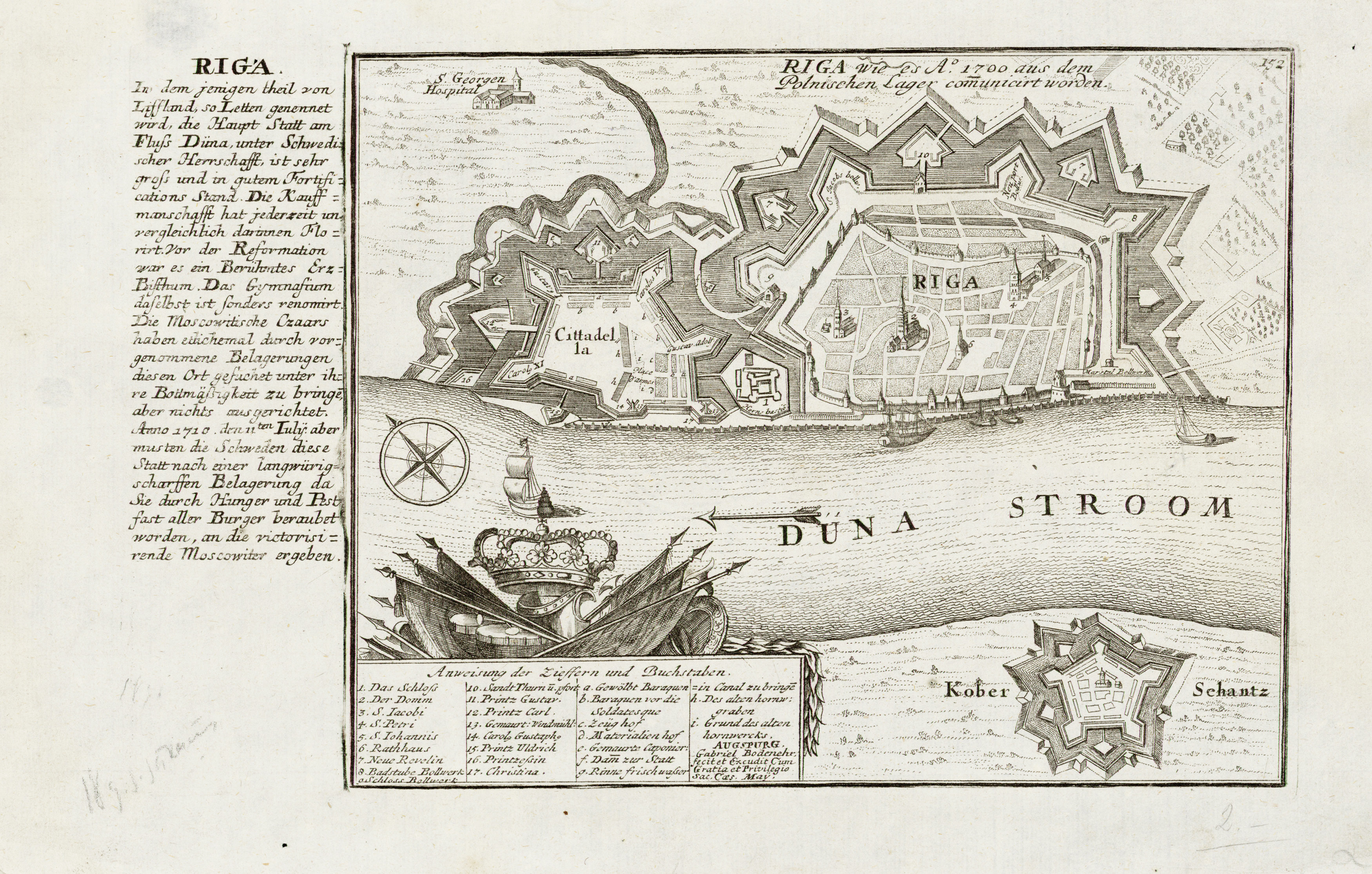
Siege of Riga (1700)
The grenadiers were dressed as peasants. They were sitting in twelve covered wagons, with eighty Saxon dragoons riding escort, and the man in command was a Saxon major general named Georg Karl von Carlowitz. He told the Swedish border guards at Olaine that he was on his way to Moscow with the general's personal belongings. It was 11 February 1700, and Captain Eriksson, commanding the Swedish post, was suspicious enough to order the wagons opened. The brief firefight that followed killed Eriksson and revealed the grenadiers and the ammunition. The Saxons retreated. Within five days, a force of seven thousand Saxon soldiers under Major General Johann Patkul had crossed the border for real. The Great Northern War, which would take twenty-one years to settle and would end Sweden's century as the dominant Baltic power, had begun on a frozen Latvian highway with a wagon search.
The Conspirators
The plot to dismember the Swedish Baltic Empire had been formed in August 1698, when Augustus II the Strong, ruler of the Polish-Lithuanian Commonwealth and Elector of Saxony, met Tsar Peter I in Rava-Ruska in what is now western Ukraine. They agreed that Sweden's Baltic provinces should be divided: Livonia and Estonia would go to Poland-Lithuania, Ingria and Karelia to Russia. Denmark-Norway joined the alliance later. The architect of the eastern attack was Johann Reinhold von Patkul, a Livonian nobleman who had fled Sweden under sentence of death and persuaded the Livonian nobility, by August 1699, to formally renounce their Swedish allegiance to Augustus. The coalition agreement was signed at Preobrazhenskoye, outside Moscow, on 21 November 1699. The Swedish governor-general of Livonia, Erik Dahlberg, the great fortress engineer of his age, had been quietly reinforcing Riga's defenses for years and was ready when the wagons arrived at Olaine.
Daugavgriva and the Frozen Rivers
Patkul's plan had called for an attack at Christmas 1699. Once the surprise was lost, the Saxons postponed their main move to February 1700. Saxon General Jacob Heinrich von Flemming captured the small Kobron redoubt on 16 February with its forty-one defenders under Major Bildstein. The main Saxon force then crossed the Daugava near Mazjumprava Manor and pushed dragoon raids as far as Valmiera. The Livonian nobility, however, did not rise. Magnus Johann von Tiesenhausen rallied a counterforce. On the night of 24 March 1700, Flemming launched the major assault: the Saxon army crossed the frozen Bullupe River and attacked the Daugavgriva fortress at the river's mouth, defended by five hundred Swedes under Karl Ludwig von Budberg. The first assault was repelled at the cost of 248 Saxon dead. But six Saxon battalions could attack from any side once the rivers froze; the war council voted to surrender. On 28 March the Swedes left Daugavgriva with their arms. Flemming renamed the fortress Augustusburg, in honor of the king who had not yet arrived.
The Bombardment That Did Not Land
Through the spring and summer the campaign drifted. The Swedes pushed back; the Battle of Mazjumprava on 6 May was a Swedish victory that retook the right bank of the Daugava but not Daugavgriva. By mid-July, Augustus II had assembled fourteen thousand men near Riga under Field Marshal Steinau. The Saxons crossed the Daugava again, defeated a Swedish force at Ciemupe, and on 28 August the Saxon artillery began shelling Riga. Erik Dahlberg's defenses, the four thousand Swedish defenders inside the walls, and the city's pentagonal bastions held. Augustus II then learned that his ally Denmark had been knocked out of the war by a young Charles XII of Sweden, eighteen years old and already calling himself the Lion of the North. Augustus broke off the siege, took the smaller Koknese Castle on 17 October, and went into winter quarters in Selonia and Lithuania. On 30 November 1700, Charles XII destroyed Peter I's army at the Battle of Narva.
The War That Followed
The two failed sieges of Riga in 1700 are now footnotes to the war they began. Charles XII swept through the next decade in a series of victories that should have ended the Northern War in Sweden's favor; instead the Russian campaign of 1708-1709 destroyed his army at Poltava, and Sweden's Baltic empire collapsed in stages over the following decade. Riga itself fell in 1710 to a Russian siege under Boris Sheremetev, after a winter blockade that killed thousands of citizens to plague. By the Treaty of Nystad in 1721, Sweden ceded Livonia, Estonia, Ingria, and most of Karelia to Russia. The Latvian and Estonian provinces would remain Russian until the empire's collapse in 1917, and would emerge as independent states in 1918. Today the Daugavgriva fortress, where Karl Ludwig von Budberg's Swedes held off the first major Saxon assault of the Great Northern War, sits at the mouth of the river as a ruin and museum, the brick bastions still tracing the star pattern Erik Dahlberg drew.
From the Air
Riga lies at 56.95°N, 24.11°E along the Daugava River, with the Daugavgriva fortress at the river's mouth on the Gulf of Riga, about 15 km north of the city center. The principal airport is EVRA (Riga International). From altitude, the entire 1700 campaign theater is visible at once: the Daugava's brown ribbon, the Gulf of Riga to the north, the small bastioned fortress at Daugavgriva on the western bank of the river mouth, and the Old Town's spires upstream. Recommended viewing altitude FL250–FL340; the river meanders are distinctive and the forested Bullupe-Lielupe junction shows clearly in summer.