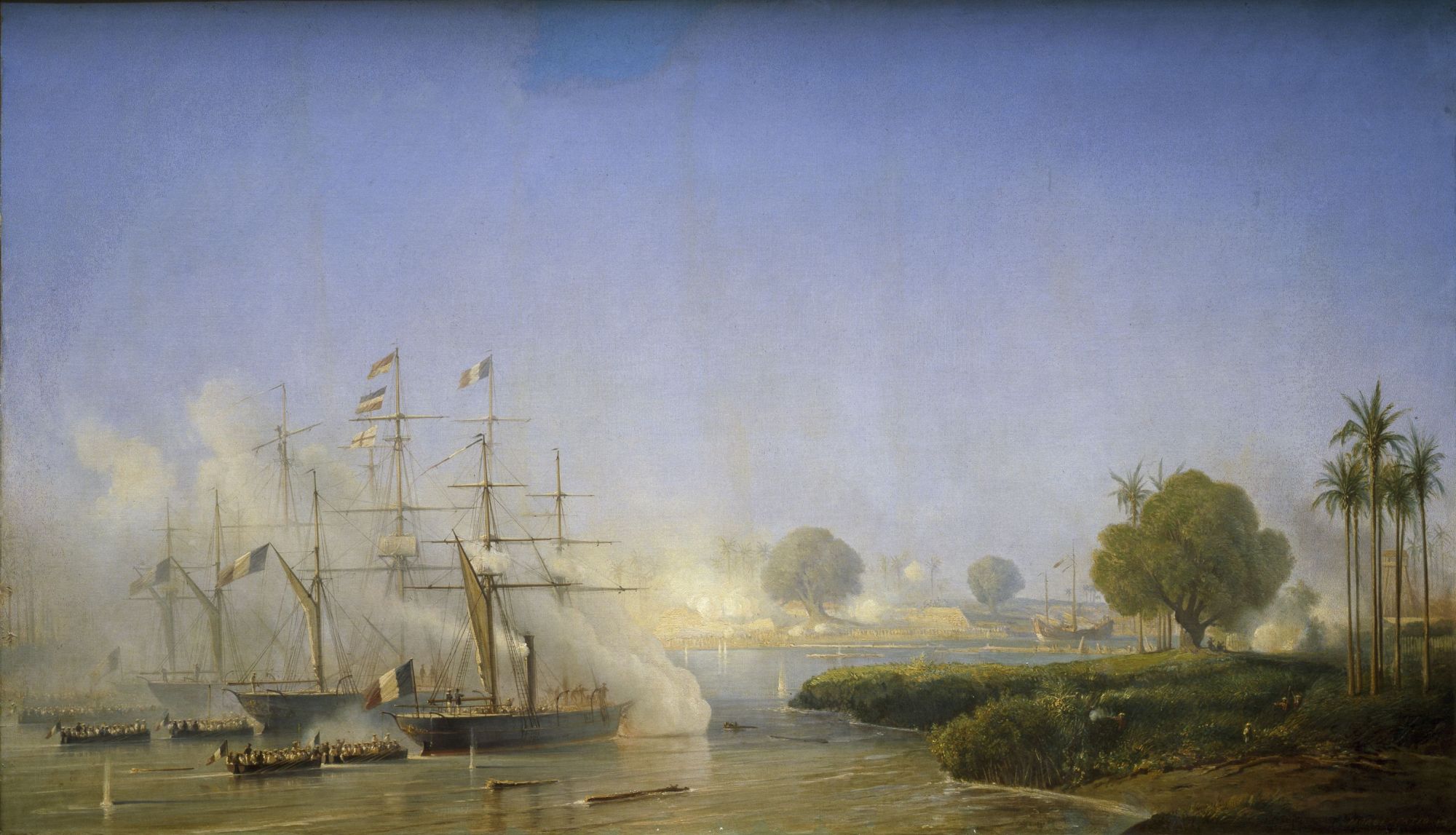
Siege of Saigon
For eleven months, roughly 1,000 French and Spanish soldiers held a single repaired fort against a Vietnamese army ten times their size, waiting for reinforcements that wars on three continents kept diverting elsewhere. The siege of Saigon, which dragged from March 1860 to February 1861, was not the kind of siege that produces heroic paintings. It was a siege of exhaustion and miscalculation -- a colonial expedition that had bitten off a city it could not chew, then found itself unable to either advance or retreat while France fought in Italy, then in China, before finally sending ships to finish what it had started in Cochinchina.
A War Born from Missionary Grievance
The chain of events that led to the siege began in 1858, when Admiral Charles Rigault de Genouilly attacked Vietnam on orders from Napoleon III. The stated mission was to stop the persecution of Catholic missionaries and guarantee the free propagation of the faith. Rigault de Genouilly commanded 14 warships, 1,000 French marine infantry, and 1,000 troops from Spain's Philippine garrisons -- 550 Spanish infantry and 450 Filipino light infantry. This Franco-Spanish force landed at the port of Tourane (modern Da Nang) in September 1858 and took the city after a brief bombardment. But the victory dissolved quickly. Vietnamese forces surrounded the allies, who could not advance beyond the protective range of their ships' guns. Tourane became a trap, and Rigault de Genouilly needed a new strategy.
Five Days Upriver
In January 1859, Rigault de Genouilly proposed striking Saigon instead -- a city of strategic importance as the key food-producing area for the Vietnamese army. On 2 February, he sailed south with corvettes, gunboats, a Spanish dispatch vessel, and transports. After pausing five days at Cam Ranh Bay for supply ships, the flotilla reached Cape Saint-Jacques on 10 February and bombarded the harbor forts into silence. Then began the five-day voyage upriver. The gunboat Dragonne scouted ahead, drawing Vietnamese fire -- three cannonballs hit her hull, while Avalanche took seven. Engineers went ashore to burn the wooden stockades linking riverside forts, and captured cannons were spiked or hauled aboard. The river narrowed as they approached Saigon, until Admiral Charner could shout orders from his bridge to the captains of neighboring vessels. On the morning of 17 February, French and Spanish troops stormed the Citadel of Saigon. Sergeant des Pallieres of the marine infantry was the first man through the walls. By 10 a.m., French and Spanish flags flew above the ramparts.
A Victory Too Big to Hold
The citadel was enormous, and the allied force far too small to defend it. Rigault de Genouilly's solution was ruthless: he had thirty-two mines prepared and on 8 March 1859 blew the citadel to rubble. The rice magazines were set alight and burned for months. Then Rigault de Genouilly sailed back to Tourane with most of his forces, leaving capitaine de fregate Bernard Jaureguiberry to hold Saigon with a single company of French marines, a company of Filipino light infantry, and 400 sailors to work the artillery. Jaureguiberry repaired the Southern Fort and made it his stronghold. When he tried a sortie against a Vietnamese position on 21 April, the attack succeeded but cost 14 dead and 31 wounded out of 800 men -- losses so heavy relative to his tiny force that he never attacked again. The garrison withdrew behind its walls and waited.
Wars on Three Continents
What followed was a slow-motion crisis driven by events thousands of miles from Saigon. The Austro-Sardinian War broke out in 1859, tying down French troops in Italy. Rigault de Genouilly, criticized for his failures, was replaced by Admiral Francois Page, who was told to negotiate a treaty protecting Catholic missionaries but not to seek territory. The Vietnamese, sensing France's distraction, refused even these modest terms and dragged out negotiations, hoping the Europeans would simply leave. By early 1860, France was at war again -- this time with China -- and Page diverted most of his forces to support Admiral Leonard Charner's China expedition. In April 1860, Page departed Cochinchina entirely, leaving capitaine de vaisseau Jules d'Aries to defend both Saigon and the neighboring Chinese commercial town of Cholon with 600 French marines and 200 Spanish troops. D'Aries armed junks, recruited local auxiliaries, and waited while 10,000 Vietnamese soldiers tightened the ring around his position.
Seventy Ships and the Battle of Ky Hoa
The siege broke because of a battle fought in China, not Vietnam. The Anglo-French victory at the Battle of Palikao on 21 September 1860 ended the war with China and freed the forces France needed. Admiral Charner arrived off Saigon with 70 ships -- the most powerful French naval force seen in Vietnamese waters before the Sino-French War two decades later. His squadron included the steam frigates Imperatrice Eugenie and Renommee, five corvettes, eleven screw-driven dispatch vessels, five first-class gunboats, seventeen transports, a hospital ship, and half a dozen armed lorchas purchased in Macao. General de Vassoigne brought 3,500 soldiers. On 25 February 1861, this overwhelming force defeated the Vietnamese besiegers at the Battle of Ky Hoa and lifted the siege. The campaign would grind on until 1862, when France formally took possession of Cochinchina -- beginning a colonial presence that would last nearly a century and reshape Saigon into the city that exists, under a different name, today.
From the Air
Located at approximately 10.82N, 106.63E, northwest of central Ho Chi Minh City. The siege took place in and around what is now the greater Saigon metropolitan area, with the Southern Fort positioned along the river approach from Cape Saint-Jacques (modern Vung Tau). The Saigon River, which the Franco-Spanish flotilla navigated, remains the dominant waterway visible from altitude. Nearest major airport is Tan Son Nhat International (ICAO: VVTS). Best viewed at 3,000-5,000 ft AGL to appreciate the river approach and surrounding terrain. The river winds northwest from Vung Tau through flat alluvial terrain.