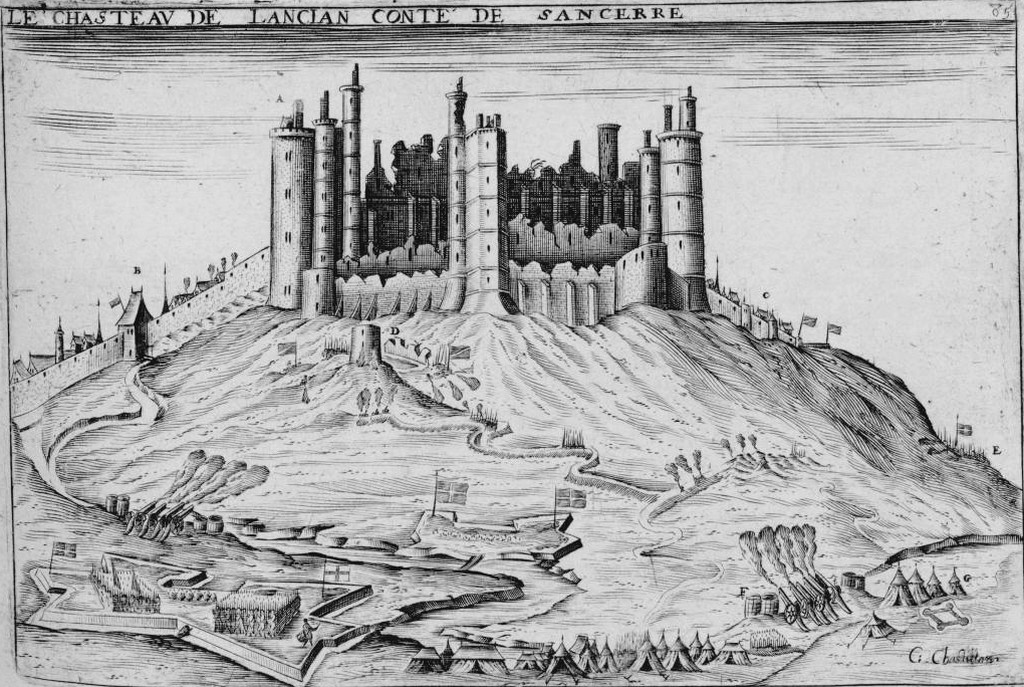
Siege of Sancerre
"We light here, We fight here; go and assassinate elsewhere." The taunt rang out from the ramparts of Sancerre, a fortified hilltop city in central France, sometime in the spring of 1573. The people shouting it were outnumbered, starving, and surrounded by 7,000 royal troops with 18 artillery pieces. They had been under siege since the previous November, and they would not surrender. Today Sancerre is famous for its white wine. In the 16th century, it was famous for something far grimmer -- one of the most desperate stands of the French Wars of Religion, a siege so brutal it was compared to the fall of Jerusalem.
A Hilltop Haven for Heretics
Calvinism arrived in Sancerre around 1540, part of the wave of Reformation theology that swept through the Berry region after John Calvin studied law in nearby Bourges in 1529. By the 1560s, Sancerre had become one of the principal Huguenot cities in France, alongside Nimes, Montauban, and La Rochelle. Its geography made it a natural fortress: perched on a steep hill overlooking the Loire valley, it had already repelled attackers in 1564, when Count Sciarra Martinengo and Claude de La Chatre besieged it for five weeks with trebuchets -- one of the last recorded uses of medieval siege engines in European warfare -- before withdrawing in frustration. Another attempt in 1568 also failed. The hilltop was simply too strong, the garrison too determined, and the cause too deeply felt.
After the Massacre
Everything changed on August 24, 1572, when the St. Bartholomew's Day Massacre unleashed targeted killings of Protestants across France. Huguenots fleeing the violence poured into Sancerre, swelling the city's population with refugees who had witnessed what Catholic zealotry looked like without restraint. When King Charles IX demanded that Sancerre accept a royal garrison, the city refused. On November 9, 1572, Honorat de Bueil launched a surprise attack that briefly occupied the city. But the Huguenots, led by Mayor Johnanneau and Captain Lafleur, fought back through 17 hours of street combat and regained control. The full siege began on March 19, 1573, when Claude de La Chatre returned with an army of 7,000 and bombarded the 400-year-old ramparts. When the wall finally collapsed, it fell on the attackers, killing 600 of them. La Chatre pulled back to the neighboring town of Saint Satur and settled in for a blockade.
Rats, Leather, and Ground Slate
What followed was starvation on a scale that shocked even a century accustomed to religious violence. Cut off from supply, the population ate their way through every animal in the city, then turned to rats, leather, and ground slate mixed into a desperate substitute for flour. Some 500 people died during the siege, the majority of them children. Isolated reports of cannibalism circulated -- horrifying enough that the Protestant minister Jean de Lery, himself a survivor, documented them in his 1574 account, "The Memorable History of the Siege of Sancerre." The siege became a Protestant cause throughout Europe. Its suffering was not abstract; Lery's eyewitness testimony made it real to readers across the continent, and the parallel with Jerusalem was drawn deliberately to cast the Sancerrois as a people of faith enduring persecution with biblical fortitude.
A Polish Crown Ends a French Siege
Salvation came from an unexpected direction: Poland. The Polish throne was offered to Henri, Duke of Anjou, the fourth son of Queen Catherine de Medici, on the condition that France ameliorate its treatment of the Huguenots. The Duke had been fighting simultaneously at the Siege of La Rochelle, where his army had been repulsed 29 times in four months. The Polish offer gave him a convenient reason to abandon a losing campaign. On June 6, 1573, Charles IX signed the Peace of La Rochelle, ending the Fourth Civil War and guaranteeing French Protestants religious freedom. It took two more months for the peace to reach Sancerre. On August 25, 1573 -- exactly one year and one day after the St. Bartholomew's Day Massacre -- the last survivors walked out of the fortress. La Chatre entered an empty city on August 31 and ordered the surrounding peasantry to demolish the ramparts. For payment of war damages and taxes, King Charles IX accepted 2,000 litres of wine from the caves of Sancerre.
What the Ramparts Left Behind
Sancerre never fully recovered its former importance. During the League Period that followed, the diminished city supported the king while Bourges and other Berry towns sided with the Catholic League. When Protestant Henri de Navarre was crowned King of France in 1594, the fighting finally ended. The medieval Chateau de Sancerre was destroyed in 1621 to prevent the city from ever again serving as a stronghold of resistance. Only the Tour des Fiefs, the great tower, was spared -- though not before its structural supports were deliberately broken by artillery fire, leaving it standing but weakened, a monument to what the city had endured and what those who feared its defiance were determined it would never endure again.
From the Air
Located at 47.33°N, 2.84°E on a prominent hilltop overlooking the Loire valley in the Berry region of central France. The town of Sancerre is visible from the air as a compact settlement on a rounded hill, surrounded by the vineyards for which it is now famous. The Loire River runs to the east. Nearest significant airport: Bourges Airport (LFLD) approximately 45 km south. The Tour des Fiefs tower may be visible from lower altitudes.