Siege of Santo Domingo (1655)
The crabs, they said afterward, had won the battle. Spanish soldiers swore that the English invaders, stumbling through the tropical dark on the beach at Haina, had been so terrified by the clicking and rustling of land crabs that they mistook the creatures for an approaching army. It was a joke, of course - the Spaniards even fashioned a gold crab to parade through the streets of Santo Domingo in triumph. But the real story of April 1655 needed no embellishment. Oliver Cromwell's grand plan to seize the Caribbean from Spain had collapsed before it truly began, broken against the walls of a city defended by a force one-fifth the size of the attacking army.
Cromwell's Western Design
The scheme was called the Western Design, and it was supposed to be easy. In 1655, Cromwell's Commonwealth of England decided to strike at the heart of Spain's New World empire. Religious conviction drove part of the decision - the Puritan rulers of England loathed Catholic Spain with an intensity that blurred the line between strategy and crusade. But practical calculation mattered too. Cromwell had a large standing army, ambitious commanders with restless ambitions, and an appetite for the kind of profitable foreign campaign that would keep both occupied far from domestic politics. Command fell to General Robert Venables for the army and Admiral William Penn for a naval squadron of 34 ships. Their authority was immediately undercut by two Civil Commissioners appointed to ensure their loyalty - Cromwell trusted neither man entirely. The 13,000 troops were chosen by a grim logic: they were the soldiers England would miss least, selected for their perceived weakness rather than their strength. The expedition sailed short of equipment, supplies, and confidence.
Thirty Miles of Misery
High winds and heavy surf kept the English from landing near Santo Domingo itself. When the troops finally came ashore on April 13, 1655, they found themselves at the mouth of the Nizao River, thirty miles from the city. What followed was four days of grueling march through unfamiliar tropical terrain, the soldiers desperately short of water, food, and military supplies. The Caribbean sun and dense vegetation sapped men already weakened by a long Atlantic crossing. Governor Bernardino Meneses y Bracamonte, the Count of Penalba, had time to prepare. He commanded roughly 2,400 Spanish troops - a fraction of the invading force - but he knew the terrain, held the fortified city, and understood that the English were arriving exhausted and disorganized. When Venables' columns finally staggered within sight of Santo Domingo's walls, they were in no condition to fight. They did not know yet just how badly things were about to go.
An Afternoon's Ruin
The ambush came from a force of approximately 300 Spanish militiamen. Three hundred against thirteen thousand - and the three hundred won. The English, strung out and demoralized after their march, broke and ran. Venables' army suffered roughly 600 killed and another 400 wounded or captured. The English fleet attempted a bombardment of the city, but the cannonade was ineffectual, the ships too far out and the walls too strong. As British historian Nicholas A. M. Rodger later wrote, 'In one afternoon the invincible reputation of the New Model Army had been thrown away.' The army that had crushed Royalist forces across England and Ireland, that had remade English governance through sheer military competence, had been routed in the Caribbean by a garrison it outnumbered five to one. Penn re-embarked the surviving troops, and the fleet sailed away from Santo Domingo in disgrace.
Consolation Prize
Desperate to salvage something from the disaster, the English fleet turned toward Jamaica. The island fell in six days - a far easier conquest, though one that hardly erased the shame of Santo Domingo. When Venables and Penn returned to England, Cromwell threw both of them into the Tower of London. Historian C. H. Firth blamed the failure on the lack of cooperation between the two commanders. Venables never earned the confidence of his officers or his men. Samuel Pepys, the famous diarist and Clerk of the Acts to the Navy Board, was blunter about Penn, calling him a 'false knave.' Historian John Morrill summed up Venables' fate with precision: he was 'over-promoted and under-supported in a high-profile fiasco in the Caribbean that cost him his reputation.' The troops themselves were badly equipped, undisciplined, and assembled in haste - England's castoffs sent to do the work of its best.
The Gold Crab and the Gate
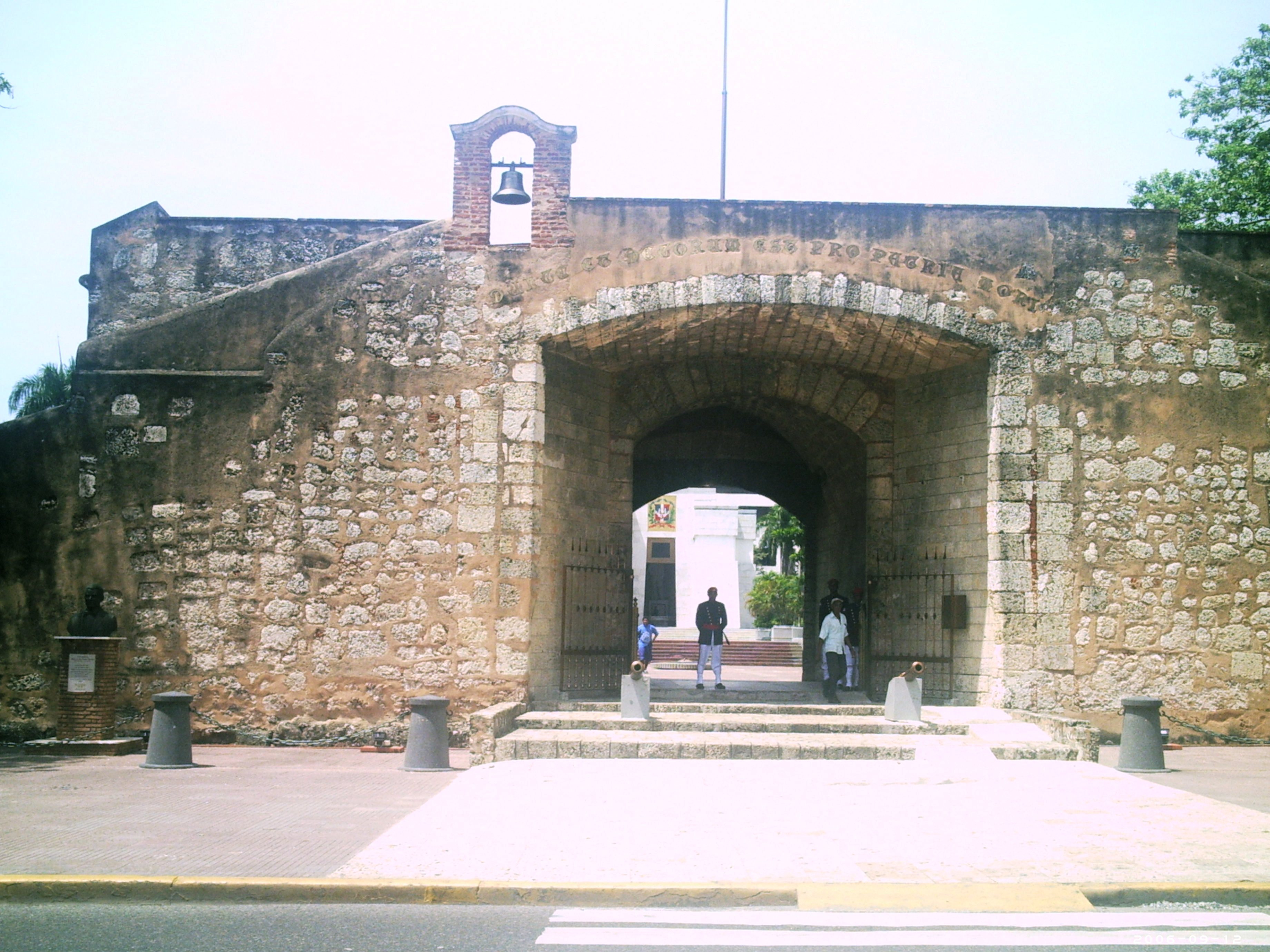
Santo Domingo celebrated. The gate where the Count of Penalba had organized the city's defense was renamed the Puerta del Conde in his honor - a landmark that still stands in the colonial heart of the Dominican capital. The story of the crabs became legendary: English soldiers supposedly panicked on the beach at Haina when the nocturnal clicking of land crabs convinced them a Spanish force was closing in. Whether the tale was history or mockery hardly mattered. The Spaniards commissioned a gold crab as a trophy and paraded it through the streets. The crab itself did not survive the centuries - it was eventually stolen by Joseph de Barquier, the last French governor of the island. But the Puerta del Conde endured, becoming one of the most symbolically important sites in Dominican history. Centuries later, it was at this same gate that the Dominican Republic declared its independence in 1844. A place that began as a monument to Spanish defiance became a monument to Dominican sovereignty.
From the Air
Santo Domingo sits at approximately 18.47N, 69.89W on the southern coast of Hispaniola where the Ozama River meets the Caribbean Sea. The Puerta del Conde is located in the Zona Colonial (Ciudad Colonial), visible from low altitude as a stone gateway structure in the historic district. The Nizao River, where the English landed thirty miles to the west, is visible along the coast. Las Americas International Airport (MDSD) lies roughly 15 nautical miles east. From 2,500 feet over the harbor, the colonial city walls and the river approach are clearly legible.