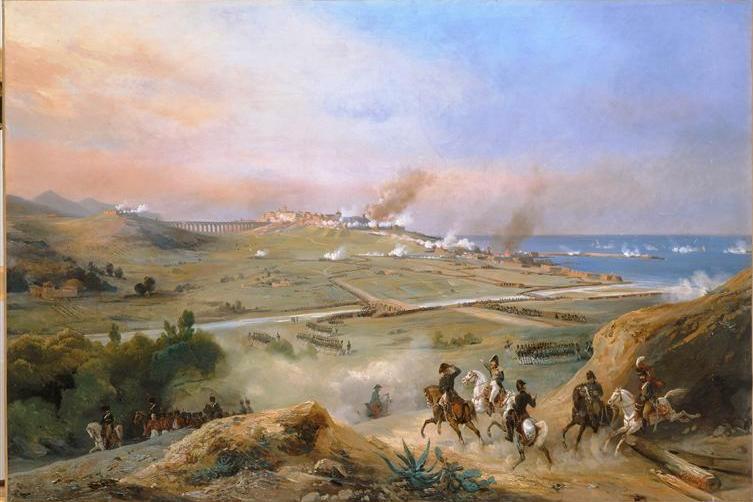
Siege of Tarragona (1811)
Napoleon dangled a marshal's baton, and Louis Gabriel Suchet obliged with blood. From May to June 1811, the French general drove his siege trenches toward Tarragona's ancient walls with single-minded ferocity, knowing that the highest military honor in the French Empire awaited him if the city fell. Inside, Lieutenant General Juan Senen de Contreras commanded a garrison of Spanish regulars and militia, while British warships under Captain Edward Codrington hammered the French lines from the sea and ferried reinforcements into the port. It was not enough. When Suchet's troops finally stormed the upper city on 28 June, what followed was not a battle but a massacre.
The Prize and the Price
Tarragona was no ordinary target. As the principal port and stronghold of Spanish Catalonia, it anchored the resistance against Napoleon's occupation of the Iberian Peninsula. The French conquest of Aragon had already begun with the fall of Tortosa in early 1811, and Tarragona was the next domino. Suchet arrived before the walls on 5 May with roughly 21,600 men and began the methodical, grinding work of siege warfare: digging parallel trenches, advancing batteries, reducing outer fortifications one by one. Spanish attempts to relieve the city by land were feeble and easily brushed aside. The British naval presence was more troublesome, pouring cannon fire onto exposed French positions and shuttling fresh troops and supplies through the harbor. But Suchet adapted, pressing closer each day, his ambition sharpened by Napoleon's personal promise.
The Walls Give Way
Near the end of June, Suchet launched a surprise assault on the lower city. The defenders, overwhelmed, pulled back to the fortified upper town, hoping the higher ground and thicker walls would buy them time. It bought them hours. On 28 June, French columns stormed the upper city's defenses in a coordinated attack. What followed shocked even battle-hardened observers. Discipline collapsed among the attacking troops, and the assault degenerated into indiscriminate killing. Soldiers who had surrendered were cut down. Civilians who had sheltered in their homes were dragged out and murdered. Among the dead were an estimated 450 women and children - people who had nothing to do with the garrison's defense but everything to do with the city's tragedy.
A Ledger Written in Lives
The numbers tell a grim story. Of Tarragona's defenders and population, between 14,000 and 15,000 became casualties. Some 7,000 to 8,000 were killed outright, with the remainder captured or dead from wounds and disease. French losses were comparatively lighter but still severe: estimates range from 1,000 to 4,300 killed and wounded, including General of Division Jean-Baptiste Salme, who fell during the fighting. The destruction of the garrison and the city's population effectively crippled the Spanish Army of Catalonia as a fighting force. Tarragona, which had been the heartbeat of Catalan resistance, fell silent.
The Baton and the Legacy
Napoleon kept his word. Suchet received his marshal's baton, becoming one of only 26 men to hold the title during the Empire. The siege of Tarragona is inscribed on the Arc de Triomphe in Paris, memorialized alongside Austerlitz and Jena as though it were a feat of comparable glory. For the people of Tarragona and Catalonia, the memory carried a different weight entirely. The fall of their city opened the road to Valencia, which Suchet besieged and captured in January 1812, extending French control along Spain's eastern coast. But these conquests proved hollow. The Peninsular War ground on for two more years, draining French resources and manpower until Napoleon's empire itself began to crack. Tarragona was rebuilt. The walls that Suchet's engineers breached were eventually restored, and today the city's Roman and medieval heritage draws visitors who walk streets where, for a few terrible days in June 1811, ambition and violence rewrote the meaning of conquest.
From the Air
Located at 41.12N, 1.25E on the Mediterranean coast of Catalonia, Spain. Tarragona's port and old town walls are visible from moderate altitudes along the coastline. The upper city where the final assault occurred sits on a promontory overlooking the sea. Nearest major airport: Reus Airport (LERS), approximately 8 km west. Barcelona-El Prat (LEBL) lies 90 km to the northeast. Best viewed from the southeast, approaching along the coast, where the layered defenses of upper and lower city are most apparent.