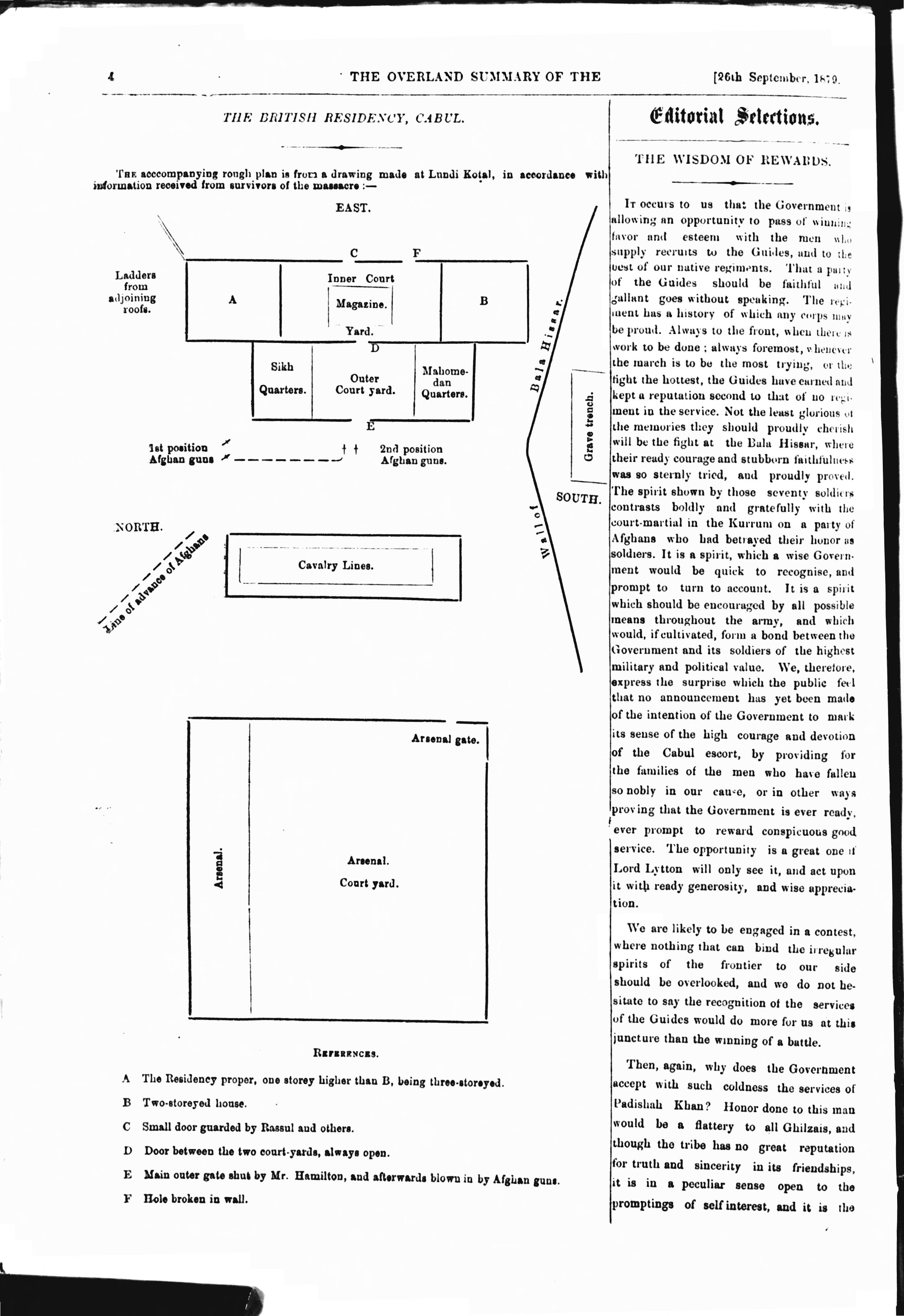
Siege of the British Residency in Kabul
"All is well in the Kabul Embassy." Sir Louis Cavagnari telegraphed those words to the Viceroy of India on September 2, 1879. By the following evening, Cavagnari was dead, his diplomatic compound was a smoking ruin, and nearly every man under his command had been killed in one of the most dramatic last stands of the Victorian era. The siege of the British Residency lasted just eight hours, but it shattered British policy in Afghanistan and sent shockwaves through the corridors of imperial power in London and Calcutta alike.
The Diplomat Who Would Not Listen
Sir Pierre Louis Napoleon Cavagnari was the son of an Italian aristocrat who had carved out a career in the British colonial administration, rising to District Commissioner of Peshawar. He was intelligent, experienced, and fatally arrogant. As the principal negotiator of the Treaty of Gandamak, which ended the first phase of the Second Anglo-Afghan War, he had extracted humiliating concessions from Afghanistan's new ruler, Mohammad Yaqub Khan. The treaty required Afghanistan to cede frontier districts and accept a permanent British envoy in Kabul. Cavagnari was chosen for the post by the Viceroy, Lord Lytton, despite warnings from officers who knew his manner would antagonize the Afghans. General Sir Neville Chamberlain doubted whether Cavagnari's temperament suited the delicacy of the assignment. Those doubts proved prophetic.
Seventy-Five Men in the Bala Hissar
Cavagnari arrived in Kabul on July 24, 1879, accompanied by his assistant Jenkyns, a surgeon named Kelly, and an escort of 75 soldiers from the Queen's Own Corps of Guides -- 25 cavalry sowars and 50 infantry sepoys, led by Lieutenant Walter Hamilton, a Victoria Cross recipient. The escort was deliberately kept small to avoid provoking Afghan hostility. They occupied a compound inside the Bala Hissar fortress, just 250 yards from the Amir's own quarters. Through July and most of August, the arrangement appeared to work. Cavagnari sent optimistic dispatches to the colonial capital at Simla. Then six Afghan regiments arrived from Herat, unpaid and resentful, and the mood inside the fortress turned dangerous. A retired Rissaldar-Major of the Guides warned Cavagnari directly: "These dogs do bite. Sahib, the residency is in great danger!" Cavagnari dismissed him.
Eight Hours
On the morning of September 3, the Herati regiments gathered inside the Bala Hissar demanding their back pay. When the treasury could offer only one month of the two owed, someone suggested the British had gold in their Residency. The mutinous soldiers confronted Cavagnari, who refused to pay, insisting it was not Britain's concern. A scuffle broke out, shots were fired, and within the hour two thousand Afghan soldiers stormed the compound. Cavagnari, struck in the head by a musket ball, still managed to lead a bayonet charge before withdrawing inside to die of his wounds. Lieutenant Hamilton took command. The Residency was surrounded on three sides by taller buildings, giving the attackers commanding firing positions that gradually reduced the defenders. By midday the main building was burning, and only thirty Guides remained able to fight.
The Last Charge of the Guides
When the Afghans brought two cannons to fire point-blank into the compound, Hamilton led charge after charge to capture them. The surgeon Kelly fell. Jenkyns was killed. Hamilton and his dwindling band retreated to the brick bathhouse -- the last defensible structure. He led one final sortie against the guns, emptying his revolver into the onrushing Afghan soldiers before being overwhelmed. His sacrifice bought time for five men to pull back inside. With every British officer now dead, the Afghans offered the Muslim soldiers among the Guides a chance to surrender. Jemadar Jewand Singh, now in command, refused. The last dozen Guides charged out of the compound and fought until every one of them was killed, the Jemadar personally accounting for eight of the enemy. Of the original 79 occupants, only seven survived: four who had been away from the compound and three detained after being sent as messengers to the Amir.
Shattered to Fragments
The massacre triggered an immediate British military response. Sir Frederick Roberts led the Kabul Field Force south, defeated Afghan forces at Charasiab, and occupied Kabul on October 12. The Amir, Yakub Khan, caught between British retribution and his own population's fury, surrendered and abdicated, reportedly declaring he would rather be a grass-cutter in the English camp than the king of Afghanistan. Roberts convened military tribunals that executed approximately one hundred Afghans for their role in the attack -- a policy that proved deeply controversial in both Britain and India. Lord Lytton's "Forward Policy" of aggressive imperial expansion into Afghanistan, intended to counter Russian influence, had, in his own words, been "shattered to fragments." The resulting political fallout contributed to the fall of Prime Minister Disraeli's government in the 1880 general election. The Corps of Guides received the battle honour "Residency, Kabul" -- a distinction earned at the cost of nearly total annihilation.
From the Air
The Bala Hissar fortress sits at approximately 34.53N, 69.17E on a hill in the southern part of Kabul, visible from the air as a walled compound overlooking the old city. Kabul International Airport (OAKB) is the nearest major airfield. The fortress's strategic hilltop position, commanding views of the Kabul basin, is clearly apparent from altitude. The surrounding Hindu Kush peaks provide dramatic terrain context.