Siege of Thessalonica (1383–1387)
Manuel cursed them as he left. He had come to Thessalonica four years earlier as a Byzantine prince in rebellion against his own father, set up an independent regime there, and made the city his base for resisting the Ottoman advance. Now, on 6 April 1387, the inhabitants he had tried to lead were forcing him out through the gates. They had heard his speech in the main square, the one urging them to fight on, the one promising honorable peace if they held firm. They had decided they preferred to surrender. Three days after Manuel's departure, the gates opened to the Ottomans, and the population was spared the pillage that would have followed an assault. Manuel, who would later become emperor of a much-diminished Byzantium, never forgot how his city had treated him.
A Family Quarrel and an Empire's Decline
The setting requires a little patience. By the late 14th century the Byzantine Empire had shrunk to a handful of cities and territories, its grandeur a memory and its survival a matter of paying tribute to whoever was strongest. Sultan Murad I led the increasingly powerful Ottomans across Anatolia and the Balkans. Inside Byzantium itself, the imperial family was eating itself in civil wars. Between 1376 and 1382, John V Palaiologos and his sons fought each other for control of what remained, and the Ottomans took advantage of every weakness. In November 1382, John V's son Manuel rebelled against his father and took Thessalonica as his power base, declaring himself the true defender of Byzantine interests against the Turks. This thoroughly annoyed Murad I, who had been operating with John V's grudging cooperation. The sultan sent his general Khayer al-Din Pasha north with orders to bring Manuel to heel.
Surrender or Massacre
The Ottoman army captured Serres on 19 September 1383, taking its population as slaves. The brutality was deliberate, meant to send a message about what awaited cities that did not surrender. The Ottomans arrived at the walls of Thessalonica in October. Khayer al-Din issued an ultimatum that boiled down to two words: surrender or massacre. Manuel called the population into the main square and gave a speech meant to steel them. He urged resistance. He promised that an honorable peace could yet be obtained. He invoked the city's historical defiance and the protection of its patron saint Demetrius, who had supposedly defended Thessalonica many times before. The audience was unmoved. Many of them, especially those whose livelihoods depended on commerce and continued trade, would have preferred immediate surrender. They had seen what happened to Serres. They had families. They had goods to lose. The atmosphere in the square was not one of patriotic fervor. It was one of cornered calculation.
Four Years of Blockade
The Ottomans, lacking naval power to cut Thessalonica off from sea reinforcements, shifted from siege to blockade. They could not assault the heavily fortified walls successfully without naval support. They could only sit and starve the city. For four years they waited. Manuel wrote constantly to potential allies asking for help. Help never arrived. The Byzantine state was too weak to send relief. The Italian maritime powers had their own conflicts. Christian Europe was indifferent. Inside the walls, Manuel faced a problem that did not get easier with time. The population's resolve was eroding. By April 1387, after years of restricted commerce and uncertainty, the inhabitants had come to a collective decision. They would force their prince out. They would open the gates. They would accept whatever terms the Ottomans offered, which they hoped would be better than a sacked city. On 6 April they made Manuel leave. Three days later the Ottomans entered Thessalonica. The agreement spared them from pillage.
What Came After
The terms were not punitive in the immediate sense. The city was granted special privileges in exchange for paying tax and accepting an Ottoman garrison. Christian institutions continued. Manuel's curse on the city did not, at this moment, prove a self-fulfilling prophecy. Manuel himself fell into Ottoman custody and was kept at the sultan's court. When his father John V died in 1391, Manuel escaped and made his way to Constantinople, where he was crowned emperor. This new development infuriated Sultan Bayezid I, the son who had succeeded Murad. Bayezid laid waste to remaining Byzantine territories and Thessalonica submitted again, possibly after brief resistance. The terms were lenient. The Christian population and Church kept most of their possessions. The city kept its institutions. Thessalonica would remain in Ottoman hands until 1403, when, in the chaos following Bayezid's catastrophic defeat by Timur at the Battle of Ankara, the Byzantines briefly recovered the city. Then came another siege between 1422 and 1430, and another fall, and this time the city would not return to Greek hands for nearly five hundred years.
From the Air
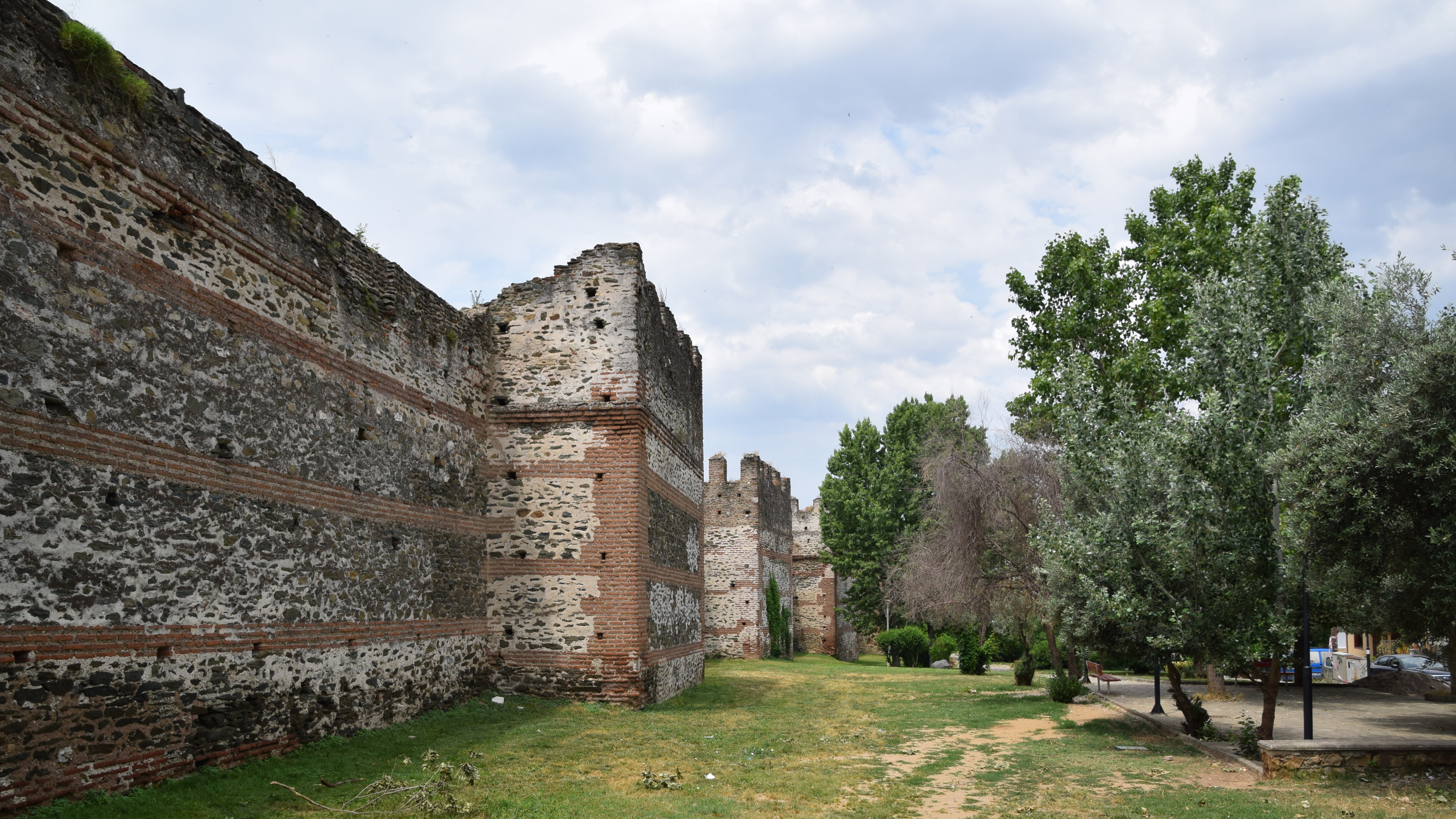
The Walls of Thessaloniki at 40.63N, 22.95E define the historic core of modern Thessaloniki on the Thermaic Gulf. The medieval walls and their towers are still visible along the upper city, with the Heptapyrgion fortress at the northeast and the Trigonion at the eastern corner. Recommended viewing altitude is 4,000-6,000 feet for the city's amphitheater shape against the gulf and the wall trace climbing the slope. Thessaloniki Makedonia (LGTS) airport sits 10 nautical miles southeast. Mount Olympus rises across the bay to the southwest. Serres, the city captured by the Ottomans in 1383 and whose population was taken as slaves, lies about 50 nautical miles east. The Vardar plain extends west toward Skopje, the historical land approach for Ottoman armies advancing from the Balkans. Northern Aegean visibility is generally best in spring and autumn.