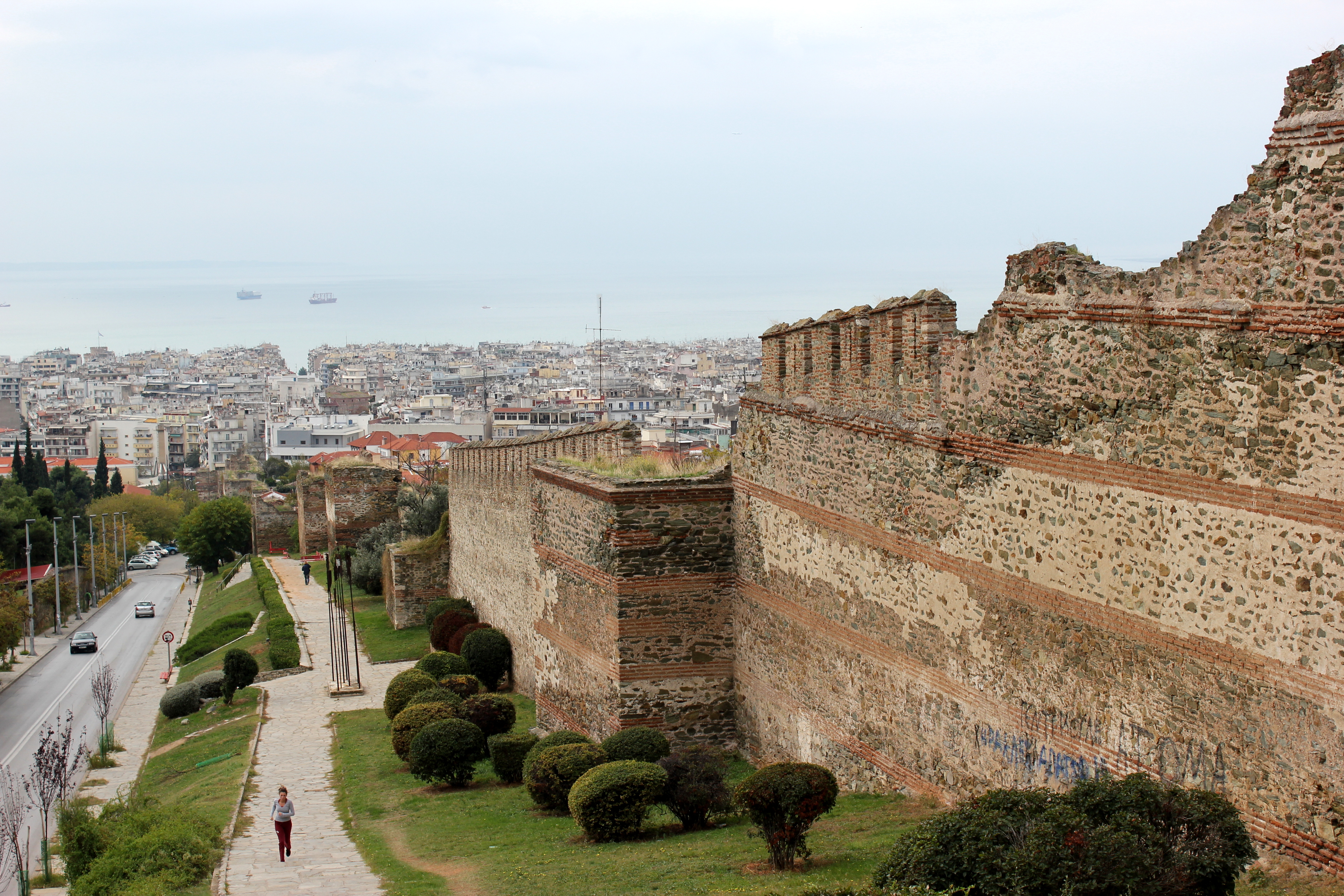
Siege of Thessalonica (1422–1430)
Seven thousand people were taken in chains the morning the city fell. They were marched out of Thessalonica on 29 March 1430, after the Ottoman army broke through the eastern walls and the three-day plundering began. The eyewitness John Anagnostes, a priest of the city, was among them. He survived to write down what he had seen, and what he wrote is one of the most painful documents of late Byzantine history. From a population that had numbered as many as forty thousand in the years before the siege, only two thousand remained when Sultan Murad II finally entered the city and ordered his soldiers out of the homes they had occupied.
Why a Greek City Belonged to Venice
The siege has an unusual feature: the city it failed to save was technically not Byzantine. Thessalonica had been ruled by Andronikos Palaiologos, a son of the emperor Manuel II, but Andronikos could not feed or defend it. In September 1423, with Ottoman forces tightening their grip, he handed the city over to the Republic of Venice. Venice took the deal hoping to maintain a trading foothold and possibly negotiate a settlement with the new sultan, Murad II. The negotiation failed. Murad considered the city his by right, the Venetians as interlopers in territory that belonged to him. The Venetians repeatedly tried to apply pressure by blockading the Dardanelles at Gallipoli. The pressure did not work. For seven years, the Republic struggled to hold a city it could not adequately supply, defend, or persuade the inhabitants to accept. The Venetian commercial aristocracy that ran the Republic was uninterested in raising the kind of army that could actually have changed the situation.
Hunger and Profiteering
Inside the walls the suffering grew steadily worse. By the winter of 1426 to 1427 the city was approaching famine, surviving on bread alone and waiting on grain shipments from Venice that arrived too slowly and too small. Mercenary guards on the walls, paid in wheat instead of cash, defected to the Turks when their rations were late. By 1430 many soldiers had no weapons because they had sold them for food. The Venetian authorities, unable to retain the population, prohibited residents from leaving and outlawed property transfers, even destroying the houses and trees of those who fled, hoping the destruction would deter others. The Thessalonians submitted formal lists of grievances about Venetian profiteering, arbitrary taxation, and broken customs. A Byzantine official whose family had escaped wrote of the enslavement of the city by the Venetians. The phrasing was angry, but it captured what many residents felt: trapped between two powers, neither of which they had chosen.
Symeon the Metropolitan
The most consistent voice for resistance inside the city was Symeon, the metropolitan bishop, who held office from 1416 or 1417 until his death in September 1429. Symeon was a Hesychast, an ardent theologian, and openly hostile to the Catholic Venetians whose religious practice he considered corrupting. He had opposed handing the city to Venice in the first place. Once the city was Venetian, however, he tried to keep his flock unified. He led litanies that paraded the city's icon of the Hodegetria through the streets. He preached sermons recalling Saint Demetrius's defense of the city in earlier sieges. The Venetians, despite Symeon's anti-Latin sentiments, considered him a most loyal servant of the Republic, because his message of resistance helped them hold the walls. When he died in autumn 1429, the population took it as an omen of the city's fall. By that winter, the eyewitness Anagnostes records, the majority of inhabitants had come to favor surrender to the Turks. They no longer believed any version of survival was likely under Venice.
The Final Assault
Murad arrived before the walls on Sunday, 26 March 1430, with an army rumored at 190,000 men. He probably expected the population to revolt against the Venetians and open the gates without a fight. He sent Christian officers to the walls to call for surrender. They were driven off by arrows. He sent another offer on 28 March. It was rejected. That night a subaltern entered the city to warn the Venetian commanders that Ottoman ships were preparing to attack the harbor. The Venetian commander Antonio Diedo was ordered to pull his men off the wall to defend the ships. He was not told to inform the population. Around midnight, Christians from the Ottoman camp approached the walls and announced the final assault would come at dawn. The news spread through the city. The population spent the night in churches in terrified vigil. When the assault began at dawn on 29 March, much of the eastern wall had been abandoned by defenders who believed the Venetians were preparing to flee.
Three Days of Plunder
Sinan Pasha, the Ottoman governor of Rumelia, led the attack on the eastern wall, with the sultan personally directing operations. Ottoman archers pinned defenders down. Around the fourth hour of the morning, troops broke through. The Venetians fled to their galleys, some still in their underclothes; over 270 Venetian crewmen died, including a son of Duke Paolo Contarini. As the civilian population was being killed in the streets, the surviving Venetians escaped by sea to Negroponte. By long-standing custom, a city taken by storm was given over to plunder, and the soldiers had three days. Anagnostes counted 7,000 captives taken to the slave markets of the Balkans and Anatolia, himself among them. Many were later ransomed by the Despot of Serbia, Đurađ Branković. The cathedral of Hagios Demetrios, the city's holiest site, was ransacked for treasure and later stripped of marble that the sultan had taken to Adrianople to pave a bath. Around 2,000 inhabitants remained when the violence ended. On the fourth day, Murad entered the city and prayed at the Church of the Acheiropoietos, which became Thessalonica's first mosque.
Five Centuries to Recover
Murad worked to repopulate the city. He promised to return property to those who had fled if they came back. He ransomed some captives himself. He brought in Muslim and Christian settlers from elsewhere in Macedonia. The Turks settled mostly in the upper part of the city. Most of the main churches were converted to mosques. Venice negotiated a peace treaty in July 1430 recognizing the new status quo, and over the following decades the antagonism between Venice and the Ottomans shifted to control of Albania. Thessalonica would remain in Ottoman hands for nearly five hundred years. It became part of the Kingdom of Greece in 1912, after the Ottoman defeat in the First Balkan War. The 7,000 enslaved that morning, the 2,000 left in their gutted city, the families ransomed back from slave markets across two continents, were the human cost of one campaign in a long war that ended an empire and reshaped the eastern Mediterranean. Anagnostes wrote his account because he wanted what happened to his neighbors not to be forgotten.
From the Air
The Walls of Thessaloniki at 40.63N, 22.95E enclose the historic core of modern Thessaloniki on the Thermaic Gulf. The eastern wall section where the 1430 assault broke through, between the Trigonion and the later Heptapyrgion (Yedi Kule, built by Murad II in 1431 to commemorate his conquest), is still visible. Recommended viewing altitude is 4,000-6,000 feet for the wall trace, the upper city where the Ottoman settlers concentrated, and the Acheiropoietos church (now a Greek Orthodox church again) that served as the city's first mosque. Thessaloniki Makedonia (LGTS) sits 10 nautical miles southeast. Mount Olympus rises across the bay to the southwest. The Vardar River, where Ottoman ships gathered before the final assault, flows just west of the city.