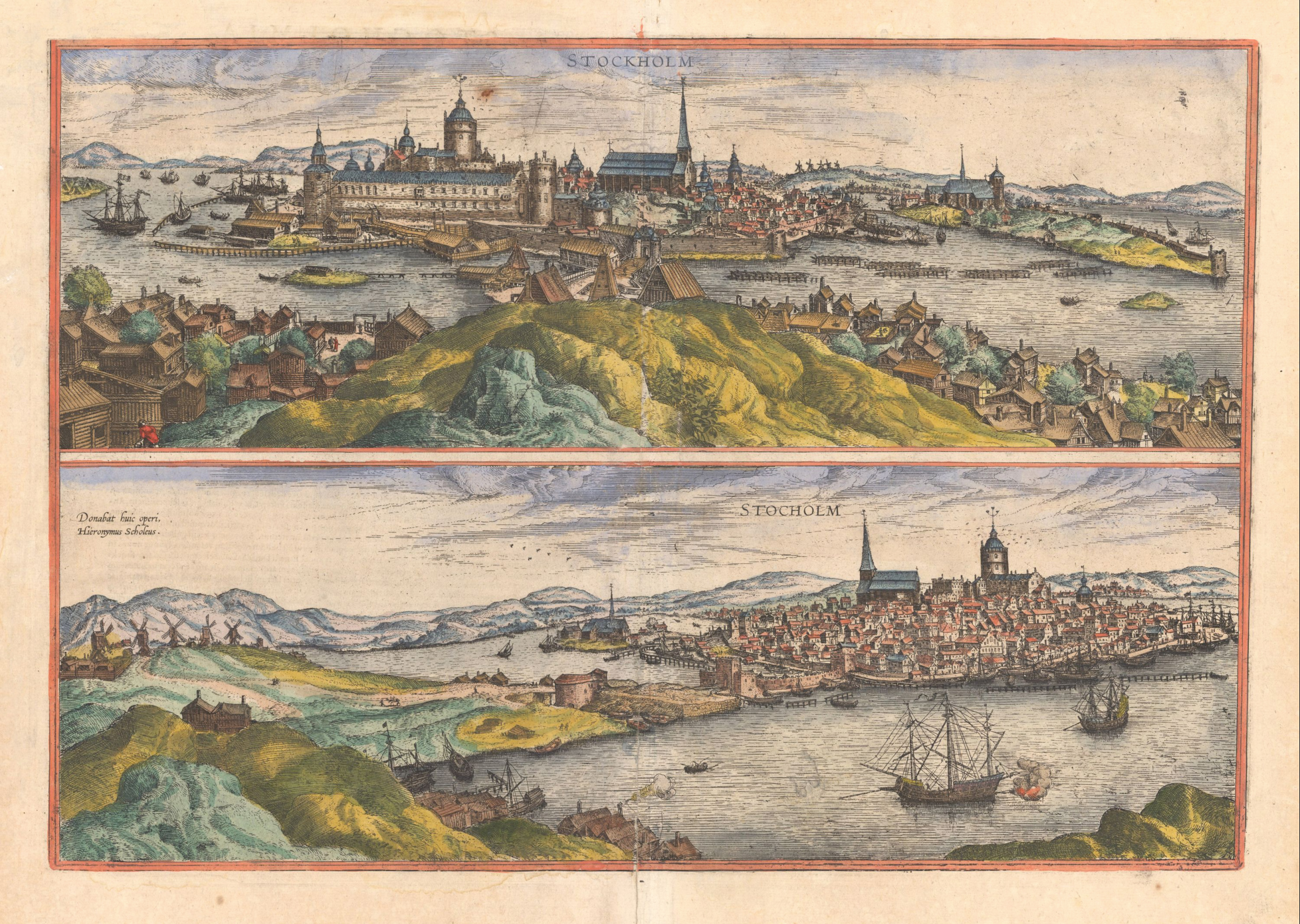
Siege of Tre Kronor
Queen Christina of Saxony watched from the walls of Tre Kronor castle as Stockholm burned. It was October 1501, and Swedish rebels had encircled the city. A quarter of Stockholm had already gone up in flames during the initial assault. The city itself surrendered on October 17, but Christina refused to yield the royal fortress. She had a thousand men - German mercenaries, Danish soldiers, and Swedish loyalists under the command of Johan von Grapendorf. She had strong walls and good provisions. And she had a husband, King John of Denmark, who had promised to send relief. For nearly seven months she would hold out, through winter storms and spring floods, bombardments and starvation, waiting for ships that would arrive three days too late.
Cracks in the Kalmar Union
The siege that engulfed Tre Kronor castle was the violent expression of decades of tension within the Kalmar Union. This political arrangement, theoretically uniting Denmark, Norway, and Sweden under one monarch, had never sat well with the Swedish nobility. In the 1490s, power in Sweden rested with Sten Sture the Elder, whose regency the Swedish nobles eventually found intolerable. In 1497, the council of the realm deposed him, and after his army was crushed at the Battle of Rotebro, King John of Denmark finally received the Swedish crown. But Danish dominion remained fragile. In 1500, Danish forces suffered catastrophic defeat at the Battle of Hemmingstedt against peasant rebels in Dithmarschen. Word spread quickly to Sweden, and the nobility saw their chance. By August 1501, open revolt had erupted. King John rushed to Denmark to raise an army, leaving Queen Christina to defend Stockholm and Tre Kronor - the beating heart of Swedish royal power.
The Castle Under Siege
Christina's garrison of 1,000 men faced daunting odds. The Swedish rebels, led by the clergyman and bishop Hemming Gadh, mustered 4,000 peasants, with another 1,400 Dalecarlian shooters on the way. Still, Tre Kronor's walls were strong, and mercenaries knew their trade. On November 30, the besieged unionists attempted to break out - and failed. Days later, on December 6, the garrison fired their great siege cannon toward Storkyrkan, the city's cathedral, shattering a palisade the Swedes had erected at the church gate. It was a show of force, but it could not break the encirclement. As winter set in, Christina requested permission to visit the city outside the castle walls. Gadh refused. The siege would be decided by time, not by negotiation - and time favored the besiegers.
Ice and Broken Promises
King John desperately tried to rescue his queen. On February 2, 1502, he wrote urgently to his commander Henrich Krummedige about organizing a relief fleet. But the waters around Stockholm were frozen solid - no ships could reach the besieged castle. Not until March 13 could the king even appoint fleet commanders, and then departure was delayed another two weeks. The Swedes, anticipating the relief attempt, stretched a boom - a floating barrier - between the city and the small island of Kapplingeholmen to block the harbor entrance. Strong currents defeated this improvised defense, but it hardly mattered. The relief fleet would not arrive in time. Inside Tre Kronor, conditions deteriorated rapidly. Provisions dwindled. Men weakened from hunger and disease. By late April, the garrison could barely defend the walls.
The Final Assault
On April 29, 1502, the Swedish forces launched their decisive attack. They stormed the castle and broke through into the bailey - the outer courtyard. Approximately 100 men died in the fighting. With the outer defenses breached and the inner garrison starving, Christina had no choice but to negotiate. She sent five delegates to meet with Swedish commanders in Storkyrkan. The terms agreed on May 5 were harsh: the queen, her servants, and her general staff would leave the castle the following Monday. They would be held in a city monastery until Sten Sture (who had returned to lead the rebellion) and Svante Nilsson determined the conditions of her return to Denmark. All surviving knights and soldiers would become prisoners of war until ransomed.
Bitter Ends and New Beginnings
On May 9, 1502, Queen Christina and her followers emerged from Tre Kronor castle. Of the 1,000 men who had begun the siege, only 70 remained alive - the rest had perished from bombardment, combat, and starvation over seven brutal months. Three days after the surrender, a Danish fleet of 30 ships finally reached Stockholm's waters. Seeing the Swedish banner flying from Tre Kronor's towers, the ships turned and sailed away. Christina would spend the next 18 months in captivity in Stockholm before Sten Sture and Hemming Gadh escorted her to the Danish border, where her son Prince Christian - the future Christian II - and other noblemen received her. The other prisoners were released in June 1502. The siege had ended Danish control of Sweden, though not Danish ambitions. Two decades later, Christian II would return to besiege Stockholm again, and that siege would end in the Stockholm Bloodbath - but that is another story.
From the Air
Located at 59.33N, 18.07E in central Stockholm. Tre Kronor castle stood on the site of today's Royal Palace on Stadsholmen (Gamla Stan) - the medieval castle was destroyed by fire in 1697 and replaced by the current baroque palace. The siege involved the waters around Gamla Stan, including the channel blocked by the boom near Kapplingeholmen (now part of Djurgarden). Stockholm Bromma Airport (ESSB) lies 7km northwest; Arlanda International (ESSA) is 37km north. Best viewed on low approaches over Lake Malaren from the west, where the defenders would have watched for the relief fleet that never came in time.