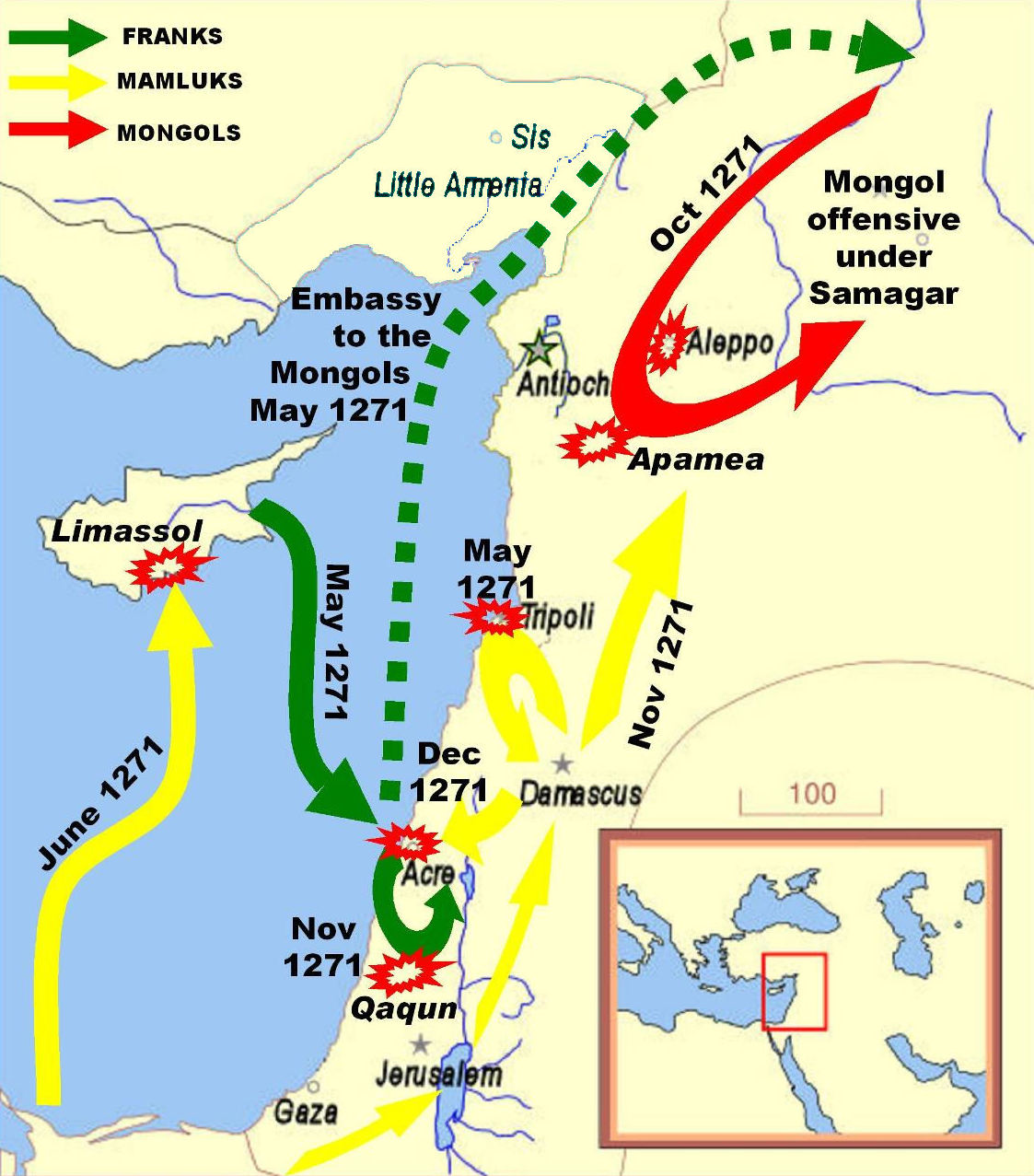
Siege of Tripoli (1271)
The letter arrived before the army. In it, Baibars, sultan of the Egyptian Mamluks, addressed Bohemond VI, the last lord of both Antioch and Tripoli, with a cruelty that was part diplomacy and part theater. He described in detail how his forces had sacked Antioch three years earlier, cataloging the slaughter and the plunder. The message was clear: Tripoli would be next. Bohemond, who had lost his greatest city in 1268 and now clung to a strip of Mediterranean coastline, faced a choice between surrender and annihilation.
Squeezed Between Empires
By the mid-thirteenth century, the Crusader states had been reduced to a chain of coastal towns and castles, pressed from the south by the Mamluks and from the east by the Mongol Empire. Bohemond VI had tried to navigate this by submitting Antioch and Tripoli to Mongol overlordship around 1260, a decision influenced by his father-in-law, King Hethum I of Armenia. For a time, it seemed shrewd. The Mongols had shattered the Abbasid and Ayyubid caliphates, and their armies appeared unstoppable. But a succession crisis in Mongolia pulled the bulk of their forces eastward, and the remnant left in Syria was defeated by the Mamluks at the Battle of Ayn Jalut in 1260. The balance of power shifted overnight. The Mamluks, now unchallenged, began reclaiming the Levant castle by castle. Jerusalem had already fallen in 1244. Antioch followed in 1268, its conquest so devastating that Bohemond was left with Tripoli alone.
Pride and Mockery
Baibars arrived before Tripoli's walls in 1271 with the confidence of a commander who had already taken every inland Crusader fortress in the region. His letter to Bohemond was designed to terrify, taunting the Crusader lord for his alliance with the Mongol ruler Abaqa and threatening total annihilation. Bohemond begged for a truce. Baibars mocked his cowardice and demanded that Bohemond pay the full cost of the Mamluk campaign. The Crusader lord, though desperate, had enough pride left to refuse. It was a standoff: Baibars held the military advantage, but Tripoli's coastal position and its walls made a quick assault difficult, and the sultan was unwilling to commit to a prolonged siege without knowing what forces might arrive from the west.
The English Prince
What saved Tripoli was not its walls but a rumor. Word reached Baibars that a new crusade was forming in Europe, led by Prince Edward of England, the man who would later become Edward I. Edward landed at Acre on May 9, 1271, and was soon joined by Bohemond and King Hugh of Cyprus and Jerusalem. His forces were small, but their arrival changed the strategic calculation. Baibars, unwilling to risk a siege while fresh European troops gathered on the coast, accepted Bohemond's offer of a truce in May and withdrew his forces to Damascus. Edward attempted to coordinate with the Mongols for a joint campaign, but the Mongols were consumed by their own internal conflicts and the English prince's army was too small to act alone. He negotiated his own truce with the Mamluks and sailed home. Tripoli was spared, but only for a time.
Eighteen More Years
The truce bought Tripoli eighteen years of borrowed time. When the next assault came in 1289, it was not Baibars but Sultan Qalawun who marched on the city, and this time there was no crusade to distract him. Tripoli fell. The Mamluk forces razed the Crusader city and rebuilt it inland, closer to the citadel that still stands on its hilltop today. Qalawun then turned his attention to Acre, the last major Crusader stronghold, but died in 1290 before he could take it. His son al-Ashraf Khalil finished the work in 1291, ending two centuries of Crusader presence in the Levant. The siege of 1271 lingers in the historical record as the moment Tripoli almost fell, a reprieve made possible by the coincidence of an English prince's ambition and a sultan's caution.
From the Air
Located at 34.433°N, 35.833°E, the site of the 1271 siege corresponds to the old walled city of Tripoli, Lebanon, clustered around the hilltop citadel on the Kadisha River. The modern city extends north and west to the coast. Tripoli Air Base lies 3 km north. From altitude, the relationship between the coastal city, the citadel hill, and the mountain passes to the east illustrates why Tripoli was both strategically valuable and difficult to assault. Best viewed at 5,000-8,000 ft AGL.