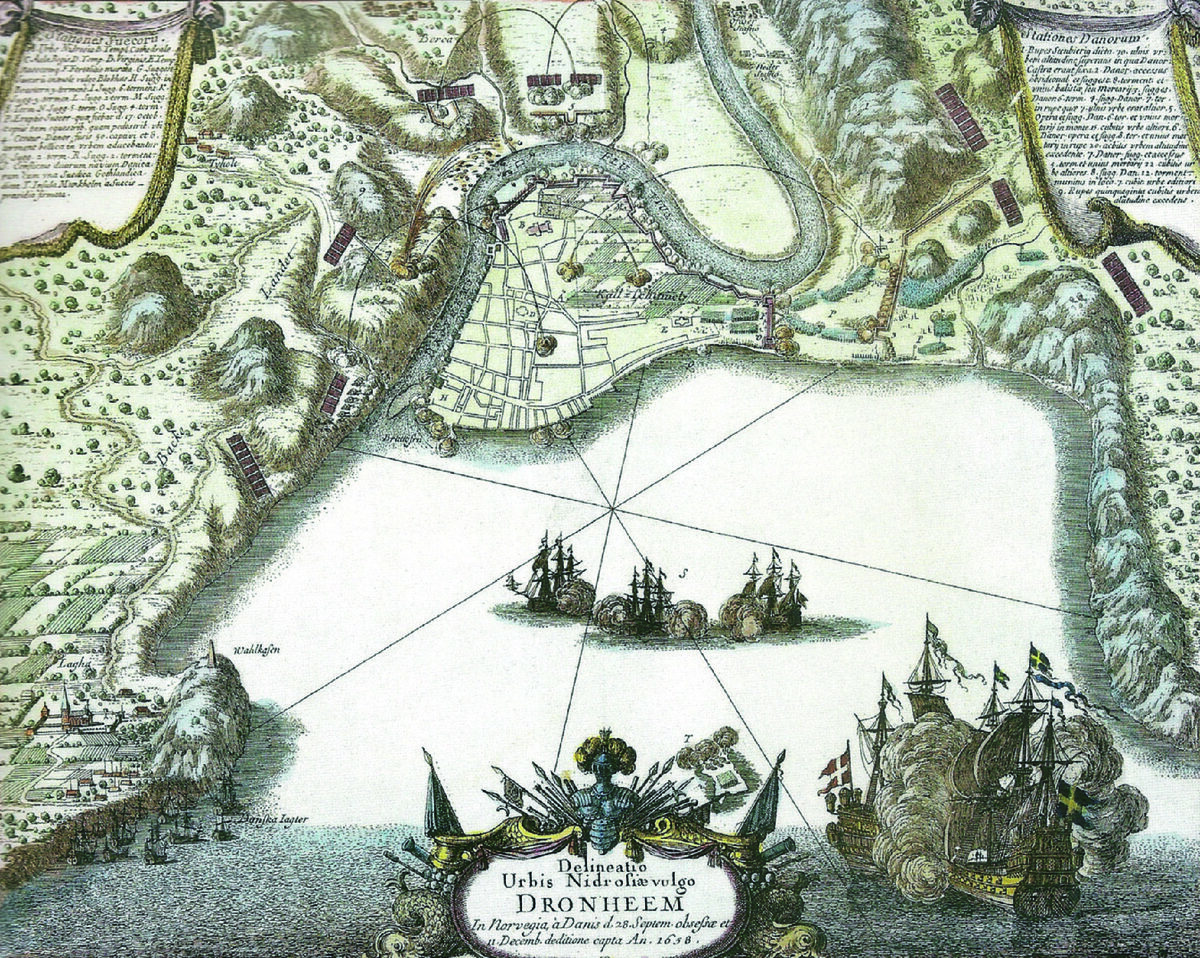
Siege of Trondheim
The Swedish garrison ran out of almost everything except pride. By the end, they were buying back the very bullets fired at them, purchasing spent ammunition from Trondheim's own merchants to reload their guns. After fifteen weeks of siege in the freezing Norwegian winter of 1658, with only three hours' worth of gunpowder remaining and more than half his men too ill to stand, the Swedish commander Claes Stiernsköld had no choice but to negotiate. The 341 survivors marched out with full military honors — a courtesy extended to men who had defended a city that never wanted them in the first place.
A Treaty's Bitter Fruit
The Treaty of Roskilde in early 1658 had been a catastrophe for Denmark-Norway. Sweden, at the height of its imperial ambition, forced the cession of Trondheim and its surrounding province — the first time in centuries that Norway's third city had been under foreign control. Lorentz Creutz, the Governor of Dalecarlia, arrived in May with fifty cavalry and 480 infantry to take possession. Reinforcements trickled in from Hälsingland, Medelpad, and Ångermanland, and a new governor was appointed. But Sweden's treasury was as stretched as its borders. Lieutenant Colonel Axel Posse, charged with defending the province, received 606 men and eight officers — but critically little artillery, gunpowder, or ammunition. The city had no proper fortifications. The garrison was holding a prize that Sweden could neither fortify nor supply.
Bjelke's Pincer
When the Dano-Swedish War erupted again later that year, the Norwegian commander Jørgen Bjelke saw his opening. He raised two new regiments in rapid succession — the Tønsbergske in August, the Vesterlenske in October — and planned a two-pronged assault on Trondheim. One force from Bergenhus would approach by sea; another from Akershus would march overland through the mountains. On September 9, some 2,500 Norwegians landed at Trondheim with both land artillery and shipborne guns. A month later, the overland column arrived. Posse and his sickly garrison found themselves surrounded, outgunned, and increasingly abandoned by the city they were supposed to govern. The burghers of Trondheim rose against the Swedes — not with weapons, but with commerce. They sold the defenders ammunition at inflated prices, profiting from both sides of the siege.
Three Hours of Gunpowder
The siege lasted fifteen weeks through autumn and into the Norwegian winter. Disease spread through the garrison faster than supplies could arrive. The Swedes, reduced to reusing enemy bullets and buying more from the very citizens they occupied, watched their position become untenable. When Stiernsköld finally opened negotiations, he had 341 men left — of whom 153 could not walk. They had three hours of gunpowder remaining. The terms were generous, as siege terms went. The Swedes marched out with full military honors, their colors flying. Days later, the column of survivors trudged east toward Sweden, leaving Trondheim Norwegian once more.
The City That Bought Itself Back
Bjelke wasted no time. With Trondheim secured, he rushed south to reinforce Fredrikshald, where the Swedes had concentrated their main offensive. Trondheim would never again be ceded to Sweden. The siege became a point of Norwegian pride — proof that the union with Denmark did not mean submission, and that Norwegian commanders could organize and execute a major military campaign. The detail that endures in local memory is the bullets: a garrison so undersupplied that it purchased ammunition from the people it occupied, who sold it cheerfully, knowing each round brought their liberation closer. The Trondheim of today, with Nidaros Cathedral rising above the Nidelva and colorful wharves lining the river, bears no visible scars from 1658. But the siege shaped the city's identity as a place that could not be given away.
From the Air
Coordinates: 63.4269°N, 10.4106°E. Trondheim sits at the southern end of the Trondheimsfjord, easily identifiable from altitude by the distinctive loop of the Nidelva river through the old city center. Nidaros Cathedral is visible as a large cruciform structure. Nearest airport: ENVA (Trondheim Airport Værnes), 32 km northeast. Approach from the fjord for the best view of the old city and the river bend that defined the siege perimeter. Best viewed at 2,000-4,000 ft AGL.