Siege of Tsingtao
On the morning of September 6, 1914, a Farman seaplane launched from the Japanese carrier Wakamiya dropped bombs on the Austro-Hungarian cruiser Kaiserin Elisabeth and the German gunboat Jaguar anchored in Jiaozhou Bay. The attack failed to hit either ship, but it marked a world first: the first naval-launched air raid in history. The Siege of Tsingtao was full of such firsts. It was the first encounter between Japanese and German forces, the first Anglo-Japanese military operation, and it produced the first nighttime aerial bombing raid. Yet this ten-week siege on the coast of Shandong Province remains one of World War I's least remembered battles, overshadowed by the slaughter unfolding simultaneously in France and Belgium.
The Ultimatum
When war erupted in Europe in August 1914, Britain quickly requested Japanese assistance under the terms of the Anglo-Japanese Alliance signed in 1902. On August 15, Japan issued an ultimatum to Germany: withdraw all warships from Chinese and Japanese waters and transfer control of Qingdao. Major-General Mitsuomi Kamio of the 18th Infantry Division was ordered to prepare for an assault the next day. The ultimatum expired on August 23, and Japan declared war. Meanwhile, Vice Admiral Maximilian von Spee dispersed the ships of the German East Asia Squadron from their Qingdao base to various Pacific destinations, eventually sailing to South America where they won the Battle of Coronel before being destroyed at the Battle of the Falkland Islands. The port was left to defend itself.
Forts Named for German Heroes
Germany had fortified Qingdao with three defensive lines. The outermost stretched along three hills named Mount Moltke, Mount Bismarck, and Mount Iltis, fortified with heavy guns: two 240mm weapons at Fort Moltke, four 280mm howitzers at Fort Bismarck, and two more 240mm guns at Fort Iltis. A network of trenches, batteries, and redoubts connected the positions. The harbor approaches were mined. The garrison, commanded by naval Captain and Governor Alfred Meyer-Waldeck, numbered 3,625 men: marines of the III Seebataillon, naval personnel, Chinese colonial troops, and Austro-Hungarian sailors from the Kaiserin Elisabeth. Against them came 23,000 Japanese soldiers supported by 142 artillery pieces, along with 1,500 British troops including the 2nd Battalion of the South Wales Borderers and 500 soldiers of the 36th Sikhs. After a friendly fire incident, British troops were given Japanese raincoats to avoid being shot by their allies.
Ten Weeks of Fire
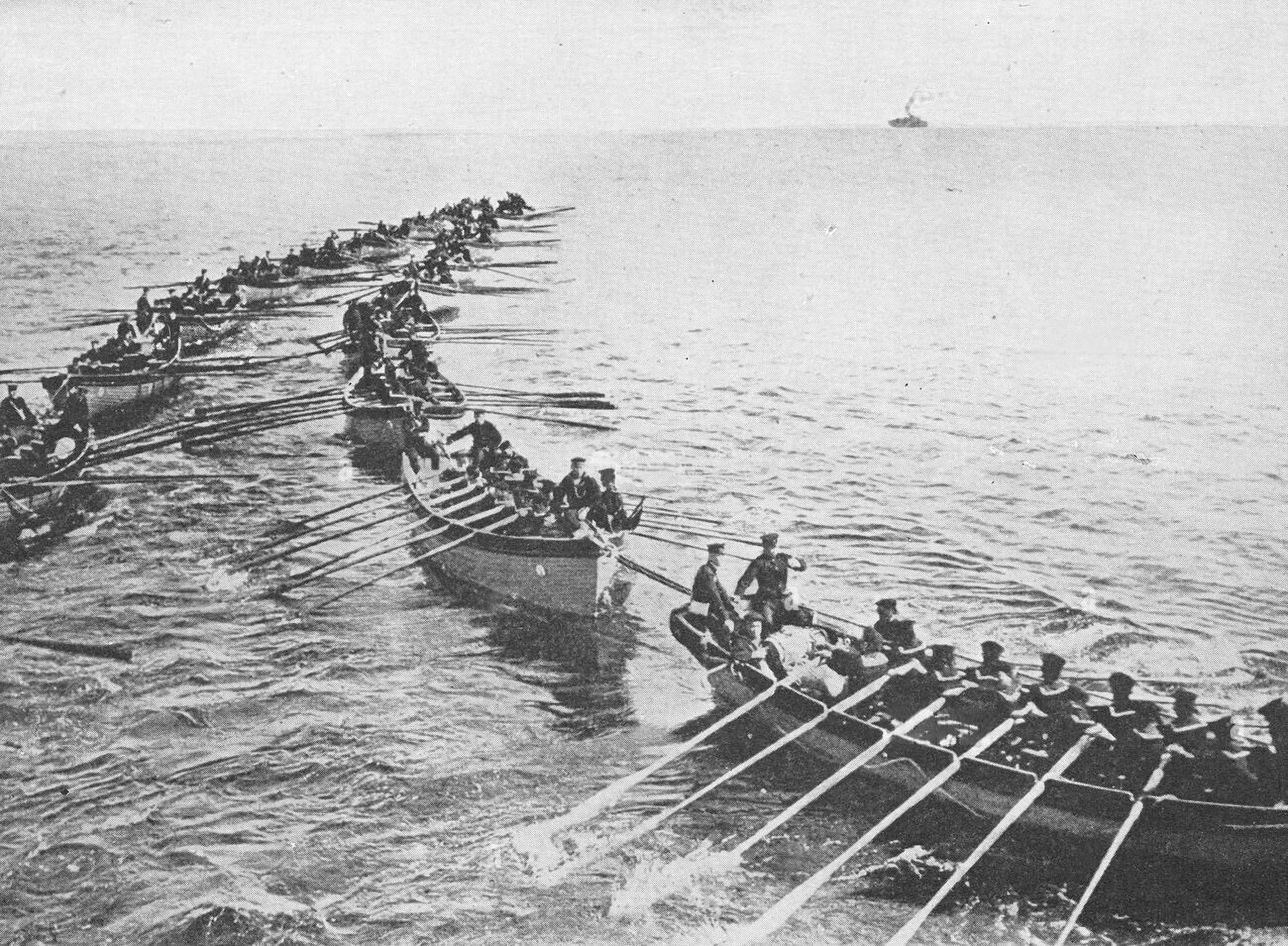
The Japanese began landing on September 2 at Lungkow, experiencing heavy floods, and later at Lau Schan Bay. Meyer-Waldeck withdrew to his innermost defensive line as the siege tightened. On September 27, the Japanese attempted a frontal assault on Prince Heinrich Hill and were caught in devastating crossfire from four Maxim guns on the summit while the Kaiserin Elisabeth and the gunboat Leopard shelled their exposed flanks from the harbor. The assault nearly routed the Japanese right flank before the allied fleet intervened. The Kaiserin Elisabeth's crew eventually removed her 15cm and 4.7cm guns and mounted them ashore as the Batterie Elisabeth, fighting alongside the infantry. The colony surrendered on November 7, 1914, after a defense that Kaiser Wilhelm II had personally demanded be maintained to the last.
Aftershocks at Versailles
The siege's consequences far outlasted the fighting. Japan occupied Qingdao until 1922, and at the Paris Peace Conference in 1919, the Allies awarded former German Pacific territories to Japan rather than returning them to China. This decision triggered the May Fourth Movement, a watershed in Chinese political consciousness that helped give rise to the Chinese Communist Party. The British soldiers who fought at Tsingtao did not linger in Asia. The 2nd Battalion South Wales Borderers embarked for England in November 1914, arriving in January 1915. They joined the newly formed 29th Division and were sent to Gallipoli in April 1915, trading one distant siege for another. The Siege of Tsingtao was a small battle by the standards of the Western Front, but its political reverberations reshaped Asia for the rest of the century.
From the Air
Located at 36.067N, 120.383E in the Qingdao area along Jiaozhou Bay. The siege took place across the hills and coastline surrounding the German colonial city. The defensive positions on the hills west of the city and the harbor approaches are the key geographic features. Nearest airport is Qingdao Jiaodong International Airport (ZSQD). The bay entrance, surrounding hills, and harbor area are visible from 5,000-10,000 feet.