Siege of Warangal (1310)
Among the treasures that the Kakatiya king Prataparudra surrendered to save his people, one precious stone reportedly left the philosophers of Delhi speechless. They refused to believe such a substance could exist. Centuries later, the eighteenth-century chronicler Khafi Khan would identify that stone as the Koh-i-Noor -- the Mountain of Light -- now set in the British Crown Jewels. Whether the identification is accurate or legend, the siege of Warangal in 1310 was undeniably one of the great plundering expeditions of medieval India, a campaign so meticulously planned that the Delhi sultan received battlefield updates every two to three days across a distance of over a thousand kilometers.
The Wealth That Drew an Empire South
In the early thirteenth century, the Deccan region of southern India remained fabulously wealthy, shielded by distance from the Turkic armies that had devastated the north. The Kakatiya dynasty controlled the eastern Deccan from their capital at Warangal, a city protected by concentric fortifications -- an outer mud wall with seventy bastions, a moat, an inner ditch, and a stone citadel whose walls were, according to the court poet Amir Khusrau, "so smooth that an ant could not climb them." Sultan Alauddin Khalji of Delhi had already tasted Deccan wealth in 1296, when he raided the Yadava capital of Devagiri and returned with staggering plunder. Warangal was next. A first expedition in 1302-1303 ended in disaster -- the army returned to Delhi "confused and shattered without accomplishing anything," as the chronicler Firishta put it. Alauddin waited, planned, and in 1309 sent his most trusted general to finish the job.
A Thousand Miles Through Hostile Country
Malik Kafur departed Delhi on October 31, 1309, with a massive army. Alauddin left nothing to chance. He established communication posts along the entire route from Tilpat, near Delhi, to the army's advancing position, stationing fast horses, news-writers, and foot-runners at regular intervals. Over six days in November, the army forded five rivers -- tributaries of the Yamuna, the Chambal, the Banas, the Kwari, and the Betwa. Kafur halted for four days at a place called Sultanpur, then for fourteen days at Khandar to review his troops. After crossing the Narmada, he reached Yadava territory, where King Ramachandra -- now a vassal of Delhi -- supplied markets with goods at prices fixed by Alauddin and reinforced the army with his own troops. Near the Kakatiya frontier, Kafur struck first at Sabar, a border fort. The surprise attack was devastating. Some defenders committed jauhar -- self-immolation with their families rather than face capture. The fort fell, and refugees fled to Warangal carrying news of what was coming.
Thirty Days Around the Walls
On January 18, 1310, Kafur's scouts captured Hanamkonda hill, from which Warangal's fortifications were clearly visible. The next day, the Delhi commander Khwaja Haji deployed his forces in a complete ring around the fort, assigning each tuman -- a unit of ten thousand soldiers -- a section of the perimeter. Wooden walls were erected around the besiegers' camp to protect against sorties from the countryside. The Kakatiyas fought back. One night, the governor Vinayaka Deva led a thousand cavalry in a sortie that cost both sides dearly before the Kakatiyas were driven back. Stone-throwing machines were positioned around the fort, and the invaders began the grinding work of filling the outer moat. On one side they broke through the mud wall with massive stones; on another, siege engines breached the gates. By February 16, the outer fort had fallen. But the inner citadel remained untouchable -- its polished stone walls defied every engine and pickaxe in Kafur's arsenal.
A Golden Surrender
With the outer defenses gone and his people suffering, Prataparudra chose negotiation over annihilation. He sent Malik Kafur a golden statue of himself with a chain around its neck -- a dramatic symbol of unconditional submission. The wealth that followed staggered even the chroniclers accustomed to hyperbole: one hundred elephants, seven thousand horses, and precious articles that Amir Khusrau described as "more than the minds of the wise could apprehend." Kafur, following Alauddin's instructions, threatened to massacre the city if Prataparudra withheld anything. The Kakatiya king agreed to all terms, including an annual tribute to Delhi. Yet Prataparudra never personally appeared before Kafur -- only his envoys negotiated the truce. The inner fort was never breached. On March 20, 1310, Kafur began the long march home. He reached Delhi on June 9, and on June 23, presented the plunder in a public ceremony near the Badaun Gate, the treasure carried on a thousand camels for the citizens of Delhi to behold. Prataparudra would stop paying tribute within a few years, inviting another siege in 1318 and a final, fatal one in 1323 that ended his dynasty forever.
From the Air
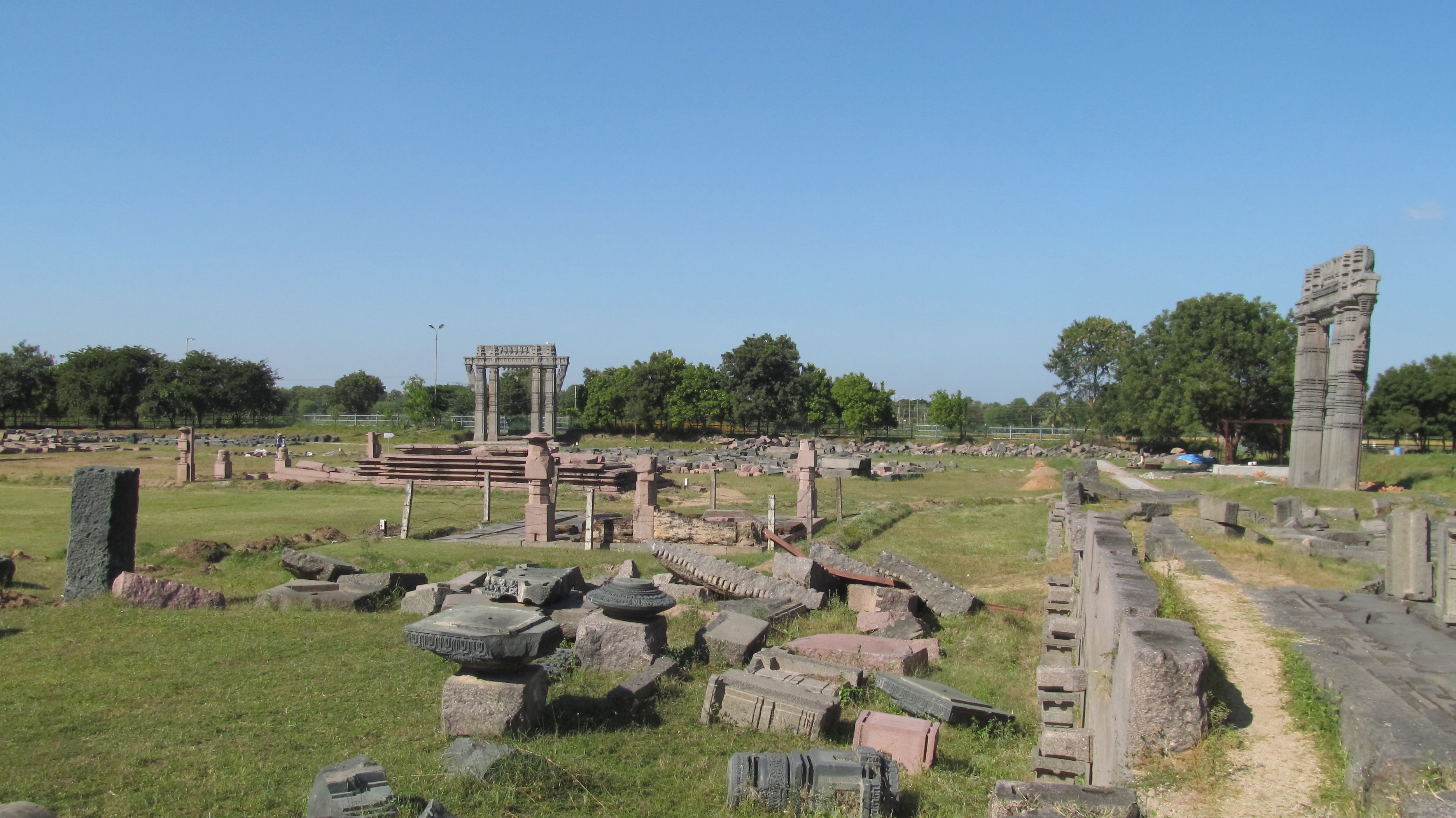
Located at 17.95N, 79.50E over modern Warangal in Telangana. The ruins of Warangal Fort, including the famous stone gateways (the Kakatiya Kala Thoranam), are visible from altitude. The fort's concentric ring structure -- outer mud ramparts and inner stone citadel -- can be traced from above. Hanamkonda hill, where Malik Kafur pitched his command tent, lies adjacent to the northwest. Nearest airport: Warangal Airport (VOWA), though Rajiv Gandhi International Airport, Hyderabad (VOHS) at approximately 150 km southwest is the nearest major facility. The terrain is Deccan plateau, relatively flat with scattered rocky outcrops.