Siege of Yorktown
"Push on my brave boys, and skin the bastards!" Colonel Robert Abercromby shouted the words as he led 350 British troops in a desperate predawn raid on allied trenches near Yorktown in October 1781. His men spiked six cannons before French reinforcements drove them back. By morning, every gun was repaired and firing again. It was the last offensive action of the British army in the American Revolution. Within days, a drummer boy would appear on the ramparts of Yorktown waving a white handkerchief, and the war that created a nation would effectively be over. The siege that brought the British Empire to its knees lasted barely two weeks, but its choreography of trenches, bombardment, and bayonet charges played out on a small Virginia peninsula that you can still walk today.
Cold Steel by Moonless Light
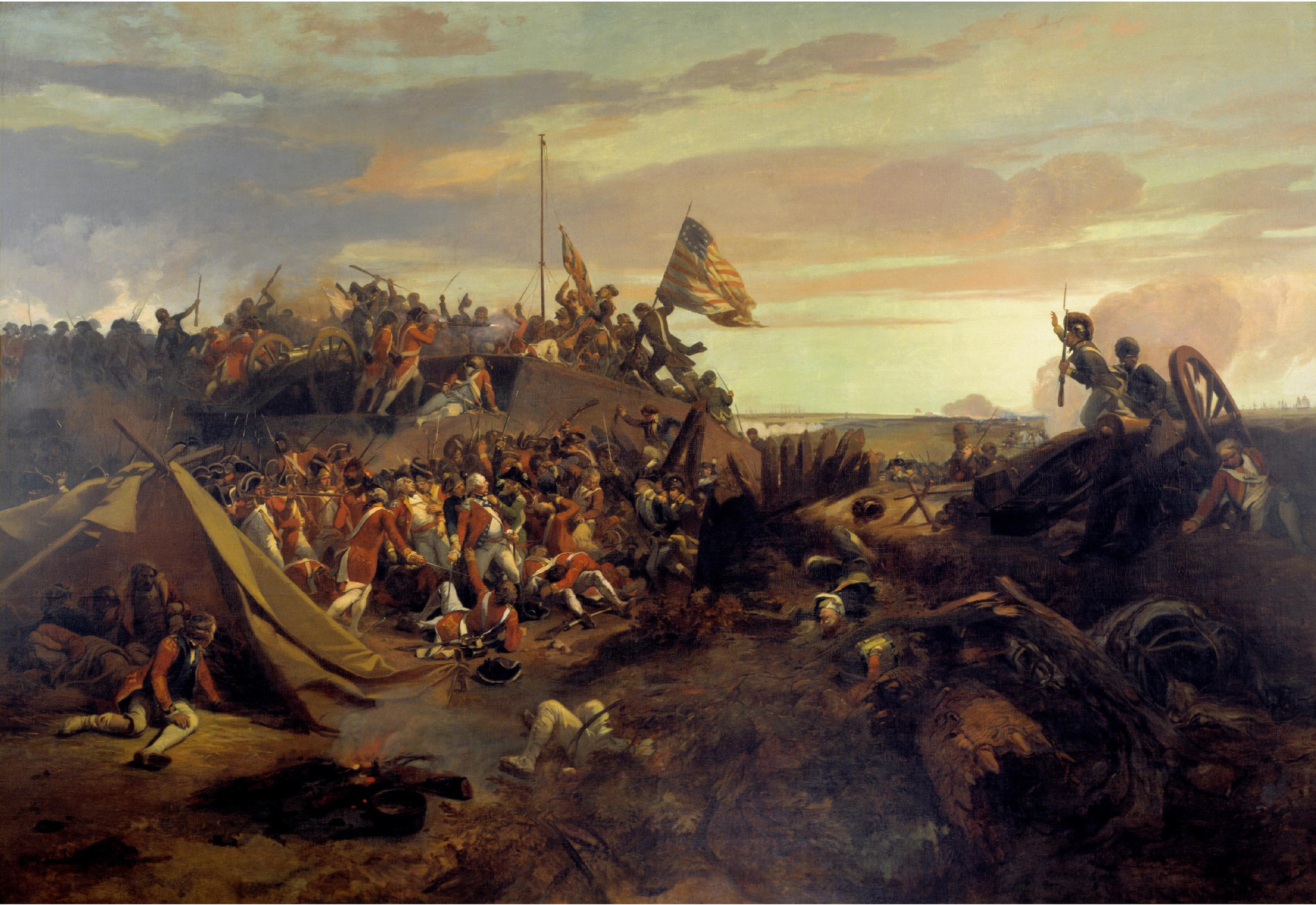
Washington planned the assault on the two key British redoubts for the night of October 14, choosing a moonless sky for cover. He added one more element: silence. No soldier was to load his musket until reaching the fortifications. The advance would be made with cold steel alone. Redoubt No. 10, near the York River, was held by just 70 men and assigned to 400 light infantry under Alexander Hamilton. Redoubt No. 9, a quarter-mile inland with 120 British and German defenders, fell to 400 French regulars of the Royal Deux-Ponts Regiment. The Americans reached their target and began chopping through wooden defenses with axes. A sentry called a challenge, fired, and the silence broke. The Americans poured into giant shell holes carved by preparatory bombardment, overwhelmed the defenders, and took the position. The French stormed their redoubt under fire, climbing the walls as Germans charged them, until a volley drove the defenders back. The Americans lost 9 dead and 25 wounded. Both redoubts fell in minutes.
The Drummer on the Ramparts
By October 17, the allied bombardment had become devastating. New artillery pieces joined the line daily, and Washington had ordered continuous fire so the British could make no repairs. Cornwallis had already sunk more than a dozen of his own ships in the harbor to prevent their capture. French guns set a British vessel ablaze, which ignited two or three others. A desperate attempt to evacuate across the York River failed when a squall scattered the boats. Cornwallis gathered his officers, and they agreed: the situation was hopeless. On the morning of October 17, a lone drummer appeared on the British ramparts, followed by an officer waving a white handkerchief. The bombardment ceased. The officer was blindfolded and led behind the allied lines. Negotiations began the next day at the Moore House, with Lieutenant Colonel Laurens representing the Americans and the Marquis de Noailles representing the French. Washington insisted the French receive an equal share in every step of the surrender process.
A Sword Twice Refused
Cornwallis refused to attend his own surrender, claiming illness. He sent Brigadier General Charles O'Hara in his place. What followed became one of the most choreographed moments in American history. O'Hara first approached Rochambeau and attempted to offer the sword to the French commander, who shook his head and pointed to Washington. O'Hara then turned to Washington, who also refused - motioning instead to his second-in-command, Major General Benjamin Lincoln. A deputy surrendering to a deputy. Washington had one more act of deliberate humiliation. The British had asked for the traditional honors of war - flags flying, bayonets fixed, band playing an American or French tune as tribute to the victors. Washington refused, denying them the same honors Britain had denied the defeated American army at the siege of Charleston the year before. The British and Hessian troops marched out with flags furled and muskets shouldered, their band playing a British or German march. Legend holds they played "The World Turn'd Upside Down," though the story may be apocryphal. In all, 8,000 soldiers, 214 artillery pieces, thousands of muskets, 24 transport ships, wagons, and horses were surrendered.
The Invisible Ally: Malaria
The marshlands of eastern Virginia held a weapon neither army could see. Malaria was endemic in the Tidewater region, and Cornwallis estimated at the time of surrender that half his army was unable to fight because of the disease. The Continental Army held a grim advantage: most of its soldiers had grown up with malaria and developed resistance. The French, newly arrived from Europe, had not yet begun to show symptoms because of the disease's month-long incubation period. Cornwallis's army had been weakening for weeks before the first trench was dug. The mosquitoes of the Virginia lowlands were as much an ally to the American cause as the French fleet that blocked the Chesapeake Bay.
Oh God, It's All Over
When word reached London, British Prime Minister Lord North reportedly exclaimed, "Oh God, it's all over." He was right. On March 4, 1782, Parliament passed a motion to end offensive warfare in North America. Lord North and his government resigned on March 20. Washington moved the Continental Army to New Windsor, New York, where they remained until the Treaty of Paris was signed on September 3, 1783, formally ending the eight-year war. The battlefield at Yorktown is preserved today within Colonial National Historical Park. The American Battlefield Trust and its partners have preserved 49 additional acres outside the park. In some German histories, the siege is known as "die deutsche Schlacht" - the German battle - because Germans served in significant numbers in all three armies, accounting for roughly a third of the forces involved. Five days after the surrender, the British rescue fleet finally arrived. It was too late.
From the Air
Located at 37.23°N, 76.50°W on the York River in York County, Virginia. The Yorktown battlefield is part of Colonial National Historical Park, visible as open fields and earthworks along the river. The town of Yorktown sits on a bluff above the York River. Best viewed at 2,000-4,000 ft AGL. The Colonial Parkway connecting Yorktown to Williamsburg and Jamestown is a distinctive road visible from the air. Felker Army Airfield (KFAF) at Fort Eustis is 8nm west. Newport News/Williamsburg International (KPHF) is 12nm northwest. Langley Air Force Base (KLFI) is 10nm southeast - active military airspace. Hampton Roads area prone to haze and marine layer conditions.