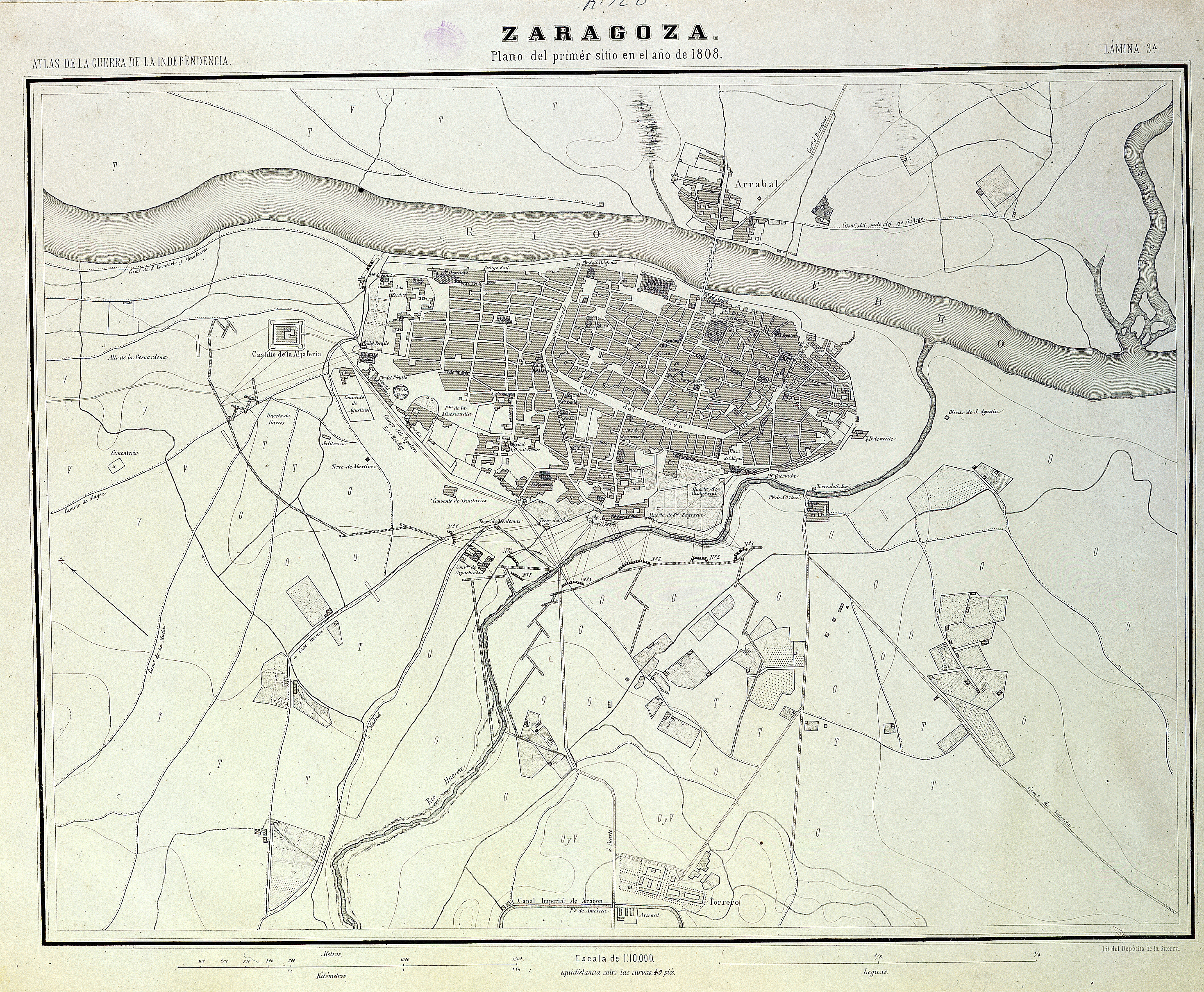
Siege of Zaragoza (1808)
When General Verdier demanded the surrender of Zaragoza on 4 August 1808, the Spanish commander Jose de Palafox gave a reply that entered history: "War to the knife." It was not bravado. In the narrow lanes and fortified buildings of this Aragonese capital, soldiers and civilians had already proven they meant it -- repelling two major French assaults and turning a city of medieval walls and barricades into a killing ground that devoured Napoleonic columns whole.
An Aristocrat Raises an Army
Jose de Palafox was the second son of an aristocratic Spanish family, appointed Captain-General of Aragon in late May 1808 as Napoleon's occupation of Spain provoked uprisings across the country. He raised 7,500 troops, but most were raw recruits -- only about three hundred experienced cavalry and a handful of trained gunners. His elder brother attempted to intercept the French at Tudela on 8 June and again at Mallen on 13 June; both efforts failed. Palafox himself led a force out to meet the French at Alagon on 14 June and was wounded in the defeat. The remaining Spanish forces fell back behind Zaragoza's walls, and the city's geography became their best weapon: the Ebro River guarded the northeast, the Huerva River protected the south, and a maze of stone buildings with narrow lanes offered perfect terrain for barricade warfare.
The Maid of Aragon
The French first assaulted Zaragoza on 16 June. Polish troops of the Legion of the Vistula broke through the Gate of Carmen and fought into the city center, but received no French support and were forced to withdraw -- their cavalry commander, Colonel Jan Konopka, openly calling the French troops "cowards." The second major assault came on 2 July with twice the force. French soldiers penetrated the city in several places but could not advance past the barricades. It was during this assault that Agustina de Aragon became legend. Her lover, an artillery sergeant at the Portillo Gate, was killed along with his entire gun crew before they could fire their last round. Agustina ran forward, took the burning match from his dead hands, and fired the cannon. The blast of grapeshot at close range broke the French attack. Palafox, who said he witnessed the act, commissioned her as a sub-lieutenant on the spot.
A Siege Without a Seal
After the costly July assault, Verdier settled into a conventional siege, but he lacked the troops to fully encircle Zaragoza. Spanish supply lines from the north bank of the Ebro remained open through most of the summer. The French focused on capturing convents and monasteries on the western approaches, taking the Capuchin and Trinitarian convents of San Jose by 24 July. On 4 August, a massive bombardment silenced the Spanish guns and opened breaches in the walls. Verdier launched thirteen battalions in three columns and his forces penetrated deep into the city. By evening, the French held half of Zaragoza. Then the Spanish counterattacked and pushed them back out, leaving only a small wedge of French troops surrounded by defenders. The assault had effectively failed. News of General Dupont's surrender to the Spanish at Bailen on 19 July confirmed what both sides already sensed: the French would have to withdraw.
Heartbreak of the Polish Legions
On 14 August, Verdier blew up his remaining strongpoints -- including the Abbey of Santa Engracia -- and withdrew from Zaragoza. French casualties totaled roughly 3,500; Spanish losses were likely around 5,000. Palafox became a national hero, sharing his fame with Agustina and the ordinary civilians who had fought alongside soldiers in the streets. But the siege left a different kind of scar on the Polish troops who fought for France. The Poles had allied with Napoleon because he was the only guarantor of the Duchy of Warsaw and had promised to help resurrect their partitioned nation. Yet at Zaragoza they found themselves attacking a people fighting for their own freedom -- a bitter irony for soldiers whose homeland had been swallowed by Prussia, Russia, and Austria. General Chlopicki commended Colonel Konopka for refusing to fight Spanish civilians and forbade his own troops from engaging noncombatants during the second siege that followed in December. The Poles fought because they had to. Their hearts, by many accounts, were on the Spaniards' side.
From the Air
Located at 41.65N, 0.88W. Zaragoza sits at the confluence of the Ebro, Huerva, and Gallego rivers in the Aragon region. The old city walls, the Puerta del Carmen, and the site of the Abbey of Santa Engracia are visible landmarks from low altitude. Nearest airport is Zaragoza (LEZG). The Ebro River cutting through the city provides the primary visual reference.