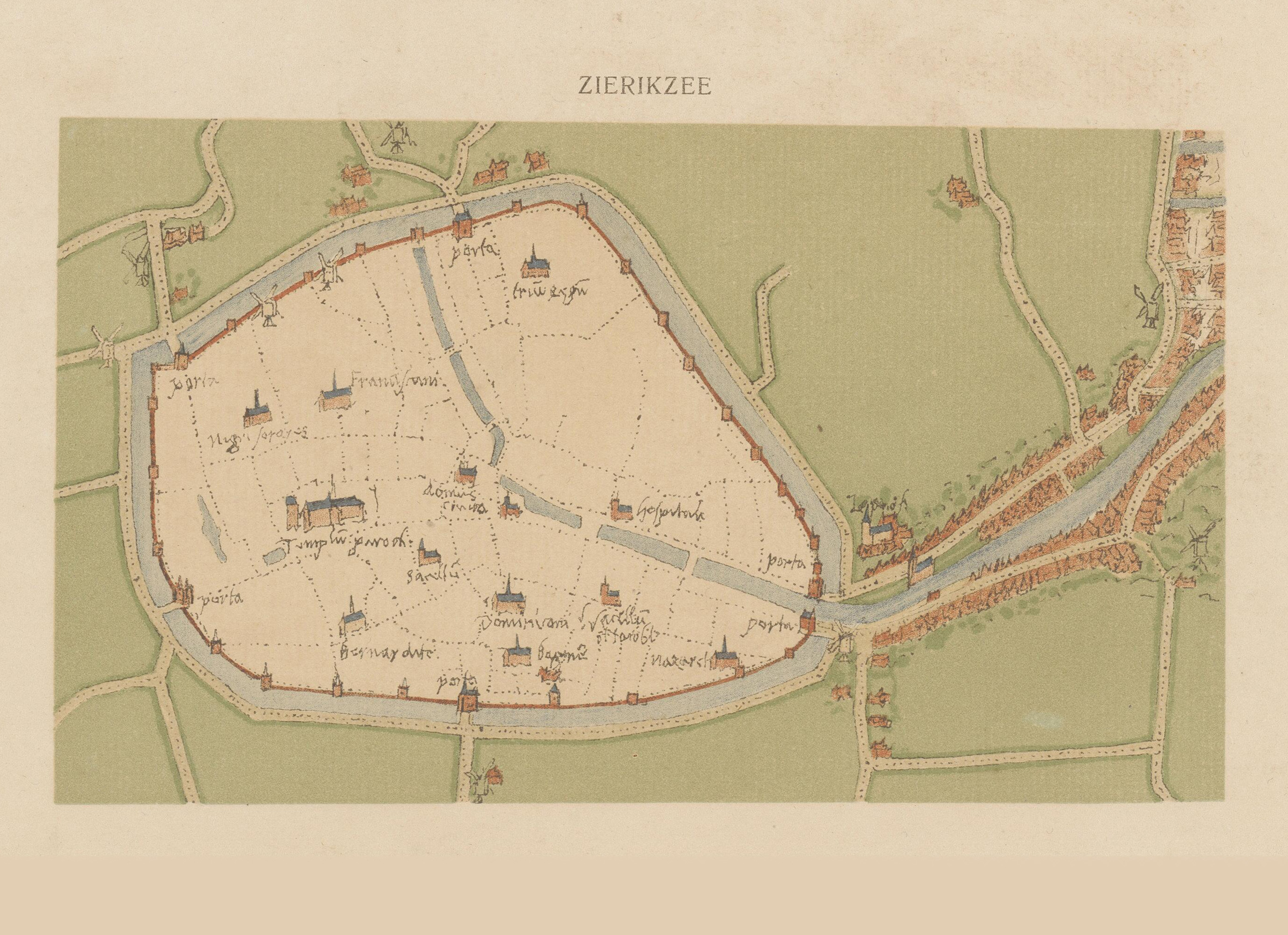
Siege of Zierikzee (1351)
He set up his tent at Borrendamme, just south of the city walls, in the heat of mid-August. The Antwerp chronicler Jan van Boendale wrote it bluntly: William "chased his mother from Zierikzee with his army." The mother was Margaret II, Countess of Hainaut. The son was William V of Holland. The city between them was Zierikzee, the last loyal Hook stronghold in a war that pitted parent against child and split the Low Countries down the middle for the next century and a half.
A Succession That Went Wrong
When Count William IV of Holland died childless in battle in 1345, the title passed to his older sister Margaret. She was already Countess of Hainaut by inheritance, already busy in the southern courts, so she appointed her own son William as her lieutenant in Holland and Zeeland. It was meant to be a tidy arrangement: the formidable mother retained sovereignty, the ambitious son ran the day-to-day. It did not stay tidy. Within a few years the cities of Holland - Delft, Leiden, Haarlem - were growing rich on cloth and herring and they wanted real political weight. The conservative nobility wanted to keep them in line. Two factions hardened around the rival claims of mother and son: the Hooks (Hoeken), the nobles' party, behind Margaret, and the Cods (Kabeljauwen), the urban party, behind William. The names probably started as insults - hooks for what fishermen use, cods for what they catch - and somehow stuck for the rest of the Middle Ages.
Last Loyal City
When the cities of Holland rose in revolt in August 1350 declaring William their lawful sovereign, almost everyone joined them. Almost. The County of Zeeland held back. Zierikzee and Middelburg both kept the Hook side, and Margaret came to Zierikzee personally to be acclaimed Countess of Zeeland by the city council. From there she rode south to Middelburg in January 1351 to gather oaths of loyalty from the Zeeland nobility. For a moment, things looked solid. Then the news arrived: her son was free of his Hainaut captivity, the Cod party had its head back, and the revolt was about to widen. Margaret left for England to enlist the help of King Edward III, taking the councils of Dordrecht, Middelburg, and Zierikzee with her. It was a fatal trip. With her gone, Dordrecht switched sides on 16 April. Then the powerful Wolfert III van Borselen defected, and Middelburg followed him. Of all the cities that had been hers, only Zierikzee remained - holding out across the salt water of the Eastern Scheldt, with Margaret's younger son Louis inside its walls.
The Tent at Borrendamme
Margaret rushed back from England to save what she could. In late spring her English ally Walter de Manny landed a fleet but failed to retake Middelburg; the citizens chased him out. On 3-5 July her army was crushed at the naval Battle of Zwartewaal. She fled - or returned, depending on which chronicler you read - to Zierikzee one last time, settled her affairs, and continued home to Hainaut. Now it was William's turn. On 5 August 1351 he wrote from Reimerswaal offering safe-conduct to sixty Zierikzee citizens to come hear why he was their rightful lord. They did not come. On 17 August he was outside the city in his tent at Borrendamme - a village long since lost to the sea, just south of the city walls. He brought an army. He brought a banner. And he brought a treaty. On 21 August the council of Zierikzee signed it: a six-week truce. If Margaret did not relieve the city by 2 October, the gates would open and Zierikzee would acclaim William as their lord. Margaret did not come. She could not.
The Cease-Fire That Made a Country
On 8 October 1351, William V entered Zierikzee as its sovereign. The treaty had been a remarkable document - not the brutal sack a medieval siege so often produced, but a careful diplomatic instrument. The citizens kept their property and their lives. The southern Zeelanders sheltering in the city were forbidden from going to Walcheren during the truce. Debts that Margaret had contracted to the city were spelled out and protected. A blockading force remained but the citizens could still use their lands. This was, in a sense, a siege that did not need to be a siege - because both sides had already lost more than the city was worth. Margaret retreated to Hainaut. The first Hook and Cod War effectively ended, although the underlying conflict would smoulder on for nearly a century and a half, until the consolidations of the Burgundian dukes and the Habsburgs finally swallowed both factions whole. Curiously, Dutch historians forgot about the 1351 siege almost entirely. It was rediscovered only in the 1770s, when a scholar named Marinus Jan de Jonge found the treaty buried in the Zierikzee municipal archives - a son's bloodless conquest of his mother's last city, hiding in plain sight for four centuries.
From the Air
Located at 51.65°N, 3.92°E on the island of Schouwen-Duiveland in Zeeland. The village of Borrendamme - William's siege camp - is gone, washed away or polderized long ago; its approximate site lies just south of modern Zierikzee. The city itself preserves remarkable medieval fabric: the squat Noordhavenpoort and the slender Nobelpoort still mark the old walls, and the massive unfinished tower of the Sint-Lievensmonsterkerk dominates the skyline. The Oosterscheldekering storm surge barrier sits offshore to the north. Nearest airports: Rotterdam-The Hague (EHRD) and Antwerp (EBAW). Best viewed at low altitude in clear light to pick out the medieval street pattern inside the old walls.