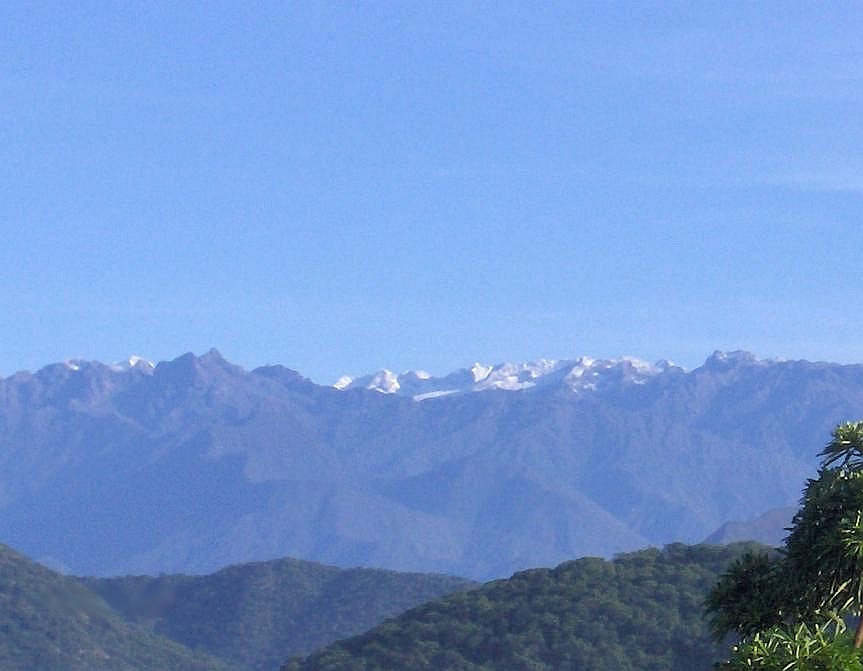
Sierra Nevada de Santa Marta
The longest confirmed line of sight between two points on Earth's surface -- just over 500 kilometers -- stretches from the Sierra Nevada de Santa Marta to Cerro Paramillo in Antioquia. That a coastal mountain range in Colombia holds this record hints at something extraordinary about the place. Rising from Caribbean beaches to approximately 5,700 meters in a horizontal distance of only 42 kilometers, the Sierra Nevada is the highest coastal range in the tropics and the tallest in the world after the Saint Elias Mountains in Canada. It is also completely alone: surrounded on all sides by lowlands below 200 meters, severed from the Andes by a gap no ridge can bridge.
An Ark Surrounded by Lowlands
The Sierra Nevada de Santa Marta covers approximately 17,000 square kilometers across the Colombian departments of Magdalena, Cesar, and La Guajira. Its isolation from the main Andean chain is not merely geographic but evolutionary. Species that arrived on its slopes millions of years ago have been evolving independently ever since, sealed off by the warm lowlands below as effectively as island species are sealed off by ocean. The result is staggering endemism. The range shelters 628 recorded bird species, dozens of endemic amphibians and reptiles, and mammals found nowhere else -- including the critically endangered red-crested tree-rat, unseen from 1898 to 2011. Its highest point ranks as the world's fifth most topographically prominent summit. Thirty-six rivers begin on its flanks, feeding the agriculture and cities of northern Colombia.
Heart of the World
Four indigenous groups -- the Kogi, Arhuaco, Wiwa, and Kankuamo -- inhabit the Sierra Nevada, tracing their ancestry to the pre-Hispanic Tairona civilization. Together they number roughly 30,000 people. In their shared cosmology, the Sierra Nevada is the heart of the world, and its health determines the health of the planet. The Kogi, perhaps the most well-known of the four groups, refer to themselves as "Elder Brothers" and to outsiders as "Younger Brothers" who have forgotten how to care for the Earth. Their spiritual leaders, called Mamas, undergo training that can last eighteen years in darkened huts, learning to read the mountain's ecological and spiritual balance. The "Black Line" -- a boundary connecting sacred sites around the range -- defines the territory they consider essential for maintaining that balance. In 2022, a new management agreement between the Colombian parks authority and the four indigenous nations expanded the national park by nearly twenty percent.
Ciudad Perdida and the Tairona Legacy
Hidden in the Sierra Nevada's northern jungle at roughly 1,200 meters elevation lies Teyuna, known to the world as Ciudad Perdida -- the Lost City. Built by the Tairona people around 800 CE, some 650 years before Machu Picchu, the site consists of 169 stone terraces carved into the mountainside, connected by tiled roads and staircases. It was abandoned during the Spanish conquest and swallowed by jungle for centuries before treasure hunters stumbled upon it in 1972. Today the four- to six-day trek to Ciudad Perdida is one of Colombia's premier adventure routes, winding through river crossings, indigenous villages, and dense tropical forest. The Kogi and Wiwa communities along the trail maintain a wary relationship with tourism, permitting access while guarding the deeper significance of their ancestral territory.
Vertical Ecology
Few places on Earth compress as many ecosystems into as short a vertical distance. The Sierra Nevada's lower slopes hold tropical rainforest with a canopy reaching 30 meters, thick with epiphytes and lianas. Indigenous communities at lower elevations have traditionally made an alcoholic beverage from the maripa palm fruit. Higher up, cloud forest gives way to paramo -- the treeless, wind-scoured grassland above 3,000 meters that acts as a hydrological sponge, absorbing rainfall and releasing it slowly to the rivers below. Above the paramo, permanent snowfields and glaciers cap the twin summits of Pico Cristobal Colon and Pico Simon Bolivar. Annual rainfall reaches 4,000 millimeters at mid-elevations. The temperature varies from tropical heat at sea level to freezing at the peaks. In the span of a single day's hike, the landscape transforms completely.
Pressure from All Sides
The Sierra Nevada faces threats that converge from every direction. Over the past fifty years, its forests have been reduced to less than twenty percent of their original extent. Two of its thirty-six rivers have dried up. A total of 251 mineral concessions, plus hydroelectric projects, agriculture, and urban sprawl press against its boundaries. Armed conflict disrupted access and conservation efforts for decades; though the 2016 peace process brought some stability, tensions persist. Climate change is shrinking the glaciers that feed the rivers and pushing ecological zones upslope, compressing the habitat of endemic species. Yet the Sierra Nevada endures. The IUCN has identified it as one of the world's most irreplaceable protected areas, and the indigenous communities who have guarded it for centuries remain its most persistent advocates.
From the Air
Located at 10.87N, 73.72W in northern Colombia. The Sierra Nevada de Santa Marta is unmistakable from the air: a massive, isolated triangular massif rising from the Caribbean coast with snow-capped peaks visible above tropical forest. The nearest major airport is Simon Bolivar International Airport (SKSM) in Santa Marta. Approaching from the north over the Caribbean provides the most dramatic view -- the range jumps from sea level to nearly 5,700 meters. Expect turbulence and cloud buildup over the slopes, especially in the afternoon. The Lost City (Ciudad Perdida) is not visible from the air due to dense jungle canopy.