SIEV X
The boat had no name, only a bureaucratic designation: SIEV X, for Suspected Irregular Entry Vessel, with the X standing in because nobody had bothered to assign a tracking number. On 19 October 2001, that anonymous vessel sank in the waters south of Java, carrying 421 people who had paid smugglers for passage to Christmas Island and, they hoped, to a new life in Australia. Three hundred and fifty-three of them drowned -- 146 children, 142 women, and 65 men -- making it one of the deadliest maritime disasters in the region's modern history. The boat was 19.5 meters long and 4 meters wide. It was never meant to carry more than a fraction of the souls packed aboard it.
A Political Storm at Sea
The timing of the sinking was as devastating as the event itself. Australia was in the middle of a federal election campaign, and the question of asylum seekers arriving by boat had become the defining political issue of the moment. The Tampa affair, in which the Norwegian freighter MV Tampa had rescued 433 asylum seekers only to be refused entry to Australian waters, had electrified the national debate just weeks earlier. Prime Minister John Howard had staked his campaign on a promise to "stop the boats," and his government had deployed the Royal Australian Navy and the Australian Federal Police to intercept vessels and disrupt people-smuggling networks. Into this charged atmosphere came news of the sinking -- a catastrophe that occurred not in some distant ocean but within the zone where Australian surveillance operations were actively running.
Nineteen Meters of Desperation
The fishing boat departed Bandar Lampung, on the southern tip of Sumatra, on 18 October 2001. By the following day, it had encountered a storm roughly 70 kilometers south of Java. The area fell within Indonesia's Exclusive Economic Zone and its internationally designated search-and-rescue zone. It also overlapped with a temporary Australian border protection surveillance area established around Christmas Island, some 1,700 kilometers from the Australian mainland. That surveillance zone was an internal planning tool, carrying no legal obligation under international law, but its existence raised uncomfortable questions about what Australian authorities knew and when they knew it. The boat broke apart. Of the 421 people aboard, only 45 survived. On 20 October, an Indonesian fishing vessel called the Indah Jaya Makmur pulled 44 survivors from the water. A 45th was rescued roughly twelve hours later by another boat, the Surya Terang.
Three Days of Silence
What troubled investigators was not just the scale of the disaster but the gap between the sinking and its discovery. Three days passed before Australian authorities acknowledged what had happened. The Australian Senate Select Committee, convened in February 2002 to investigate a range of maritime incidents involving asylum seekers, took up the SIEV X case alongside the separate "children overboard" affair. The committee found it "extraordinary that a major human disaster could occur in the vicinity of a theatre of intensive Australian operations and remain undetected until three days after the event, without any concern being raised within intelligence and decision making circles." No government department was formally blamed, but the committee expressed surprise that no internal investigation had examined whether systemic failures might have allowed the disaster to go unnoticed -- or whether earlier intervention could have prevented it.
The Weight of 353 Poles
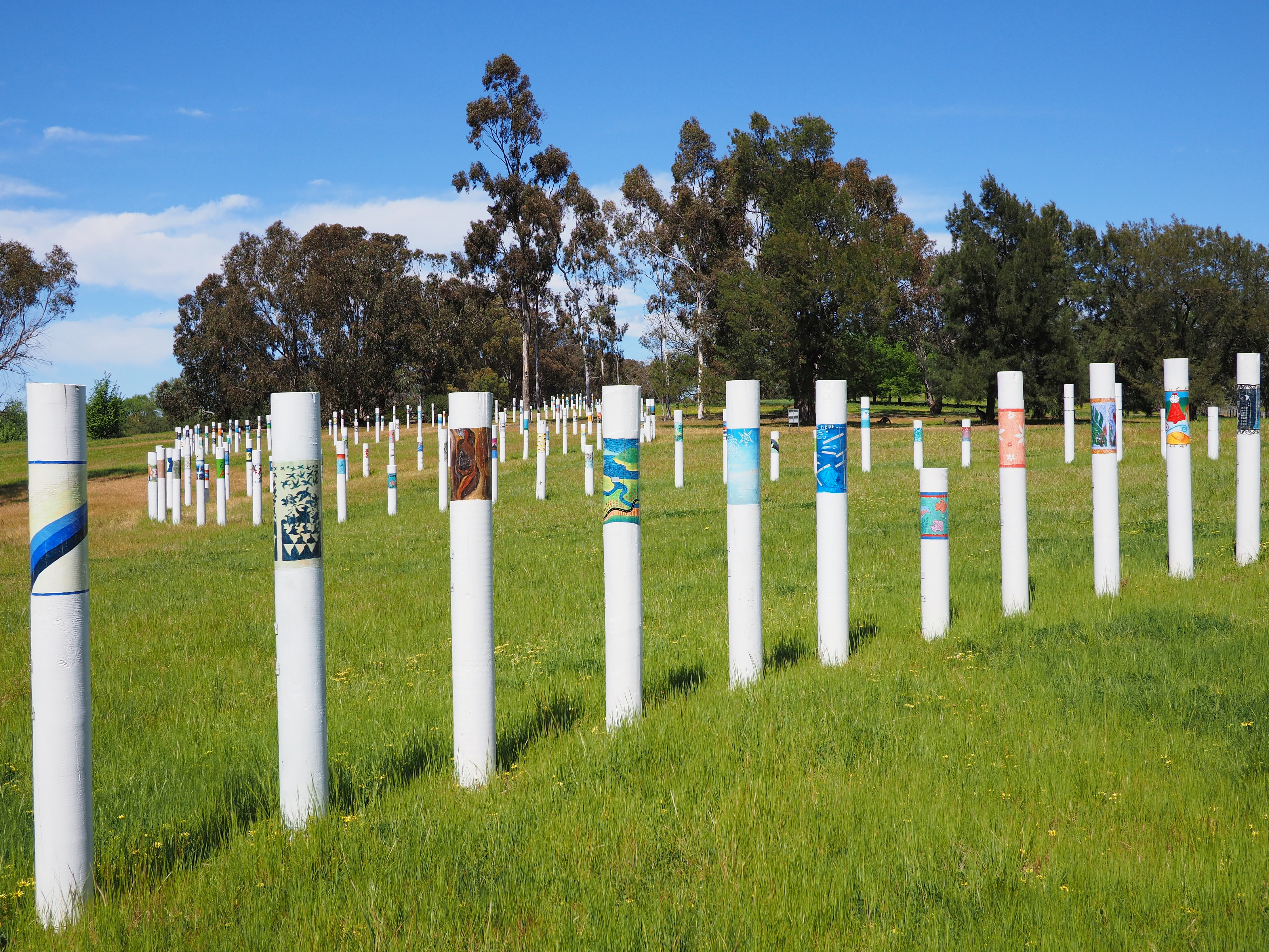
In Canberra, at Weston Park along the shores of Lake Burley Griffin, 353 white poles stand in rows across the grass. Each one represents a person who died on SIEV X, and each was decorated by a different school, church, or community group from across Australia. The memorial began as a collaboration between child psychologist Steve Biddulph and the Uniting Church, and the temporary installation went up on 15 September 2006. ACT Chief Minister Jon Stanhope opened it, but the Howard government attempted to block its construction, with the National Capital Authority claiming it was an unapproved structure. The permanent memorial, involving over a thousand student and community artists, was dedicated in October 2007. In Melbourne, three poles of differing heights -- for the children, the women, and the men -- stand at Manningham Uniting Church in Templestowe. On Christmas Island itself, a memorial occupies the grounds of the Administrator's House, near the very shore the passengers had been trying to reach.
What the Waters Remember
The Sunda Strait and the waters south of Java remain one of the world's most active corridors for irregular maritime migration. The International Organization for Migration noted after the sinking that such a disaster had been foreseeable given "the way the people smugglers pack these boats." SIEV X became a touchstone in Australia's long national argument over asylum policy, border security, and the obligations owed to people fleeing persecution. The debate has never fully resolved. But the poles in Weston Park endure, leaning slightly in the wind, each one bearing the name or image a stranger chose to represent a person they never met -- a gesture of recognition for lives that, in the bureaucratic shorthand of their final journey, had been reduced to a letter and a variable.
From the Air
Located at approximately 10.17S, 106.23E in the waters south of Java, Indonesia. The sinking occurred roughly 70 km south of the Javanese coast, in the approaches to Christmas Island. Nearest major airport is Halim Perdanakusuma (WIHH) in Jakarta, approximately 150 km to the northeast. Christmas Island Airport (YPXM) lies roughly 350 km to the south. The area is open ocean with no visual landmarks at the precise site. Recommended viewing altitude: 15,000-25,000 ft for perspective on the vast distance between Java and Christmas Island.