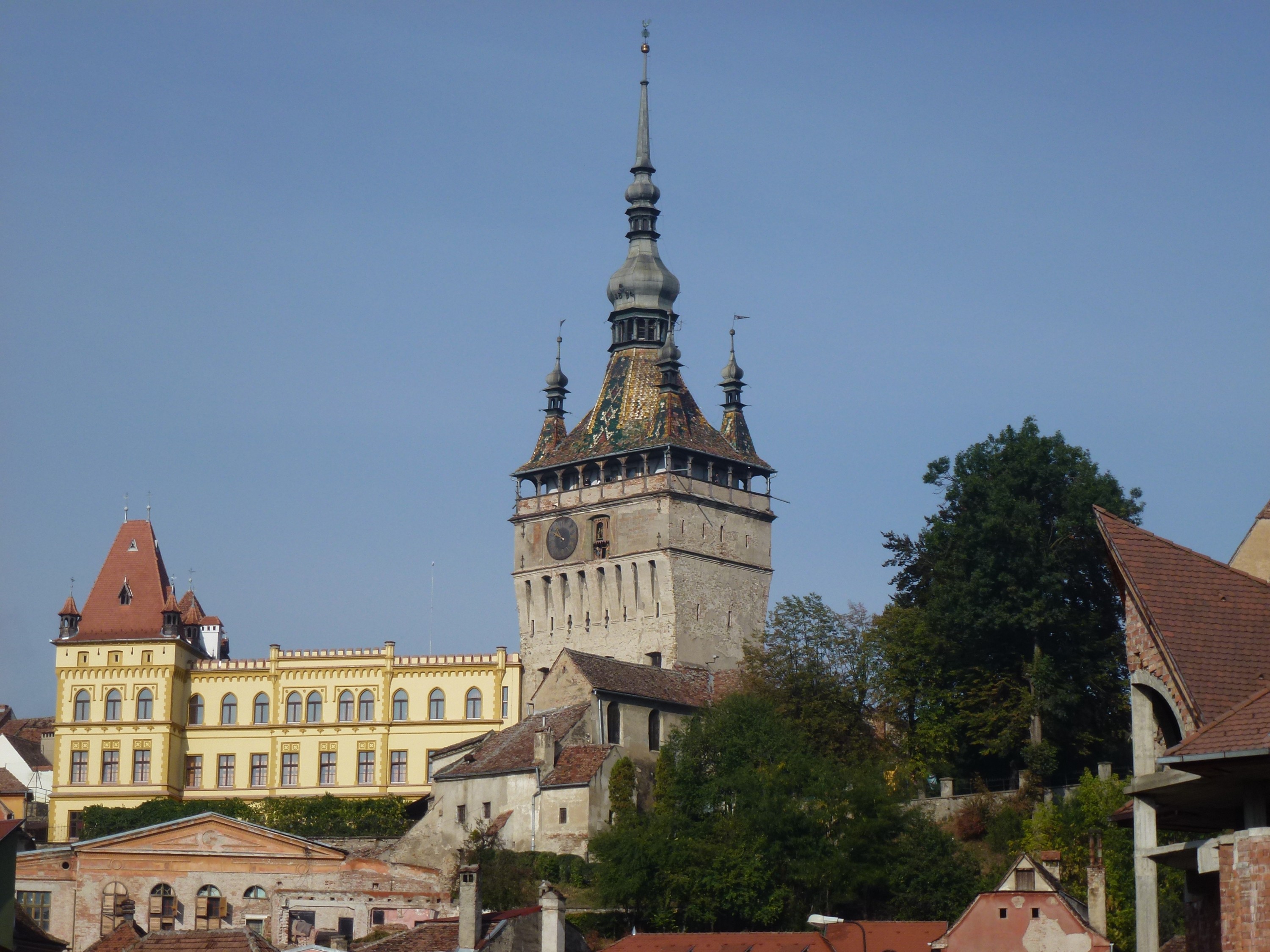
Sighișoara Clock Tower
Every night at midnight, a wooden platform hidden behind an ornamental window creaks a few degrees to the right. By morning, citizens of Sighișoara look up from the lower town to see a new carved figure gazing back at them through the fretwork: Sunday's golden-haloed sun goddess, Monday's bow-wielding Diana, or perhaps Saturn with his mysterious wooden leg. This nightly rotation has continued for centuries in the Clock Tower, the 64-meter sentinel that guards the main gate of one of Europe's best-preserved medieval walled cities. Listed as UNESCO World Heritage Site No. 902, the tower is not merely a clock or a gateway. It is a compendium of medieval thought rendered in sandstone, brick, and painted wood -- where timekeeping, alchemy, mythology, and civic authority all occupy the same structure.
Built from River Rock and Ambition
Construction began at the end of the 13th century, when the tower rose as a simple gate with sandstone and river-rock walls 2.35 meters thick at the base. It probably looked much like the Tailors' Tower standing opposite. In the 16th century, workers demolished the old roof, added two brick floors, and installed a balcony. Then came the great fire of 1676, which gutted the structure. Three travelling master craftsmen -- Veit Gruber from Tyrol, Philip Bong from Salzburg, and a carpenter known only as Valentinus "the foreigner" -- rebuilt the tower between March and September 1677 for 650 florins. Their Baroque roof, crowned with five turrets and onion bulbs, is now taller than the tower beneath it: 34 meters of roof perched on 30 meters of masonry. The four corner turrets are not decoration. They signaled to all who approached that Sighișoara's judge held the power to pronounce and execute capital sentences.
A Language of Figures
The tower's two clock faces -- each 2.3 meters in diameter, with hand-painted black and gold numerals -- look in opposite directions: one toward the upper walled city, one toward the lower town. Flanking each dial are niches filled with carved symbolic figures. On the upper-city side, Pax holds an olive branch and trumpet. Below her, a little drummer strikes a bronze drum. Justice stands blindfolded with her sword, while Righteousness grips a pair of scales. Above them, two angels representing Day and Night balance on a metal pivot. Day carries a flaming heart; Night holds a torch in each hand. They once marked the 12-hour working day for the city's craftsmen, appearing at six in the morning and six in the evening. On the lower-city face, a second drummer is paired with a figure believed to be an executioner, likely holding a whip and axe as a warning to outlaws.
Gods, Planets, and Metals
Behind the lower-city window, the rotating platform holds seven wooden figures that are far more than a weekly calendar. Each figure embodies a day of the week, a Greco-Roman god, one of the seven classical planets, and a corresponding alchemical metal. Sunday is female -- because in German, the sun is feminine, die Sonne -- wearing a gold circle with rays, the symbol for gold. Monday carries the crescent moon and a bow, playing Diana the huntress, standing for silver. Tuesday wears a helmet and spear: Mars, the god of iron. Wednesday is Hermes with his caduceus and money bag, wings on his boots, representing mercury or quicksilver. Thursday's Jupiter wears an ermine cloak and golden crown, foot planted on a globe, bearing the alchemical symbol for tin. Friday's Aphrodite gazes into her mirror, marked with the sign of copper. And Saturday's Saturn -- father of the old gods, Cronos who swallowed his children -- stands half-naked with the mark of lead on his head and an unexplained wooden prosthetic leg.
Watchtower, Town Hall, Museum
Unlike every other tower in Sighișoara, which belonged to and was defended by a specific craft guild, the Clock Tower was always a public asset. It housed the municipal administration and, during holidays, the city orchestra. Its balcony served a vital practical function: from that height, fire spotters could scan the rooftops and direct emergency crews to the nearest of nine water sources scattered across the citadel. Water was desperately scarce -- wells had to be dug 35 meters deep to reach it. Since 1898, the tower has served as the History Museum of Sighișoara. In 1964, the clock mechanism received an electric motor, though the archaic appearance was carefully preserved. The golden sphere at the roof's apex, one meter in diameter, still catches the light above the medieval skyline, a symbol of public authority visible from every corner of the city.
From the Air
The Sighișoara Clock Tower stands at 46.219°N, 24.793°E, rising 64 meters above the medieval citadel. From 3,000-5,000 feet AGL, the walled upper town is clearly visible as an oval of rooftops on a hilltop above the Târnava Mare river valley. The Baroque roof with its five turrets and onion bulbs is a distinctive landmark. The nearest airport is Târgu Mureș International Airport (LRTM), approximately 30 nm northwest. Weather in the Transylvanian plateau is continental, with frequent fog in the river valley during autumn and winter months.