Signal Hill, California
Signal Hill is a city that shouldn't exist. Two-point-two square miles, completely surrounded by Long Beach on all sides, incorporated in 1924 specifically to prevent Long Beach from annexing the oil wealth that had erupted beneath it three years earlier. The city exists because of oil, incorporated by the landowners who wanted to control their own tax base. It elected the first female mayor in California history — Jessie Nelson, 1924 — which is a remarkable footnote to a civic founding whose primary motivation was financial self-interest. Signal Hill has always been more complicated than it looks.
What the Tongva Saw
Before the Spanish arrived, before the oil was discovered, before Buster Keaton filmed chase sequences on the slopes, the hill was a navigation point. The Tongva people who lived throughout the Los Angeles Basin used Signal Hill's high ground as a signal fire site — fires lit here were visible twenty-six miles across the water to the Tongva village on Catalina Island. The name the Americans gave the hill — Signal Hill — preserved, without crediting, a communication system that had functioned for generations before European contact. The hilltop offered a clear line of sight in every direction: mountains to the north, ocean to the west, harbor to the south. It was an obvious place to stand and be seen.
Before the Oil: Citrus and Comedians
For several decades before 1921, Signal Hill was agricultural land, primarily citrus groves. The gentle slopes that had served as a Tongva signal point were well-suited to the dry-farmed orchards of the late nineteenth century. The hill also attracted film crews from early Hollywood: Buster Keaton shot scenes there, as did Roscoe 'Fatty' Arbuckle, taking advantage of the open slopes and the panoramic views. The Southern California film industry, still finding its locations in the 1910s and early 1920s, discovered that Signal Hill's terrain offered both dramatic backdrops and convenient proximity to the studios developing in Los Angeles.
The Gusher
June 23, 1921: the Alamitos No. 1 well, drilled by Shell Oil Company on Signal Hill's crest, struck the Miocene limestone formation. The pressure built for two days. On June 25, oil erupted 114 feet above the derrick floor. The gusher was visible for miles. Within weeks, the surrounding land was under frantic lease negotiation. Within months, derricks covered the hill in the dense forest that gave rise to the nickname 'Porcupine Hill.' Signal Hill became the center of the most productive new oil field California had seen — part of the Long Beach Oil Field that would eventually account for a fifth of the world's oil output during its 1920s peak.
Incorporation and the First Woman Mayor
Signal Hill incorporated as an independent city on April 22, 1924, three years after the gusher. The motivation was transparent: the oil-producing landowners on the hill wanted to control their own tax revenue and zoning, rather than having Long Beach annex the land and claim the income. The new city's first election produced something no one had expected: Jessie Nelson was elected mayor, becoming the first female mayor in California history. That Signal Hill — a city that existed primarily because of its oil wealth — produced California's first female mayor is one of the more improbable facts in the state's political history. Nelson served one term.
The Hill After the Oil
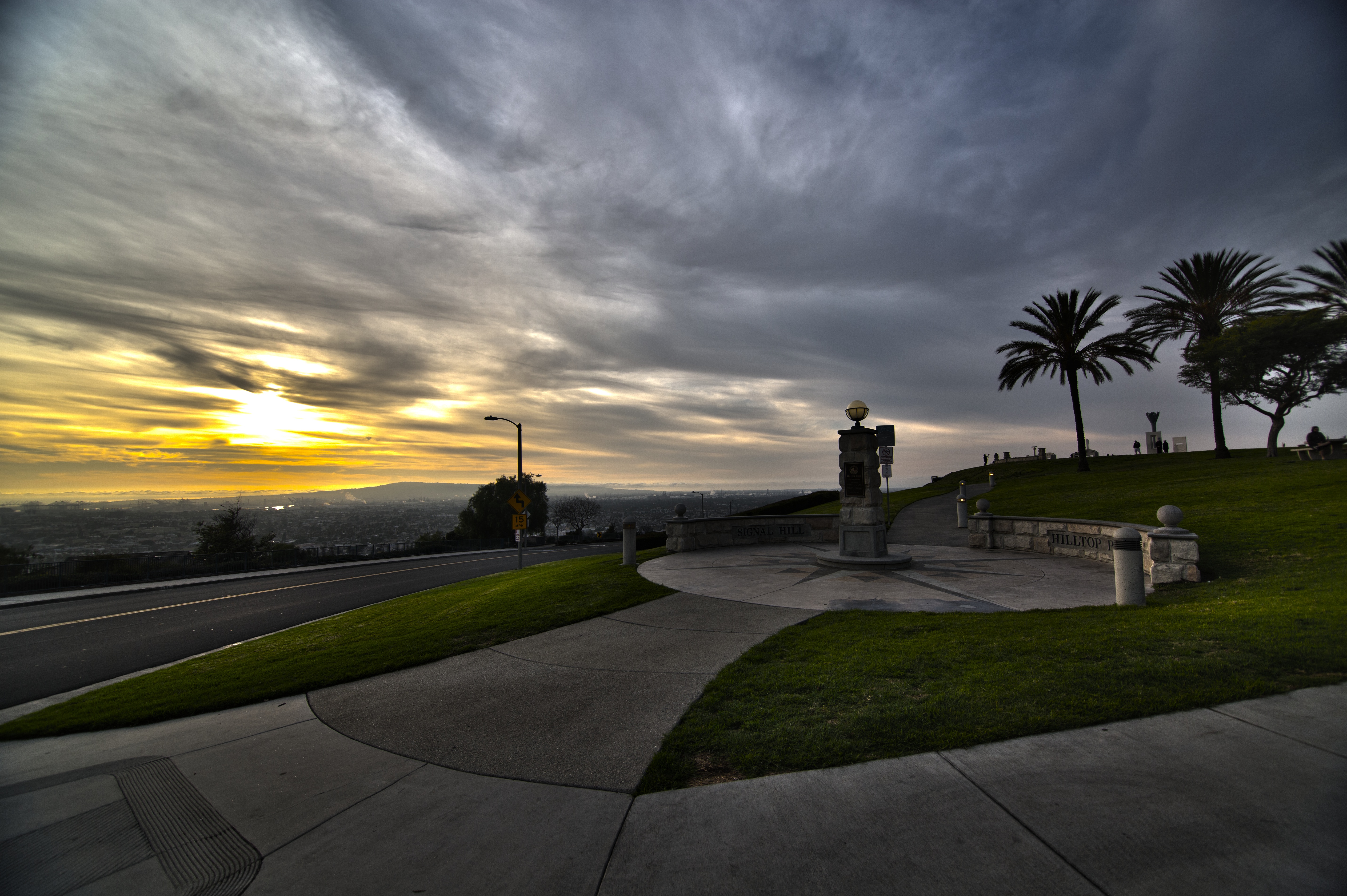
Signal Hill today is a quiet residential enclave on a hilltop, the derricks long gone, replaced by houses with views that the oil companies' crews would have recognized. The last major producing wells on the hill itself were capped decades ago, though the Long Beach Oil Field continues to produce offshore. The city maintains its independence from Long Beach, still surrounded on all sides, still governing its own affairs. Hilltop Park at the summit marks the spot where signal fires once burned and where the Alamitos No. 1 gusher once changed the world. The view from the top remains what it always was: mountains, harbor, city, sea.
From the Air
Located at approximately 33.80°N, 118.17°W, Signal Hill is a distinct elevated enclave completely surrounded by Long Beach. The hill is identifiable from altitude as an elevated residential area rising above the Long Beach grid. Long Beach Airport (KLGB) is approximately 2 miles north. The offshore oil islands in Long Beach Harbor are visible to the southwest. Approach from the west over the harbor for best orientation to Signal Hill's position relative to the Long Beach waterfront.