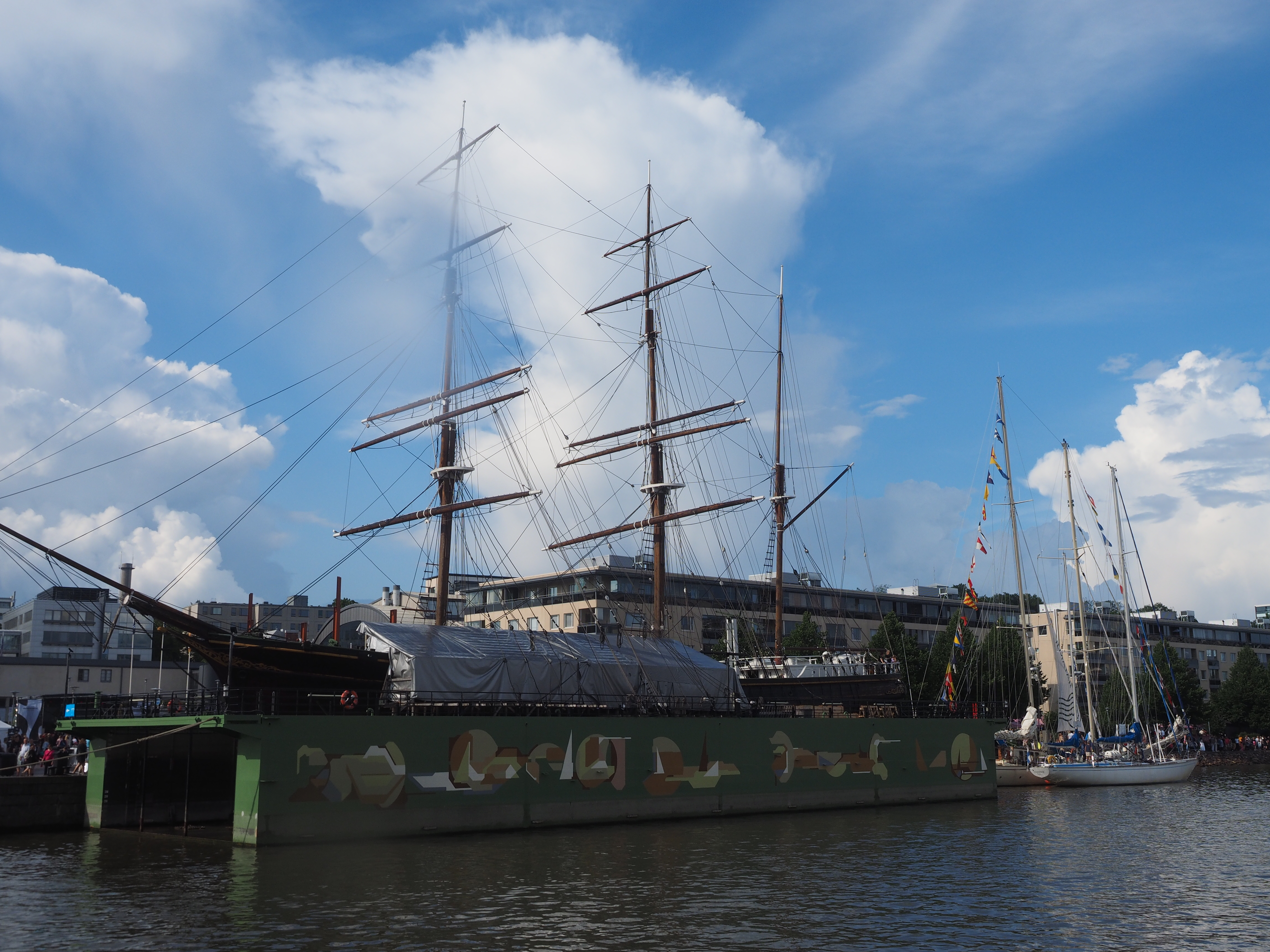
Sigyn (ship)
Of the thousands of wooden barques that once filled the world's harbors, only one remains that sailed the open oceans. The Sigyn floats quietly in Turku's Aura River today, her masts reaching toward the Finnish sky, but those timbers have known Bangkok's humidity, Norwegian storms, and the salt spray of a dozen Atlantic crossings. Built in Gothenburg in 1887, she arrived at the tail end of an era when skilled craftsmen still shaped pine and spruce into vessels that could circle the globe. The steam ships were already winning. The Suez Canal had opened nearly two decades earlier. Yet someone decided the world still needed one more wooden barque, small enough to slip into harbors the big ships couldn't reach, sturdy enough to carry cargo wherever there was profit to be made.
A Wanderer's Life
For her first decade, Sigyn worked the Atlantic as a tramp trader, going wherever cargo needed moving. Her holds carried pine and spruce from Scandinavian forests, pitch pine and mahogany from distant shores, coal for hungry furnaces, and once, improbably, hay. In 1897, she made her most exotic voyage, sailing all the way to Bangkok. After 1900, she settled into shorter routes around European waters, a working ship doing working-class jobs. Then came 1913 and a storm off Kristiansand that nearly ended everything. The damage was severe enough that her owners rerigged her as a barquentine, a cheaper configuration suited to coastal trade. They were preparing her for retirement. But wars have a way of disrupting plans, and suddenly transatlantic shipping became extraordinarily profitable. The aging wooden ship crossed the Atlantic twelve times in 1915 and 1916 alone.
The Peasant Shipowners
After Sigyn ran aground in 1917, her owners stripped and sold the copper hooding that protected her hull from shipworms, effectively ending her ocean career. She passed to a Swedish sawmill, then in 1927 was sold to Finland, as sailing ships often were in those days when richer countries were abandoning wood and canvas for steel and steam. Her buyer was Arthur Lundqvist from Vardoe in the Aland islands, one of the last great peasant shipowners. This was a distinctive Finnish tradition where farming families pooled resources to own shares in sailing vessels, creating small shipping dynasties that bridged the gap between the old world of sail and the new world of mechanized transport. The Lundqvist family shipping companies still exist today, a living link to that transitional era.
From Freighter to Treasure
In 1936, Otto Andersson, rector of Abo Akademi university, proposed something radical for Finland: a maritime museum with a real ship at its center. At that time, museum ships were rare anywhere in the world. Sigyn, still working but clearly near the end of her commercial life, was identified as the best candidate. The purchase happened in 1939, and Sigyn opened to the public on June 3rd of that year, becoming Finland's first museum ship. Within months, the Winter War erupted, followed by the Continuation War. Soviet incendiary bombs damaged her, and the struggle to maintain an aging wooden ship with no funds and few workers seemed hopeless.
Survival Against the Odds
After the wars, there were serious discussions about sending Sigyn back to sea as a merchant vessel to earn her own keep during the postwar shipping shortage. The proposal was eventually rejected as too risky, and donated money paid for repairs instead. She reopened to visitors in 1948 and even sailed again briefly in 1950, appearing in the Finnish film Laivan kannella off Turku. Her hull was partially renewed in the 1970s, but by 1994 constant flexing had weakened her structure so badly that a special floating dock called Loke was built to support her. The most extensive restoration came between 1998 and 2001 at Sjokvarteret in Mariehamn, where craftsmen who had built other wooden ships applied their knowledge to saving this last survivor of the ocean-going barques.
The Last of Her Kind
Today Sigyn rests at Forum Marinum in the Aura River, restored once more to her original barque rigging. Her small size, once a practical necessity for reaching remote harbors, now seems almost intimate compared to the massive cargo vessels of the modern era. She represents not just Finnish maritime heritage but a global moment of transition, when the ancient partnership between wood, wind, and human skill gave way to iron and coal. Somewhere in her timbers is the memory of tropical ports and North Atlantic gales, of cargo holds filled with exotic woods and mundane coal, of a world where a well-built wooden ship could still make her way across any ocean on earth.
From the Air
Located at 60.44°N, 22.24°E on the Aura River in Turku, Finland. The ship is moored at Forum Marinum near the mouth of the river where it meets the Baltic Sea. Best viewed from low altitude following the river through Turku. Nearby airport: Turku Airport (EFTU), approximately 8 km north of the city center. The masts are visible against the riverfront when approaching from the southwest.