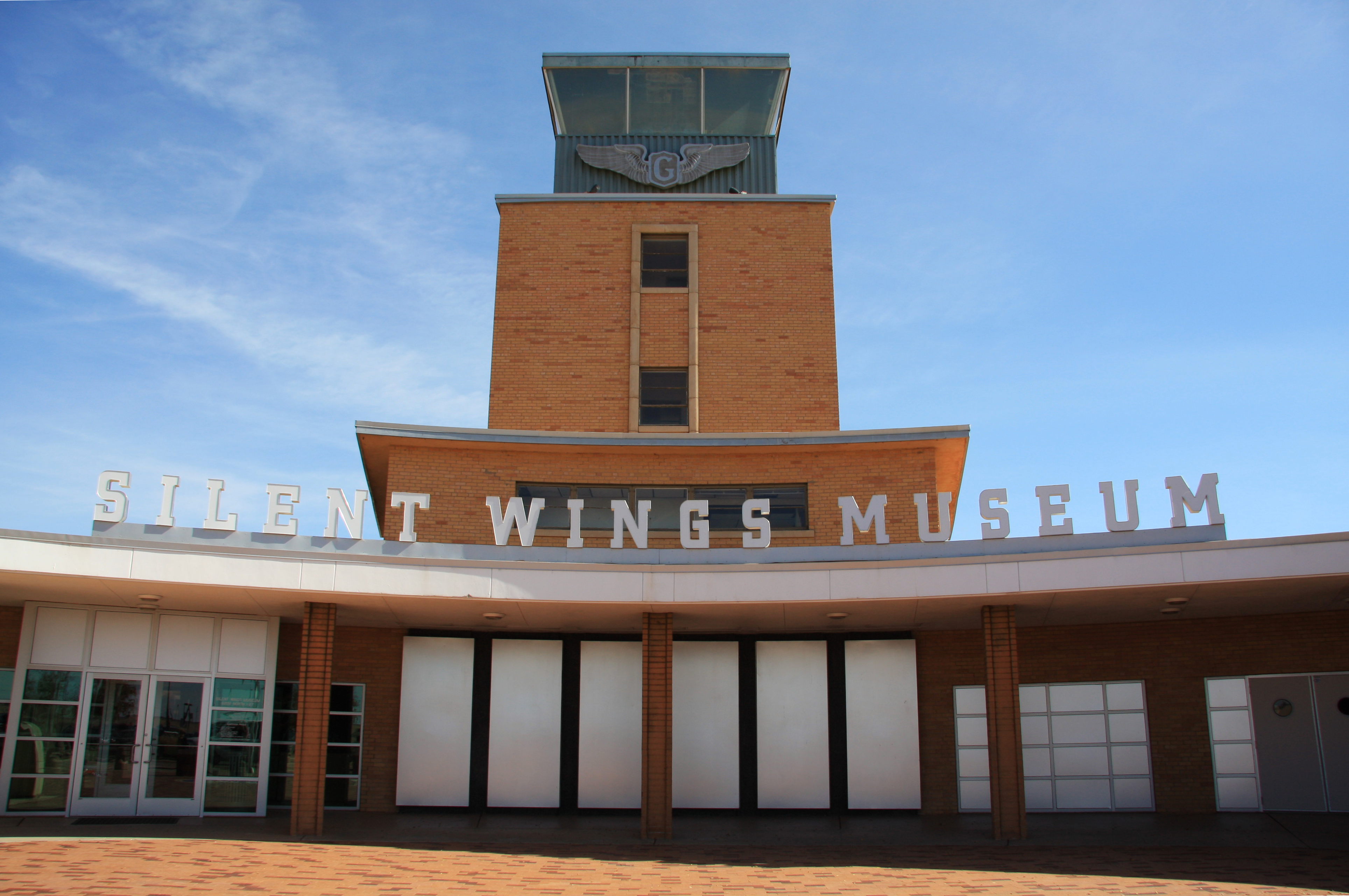
Silent Wings Museum
They called them silent wings because they had no engines, no telltale roar to warn the enemy below. During World War II, American glider pilots flew WACO CG-4A aircraft loaded with soldiers and supplies behind German lines in Normandy, Sicily, and the Rhine crossing, landing on fields that powered aircraft could never reach. More than a thousand of these pilots trained at South Plains Army Air Field outside Lubbock, Texas, drawn by the dry climate, clear skies, and thermal currents that rise from the arid land. When the war ended, the gliders became surplus, scattered and forgotten. Decades later, veterans formed an association to preserve their history, and the city of Lubbock offered them a permanent home on the site where they first learned to fly without power.
The School on the South Plains
The Army chose Lubbock for its glider school in 1942 for practical reasons: warm weather, few low clouds, and the upward air currents that the High Plains generate naturally. Between 1942 and 1945, young men learned to control the enormous WACO CG-4A, a fabric-covered aircraft with an 83-foot wingspan that carried 13 troops or a Jeep. They trained to be towed behind C-47 transports at 120 miles per hour, to release at altitude, and to spiral down silently onto fields marked only by smoke grenades. After D-Day, the Army required glider pilots to also master powered flight, recognizing that the skill of landing unpowered in hostile territory demanded a complete understanding of aerodynamics. By war's end, South Plains Army Air Field had produced hundreds of combat-ready glider pilots.
The Glider on the Tire Store
After the war, the giant WACO gliders were sold as surplus for whatever anyone would pay. One ended up on top of a tire store in Fresno, California, used as advertising, its fabric rotting in the sun. In 1971, former pilots formed the National World War II Glider Pilots Association to preserve their legacy before it disappeared entirely. They learned of the Fresno glider and purchased it in 1979. Volunteers restored the aircraft piece by piece, completing the work in time for their annual reunion in Dallas. The restored CG-4A became the seed of a museum. The first Silent Wings Museum opened in Terrell, Texas, east of Dallas, on November 10, 1984.
Coming Home to Lubbock
By 1997, the Terrell museum needed a permanent home with more space and deeper connections to glider history. The city of Lubbock offered the former tower and terminal building of its 1950s airport, standing on the same land where South Plains Army Air Field once operated. The veterans agreed. The Terrell site closed in January 2001, and the new Silent Wings Museum opened that October with the restored CG-4A as its centerpiece. Today the museum features a TG-4 trainer, a British Horsa glider restoration project, barracks replicas, airborne equipment, and a theater showing a 15-minute program on the glider program. The Adams Research Library holds an extensive archive on military glider operations. A Douglas C-47 Skytrain stands outside, the type of aircraft that towed the gliders to their targets.
The Museum From Above
Silent Wings Museum occupies the former airport terminal building at 33.658N, 101.832W, on the north side of Lubbock just west of Interstate 27. The structure is recognizable by its control tower architecture, a relic of 1950s aviation design. A Douglas C-47 transport sits on the ramp in front of the building, visible from aircraft approaching or departing Lubbock Preston Smith International Airport less than two miles to the east. The museum grounds mark the approximate location of South Plains Army Air Field's glider training area. From the air, the site connects past and present: the tower where civilians once watched propeller planes now houses the story of men who flew without engines into the most dangerous missions of World War II.
From the Air
Silent Wings Museum is located at 33.658N, 101.832W on Lubbock's north side, just west of I-27. The museum occupies a distinctive 1950s-era airport terminal with control tower, easily identified by the Douglas C-47 Skytrain on display out front. Lubbock Preston Smith International Airport (KLBB) is approximately 2 nm east. The site marks the former South Plains Army Air Field where WWII glider pilots trained. Best viewed from the north or east during approach to KLBB. Clear weather typical; strong thermal activity common in summer months, the same conditions that made this ideal glider training territory.