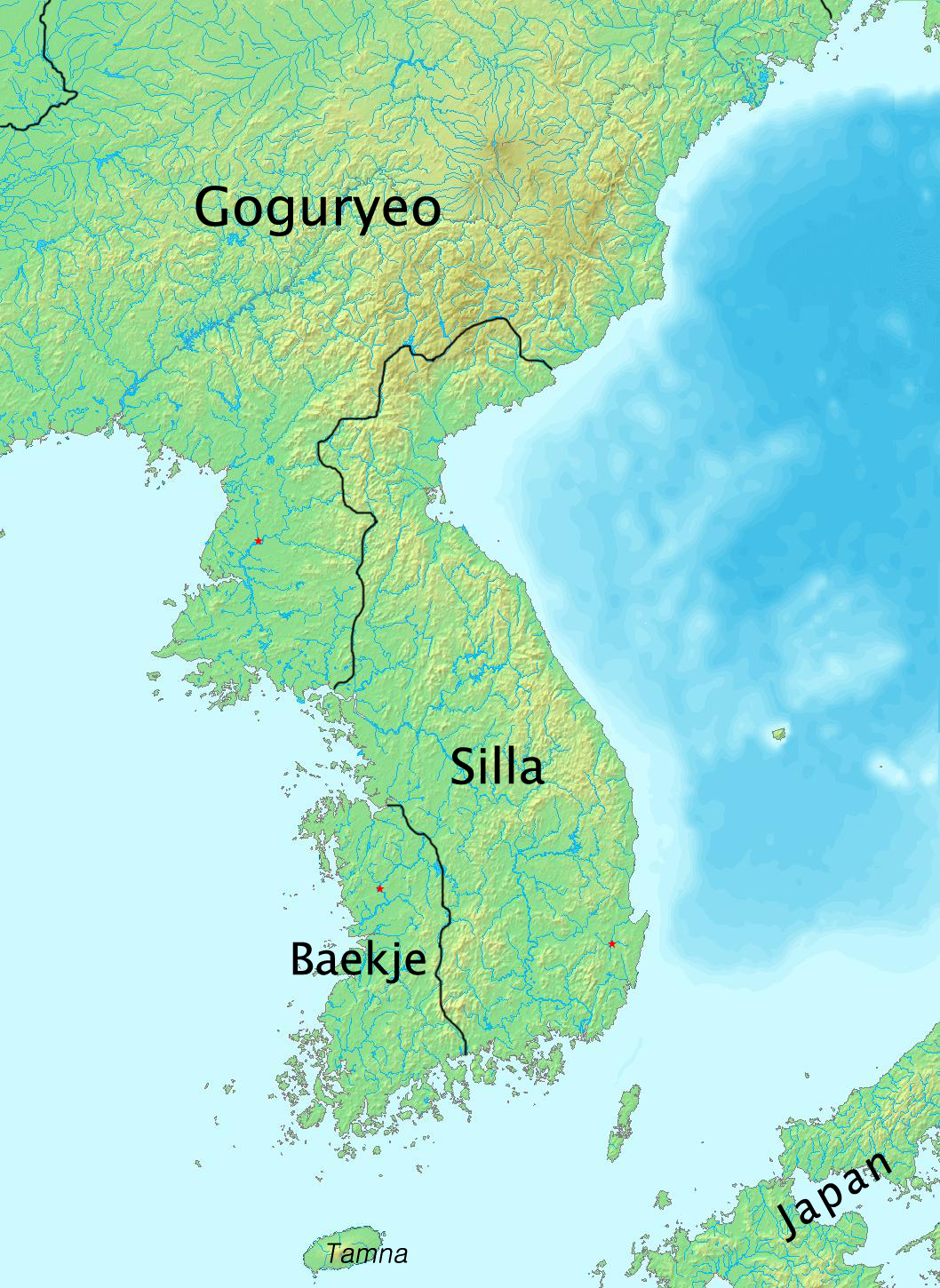
Silla
Of the Three Kingdoms that divided the Korean peninsula, Silla was the underdog. With roughly 850,000 people -- dwarfed by Baekje's 3.8 million and Goguryeo's 3.5 million -- it occupied the southeastern corner, hemmed in by mountains and cut off from direct contact with China. Its foundation mythology traces to 57 BCE and a semi-legendary figure named Hyeokgeose, whose Old Korean name meant "light of the world." For centuries, this small kingdom seemed destined to remain a regional power at best. Instead, it conquered everything.
From Chiefdom to Kingdom
Silla began as a chiefdom in the Jinhan confederacy, one of the Samhan tribal leagues that preceded Korea's Three Kingdoms era. Power rotated among three clans -- the Park, the Seok, and the Kim -- who used Old Korean titles rather than Chinese-style names for their rulers. The early title Geoseogan gave way to Chachaung, then Isageum, and finally Maripkan as the kingdom consolidated. Beginning with King Michu in the third century, the Gyeongju Kim clan secured a grip on the throne that would last 586 years. Silla's capital at Gyeongju, in the southeast of the peninsula, grew from a modest settlement into a cosmopolitan city that would eventually rival the great capitals of Tang China.
The Alliance That Won the Peninsula
Silla's strategic breakthrough came through diplomacy rather than battlefield dominance. Surrounded by enemies and too small to conquer alone, it first allied with the Sui Dynasty and then with Tang China. Together, Silla and Tang forces destroyed Baekje in 660 and Goguryeo in 668, eliminating the other two kingdoms in less than a decade. But Silla's rulers had no intention of becoming a Chinese vassal state. When Tang attempted to establish direct control over the conquered territories, Silla fought back, driving Chinese forces from the peninsula by 676. The result was Unified Silla -- a single Korean state controlling most of the peninsula south of Pyongyang, while the northern territories re-emerged as Balhae, a successor state of Goguryeo.
The Golden Kingdom of Gyeongju
At its height, Unified Silla produced a civilization of remarkable sophistication. The capital Gyeongju became a center of Buddhist art and scholarship. The Seokguram Grotto, a granite cave temple overlooking the East Sea, housed a monumental Buddha sculpted with geometrical precision. Nearby Bulguksa Temple, with its stone bridges and pagodas, represented the Buddhist paradise made tangible in architecture. The kingdom adopted a bone-rank system that organized society into hereditary classes based on bloodline, concentrating power but also creating a remarkably stable governing structure. Gold crowns, ornate jewelry, and astronomical observatories survive from this period, testifying to a culture that valued both beauty and knowledge.
Decline and the Long Shadow
By the ninth century, Unified Silla was fracturing. Provincial warlords carved out territories, and the old three-kingdom boundaries reasserted themselves in what historians call the Later Three Kingdoms period. In 935, the last king of Silla peacefully surrendered to Wang Geon, founder of the Goryeo Dynasty -- the kingdom whose name would give Korea itself its English name. Silla vanished as a political entity after 992 years, but its legacy persisted. The tomb mounds of Gyeongju still punctuate the city's landscape, grassy hills holding golden treasures beneath. The cultural unification that Silla achieved -- a shared language, shared Buddhism, shared identity across the peninsula -- proved far more durable than any single dynasty.
From the Air
The historic capital of Silla was Gyeongju, located at approximately 35.85N, 129.21E in southeastern South Korea. The area features numerous tomb mounds visible from the air as grassy hillocks across the modern city. Nearby airports include Ulsan Airport (RKPU) and Gimhae International Airport (RKPK) in Busan. Best viewed at 3,000-5,000 feet to see the tomb mounds scattered throughout the Gyeongju basin.