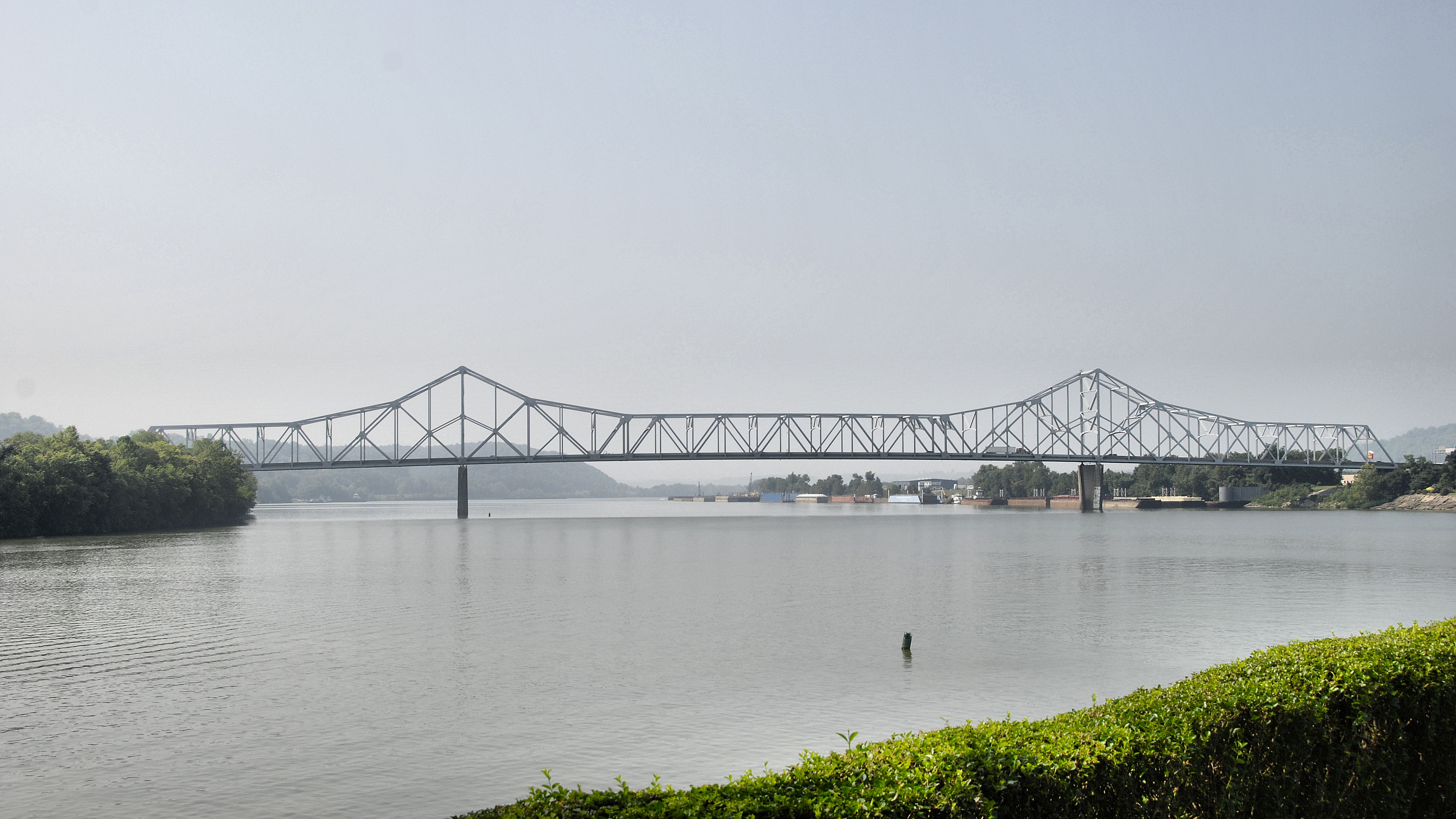
Silver Bridge
The crack was barely a tenth of an inch deep. It sat hidden inside the eye of a single steel bar -- one link among hundreds in the suspension chains of the Silver Bridge, which carried U.S. Route 35 over the Ohio River between Point Pleasant, West Virginia, and Gallipolis, Ohio. For 39 years, that flaw grew in secret, undetectable by any inspection technology of the era. Then, at 5:00 p.m. on December 15, 1967, during the Christmas shopping rush, the eyebar failed. Within one minute, the entire bridge was in the river. Forty-six people died, two of whose bodies were never recovered. The disaster exposed a truth that Americans had preferred to ignore: the nation's bridges were aging, uninspected, and in some cases engineered in ways that made catastrophic failure almost inevitable.
Strength Without Mercy
Built in 1928 and officially named the Point Pleasant Bridge, the span earned its popular name from the gleam of its aluminum paint. The Silver Bridge was an eyebar-chain suspension bridge, an elegant design in which flat steel bars with holes at each end -- eyebars -- were linked together by cylindrical pins to form suspension chains. Each bar ran 45 to 55 feet long and two inches thick, joined by pins 11.5 inches in diameter. The bridge's designers used a new high-strength steel with more than twice the tensile strength of conventional steels, which meant they needed fewer eyebars per link -- just two where older bridges used four or more. The result was lighter, cheaper, and stronger on paper. But it was also ruthlessly unforgiving: with only two bars per link, the failure of one instantly doubled the load on the other. As investigators later concluded, had there been three or more eyebars per link, the failure of one might not have led to disaster.
Towers That Told the Story
The Silver Bridge's two towers rose nearly 130 feet from their main piers and rested on a rocker design -- they could tilt slightly at their bases to accommodate shifting loads and temperature changes. It was a clever solution that eliminated bending stress and saved material, but it meant the towers depended entirely on the suspension chains for stability. When investigators reached the wreckage, they found a critical clue: both towers had toppled eastward, toward the West Virginia bank. If a chain had broken in the center span, the towers would have fallen away from each other. The uniform eastward collapse pointed to a break on the Ohio side, west of the tower. Working from this evidence, divers and engineers eventually located the failed eyebar. The fracture had originated from a corrosion-stress crack in the pin hole -- a defect that inspection prior to construction could not have noticed, and that the only way to detect afterward would have been to disassemble the eyebar entirely.
A Design That Made Failure Inevitable
Engineering historian Henry Petroski, reviewing the case in his 2012 book To Forgive Design, called it a cautionary tale for engineers of every kind. The cause, he wrote, was precisely and indisputably found to be a design that inadvertently made inspection all but impossible and failure all but inevitable. Two sister bridges shared the Silver Bridge's eyebar-chain design. One, upstream at St. Marys, West Virginia, was immediately closed and demolished by the state in 1971. The other, the notably longer Herculio Luz Bridge in Florianopolis, Brazil, remained in service until 1991 -- it had been built to a higher safety factor with four eyebars per link instead of two. Petroski did not fault the Silver Bridge's original designers, who could not have known about the hazards their choices introduced. Instead, he pointed forward: the legacy of the Silver Bridge should be to remind engineers to proceed with the utmost caution, ever mindful of the possible existence of unknown unknowns.
The Bridge That Changed All Bridges
The collapse forced an overdue reckoning with American infrastructure. Within a year, Congress passed the Federal-Aid Highway Act of 1968, which established the first national bridge inspection program in the country's history. The Silver Bridge has since been designated a National Historic Civil Engineering Landmark by the American Society of Civil Engineers -- not for its design, but for its failure's consequences. The Silver Memorial Bridge, a cantilever structure opened in 1969, now carries U.S. Route 35 across the Ohio River about a mile downstream from where its predecessor stood. On the Ohio bank, a roadside rest area along Route 7 displays one of the Silver Bridge's recovered eyebars, a steel relic from a bridge whose destruction taught a nation to start looking at what holds it up. Point Pleasant itself has woven the disaster into its identity alongside its other famous resident -- the Mothman, whose sightings in 1966-67 became inseparable from the bridge's fall in local folklore.
From the Air
The Silver Bridge site is at approximately 38.845N, 82.141W, where U.S. Route 35 crosses the Ohio River between Point Pleasant, West Virginia, and Gallipolis, Ohio. The replacement Silver Memorial Bridge is visible about one mile downstream. Tri-State Airport (KHTS) is roughly 30 nautical miles to the southwest; Yeager Airport (KCRW) in Charleston is about 50 nautical miles to the southeast. The Ohio River provides a clear visual reference, with Point Pleasant at the confluence of the Kanawha and Ohio Rivers. From 1,500-3,000 feet AGL, the modern bridge and the river crossing are easily identifiable. The eyebar exhibit at the rest area on the Ohio side is along Route 7 on the west bank.