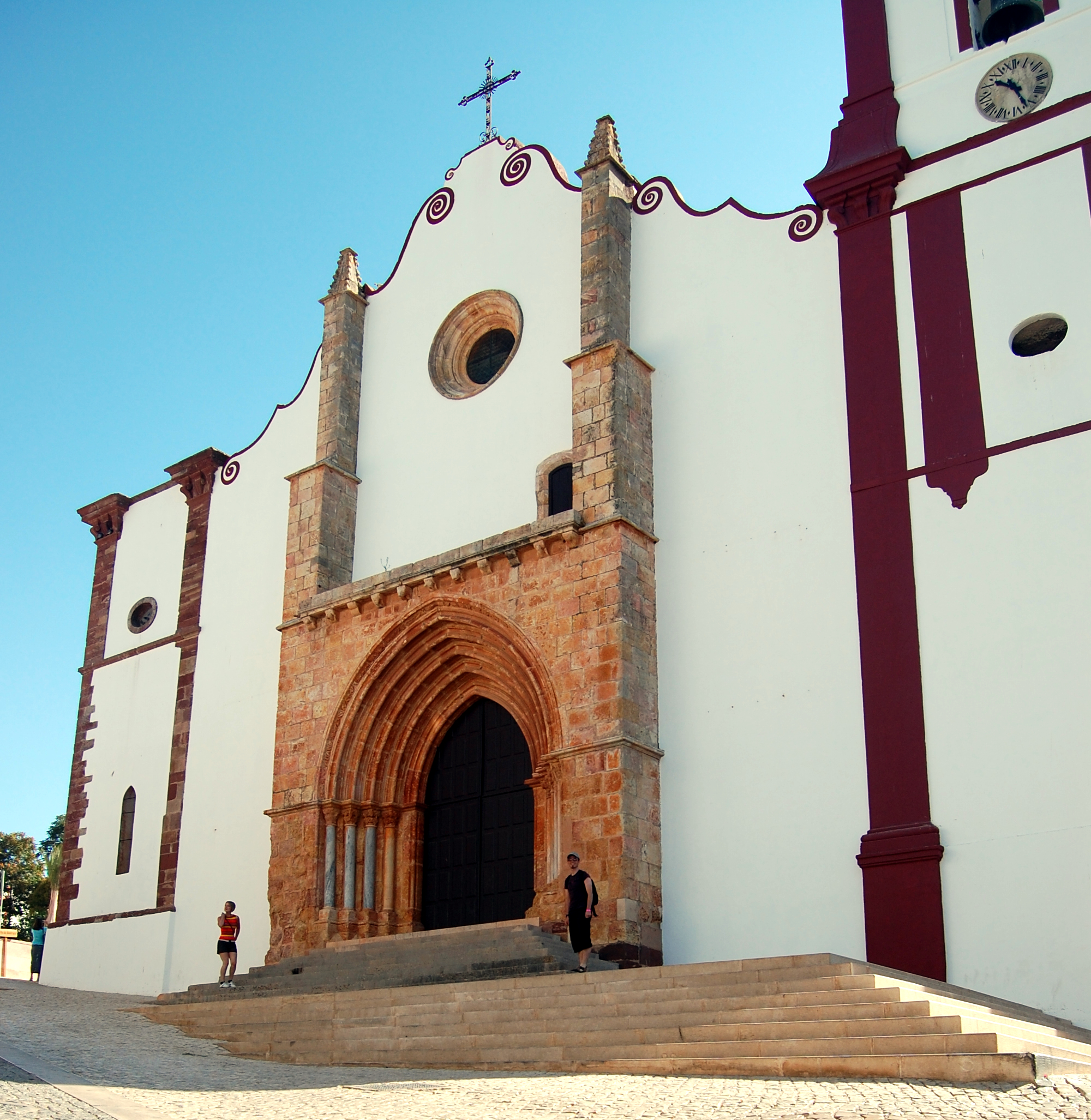
Silves Cathedral
Walk into Silves Cathedral and look down. The floor is a palimpsest of the dead. Tomb slabs of crusaders, bishops, explorers, judges, and ordinary townspeople tile the stone surface, each carved inscription a compressed biography. Here lies Bishop Fernando Coutinho, who helped negotiate the Treaty of Tordesillas -- the 1494 agreement that divided the undiscovered world between Portugal and Spain -- and who defended the Jewish community. Nearby rests Egas Moniz Teles, a nobleman whose family were among the first settlers of Madeira. And in the main chapel, a Gothic inscription marks the spot where King John II himself once lay.
From Mosque to Cathedral
A mosque stood here during the centuries of Moorish rule over the Iberian Peninsula. After King Sancho I captured Silves in 1189, the Muslim conquest proved temporary -- the Moors retook the city in 1191, making any cathedral construction unlikely during that brief Christian interlude. Only in 1242, when Christian knights definitively reconquered Silves under King Afonso III, did the conversion begin in earnest. Afonso is believed to have ordered the construction of a cathedral on the mosque's foundations, establishing it as the seat of a new Algarve diocese. The work proceeded slowly, hampered by limited resources. An earthquake in 1352 damaged what had been built. It was not until the 1440s, when King Afonso V invested heavily in the cathedral workshop, that construction gained real momentum. The apse with its three chapels, the transept, and the main portal all date from the 1470s, executed in Gothic style. The three-aisled nave was finished only in the early 16th century -- two hundred and fifty years after construction began.
Red Stone Against White Walls
From the outside, the cathedral announces its dual identity through color. Whitewashed wall surfaces contrast sharply with the red sandstone -- the local gres de Silves -- of the apse, window frames, and main portal. This interplay of materials creates a visual tension that reflects the building's layered history. The main portal, dating from the 1470s, is set within a stepped rectangular molding called an alfiz, a feature borrowed from Islamic architecture that persisted in Portuguese medieval buildings long after the Reconquista. Figurative corbels along the upper cornice depict animal and human faces, while the outer archivolt carries reliefs of vegetal motifs and human figures, some playing musical instruments. The column capitals reveal the influence of the Batalha Monastery workshop, the premier center of Gothic craftsmanship in 15th-century Portugal. The portal of the main church in nearby Portimao is nearly a replica of this one, believed to have been carved by the same artisans.
The Bishop Who Left
Economic decline and depopulation haunted Silves through the 15th and 16th centuries. Bishops increasingly stayed away from the city, finding excuses to reside elsewhere. The most notable among them was Jeronimo Osorio, one of Portugal's greatest humanists and theologians, who in 1577 made the separation official by transferring the bishopric from Silves to Faro, a coastal city with better prospects. The cathedral, stripped of its status, became a parish church. The interior was enriched during the following centuries with Mannerist and Baroque altarpieces, some of which survive, but the building's importance faded with its diocese. Then came the earthquake of 1755, which destroyed part of the nave. Repairs replaced the simple Gothic forms of the upper facade with Rococo volutes; the bell tower and south portal are also 18th-century additions. In the 20th century, extensive renovation stripped away many of the Baroque accretions, returning the building to a more medieval appearance -- a restoration that was itself a kind of interpretation, choosing which layer of history deserved to be visible.
Vaulting and Light
Inside, the cathedral follows a Latin cross plan with three aisles, a transept, and three eastern chapels. The eastern end, built in the mid-15th century, is covered by Gothic stone rib vaulting -- the kind of ambitious stonework that the builders presumably intended for the entire church. But when the nave was finally completed in the early 16th century, budget or ambition had diminished: the aisles received simple wooden roofs instead. This architectural compromise is visible to anyone who looks up while walking from east to west, the stone vaults of the transept giving way to timber overhead. The aisles are separated by pointed arches resting on octagonal columns, and the south transept arm is lit by a large mullioned window with Gothic tracery that throws patterned light across the tomb slabs below. It is a building that never quite became what its builders envisioned, yet achieved something perhaps more interesting: a record of aspiration meeting reality across three centuries of construction.
From the Air
Located at 37.19N, 8.44W in Silves, directly below the Castle of Silves on the same hilltop in the central Algarve. The cathedral's Gothic apse in distinctive red sandstone is visible from the air, contrasting with whitewashed walls. It sits adjacent to the castle, making both landmarks easy to spot together. Recommended viewing altitude: 2,000-3,000 feet. Nearest airport: Faro (LPFR), approximately 30 nm east. Portimao aerodrome (LPPM) is about 10 nm southwest.