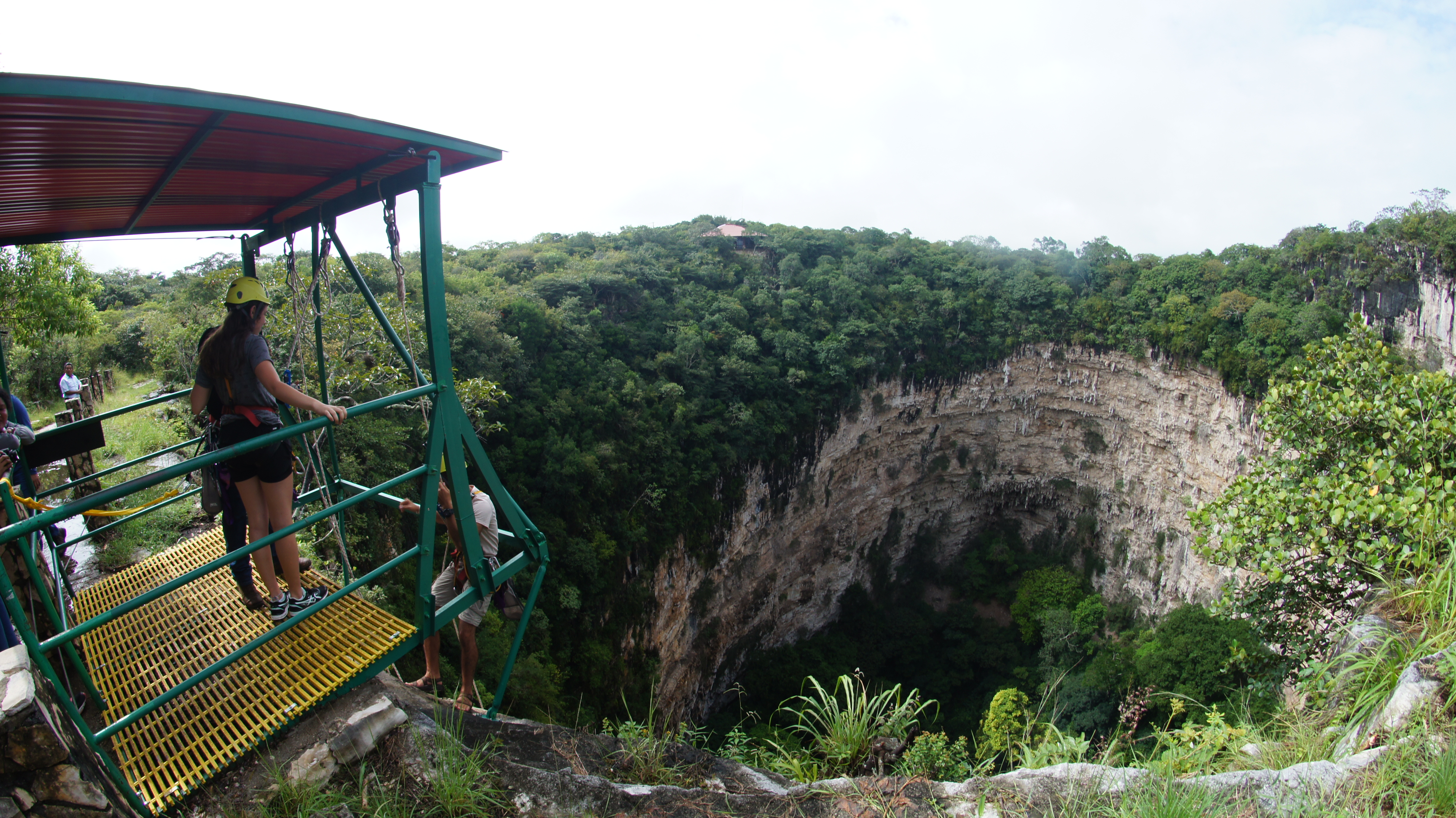
Sima de las Cotorras
Every morning at dawn, the sound starts -- a rising chatter that fills the limestone bowl like water filling a basin. Then the birds emerge. Thousands of Mexican green parakeets launch from their roosts inside the sinkhole, spiraling upward in tight circular patterns until they clear the rim and scatter across the surrounding forest. In the evening, they reverse the choreography, funneling back down into the darkness. The Zoque people who live near this sinkhole in western Chiapas call their land Coita, a word meaning "place of rabbits." But it is the parakeets that have given the place its fame: Sima de las Cotorras, the Sinkhole of the Parrots.
A Hole in the Earth
The sinkhole is part of the El Ocote Biosphere Reserve, about ninety minutes from the Chiapas state capital of Tuxtla Gutierrez. It belongs to the municipality of Ocozocoautla de Espinoza, accessible by nineteen kilometers of rough road from the town center. The nearest community is Piedra Parada, home to about five hundred residents. At 820 meters above sea level in the Sierra Madre de Chiapas, the opening is elliptical, with the north and southwest rims elevated above the rest and the low point on the eastern side. Tectonic activity and erosion of the region's limestone created this and several other sinkholes in the area, though none of the others receive any tourism. Caves pock the sinkhole walls, also carved by erosion. The floor is blanketed in low deciduous rainforest -- a pocket of tropical vegetation thriving in the protected microclimate below the rim. It is a landscape shaped by subtraction, by the slow dissolution of rock over geological time, leaving behind a vertical world that shelters life the surrounding plateau cannot.
Paintings in the Dark
The sinkhole walls hold cave paintings whose age and origin are not fully documented but predate European contact. Visitors who rappel the walls or take guided tours along the rim path can see them alongside the tropical vegetation that covers the sinkhole floor. The caves within the walls add another dimension -- hollows within hollows, erosion nested inside erosion. The park hosts over eighty bird species across thirty families. Seven are classified as endangered by the Mexican government. Thirty-five species inhabit the low deciduous rainforest of the sinkholes themselves, including species highly sensitive to human intrusion such as bobwhite quail, white-bellied emerald hummingbirds, and plain chachalacas. Several species found in the Sima de las Cotorras area have not been recorded in the larger El Ocote reserve, including great horned owls, eastern bluebirds, and varied buntings -- suggesting the sinkhole functions as a distinct ecological niche within the broader biosphere.
An Ecotourism Experiment
In 1985, the Sima de Cotorras Ecotourism Center was established to give local Zoque families an alternative to agriculture and a reason for younger generations to stay rather than migrate. The cooperative built a road, a restaurant, eight cabins for up to five people each, a camping area, and a path around the rim. Visitors can rappel into the sinkhole and take guided tours to see the cave paintings and the rainforest floor. Constructions use local materials wherever possible -- paving from local rock, buildings modeled on pre-Hispanic architecture, including rock foundations visible on the restaurant. At its peak, the center generated eighty to one hundred jobs. But as of 2016, only ten to fifteen visitors arrive per day. About half come from Tuxtla Gutierrez, thirteen percent from Mexico City, and just two percent from abroad. Two-thirds come only to see the parakeet flights and leave the same day.
The Parrots and the Patience
The center's challenges are practical: poor access roads, almost no signage, and limited promotion. Most visitors learn about the site through word of mouth. Government support has been intermittent and sometimes counterproductive -- officials have cut down trees to install cement utility poles and built non-composting toilets in an ecotourism park. Political shifts bring changing attitudes toward the project's ecological focus. Most members of the cooperative are now between fifty and eighty years old; younger people have not shown sufficient interest in continuing the work. Only thirty percent of the local population recognizes the area's intangible value, though eighty percent favor efforts to make it better known. The tension is real: the sinkhole cannot handle mass tourism without ecological damage, but without more visitors, the cooperative cannot sustain itself. Meanwhile, the parakeets continue their daily ritual -- spiraling up at dawn, spiraling down at dusk -- indifferent to whether anyone is watching.
From the Air
Located at 16.81N, 93.47W in the El Ocote Biosphere Reserve in western Chiapas. The sinkhole is an elliptical depression in the limestone plateau of the Sierra Madre de Chiapas at approximately 820 meters elevation. The opening may be visible from lower altitudes as a dark gap in the forested plateau. Nearest major airport is Angel Albino Corzo International Airport (MMTG) near Tuxtla Gutierrez, approximately 90 minutes by road. The surrounding biosphere reserve is largely undeveloped forest.