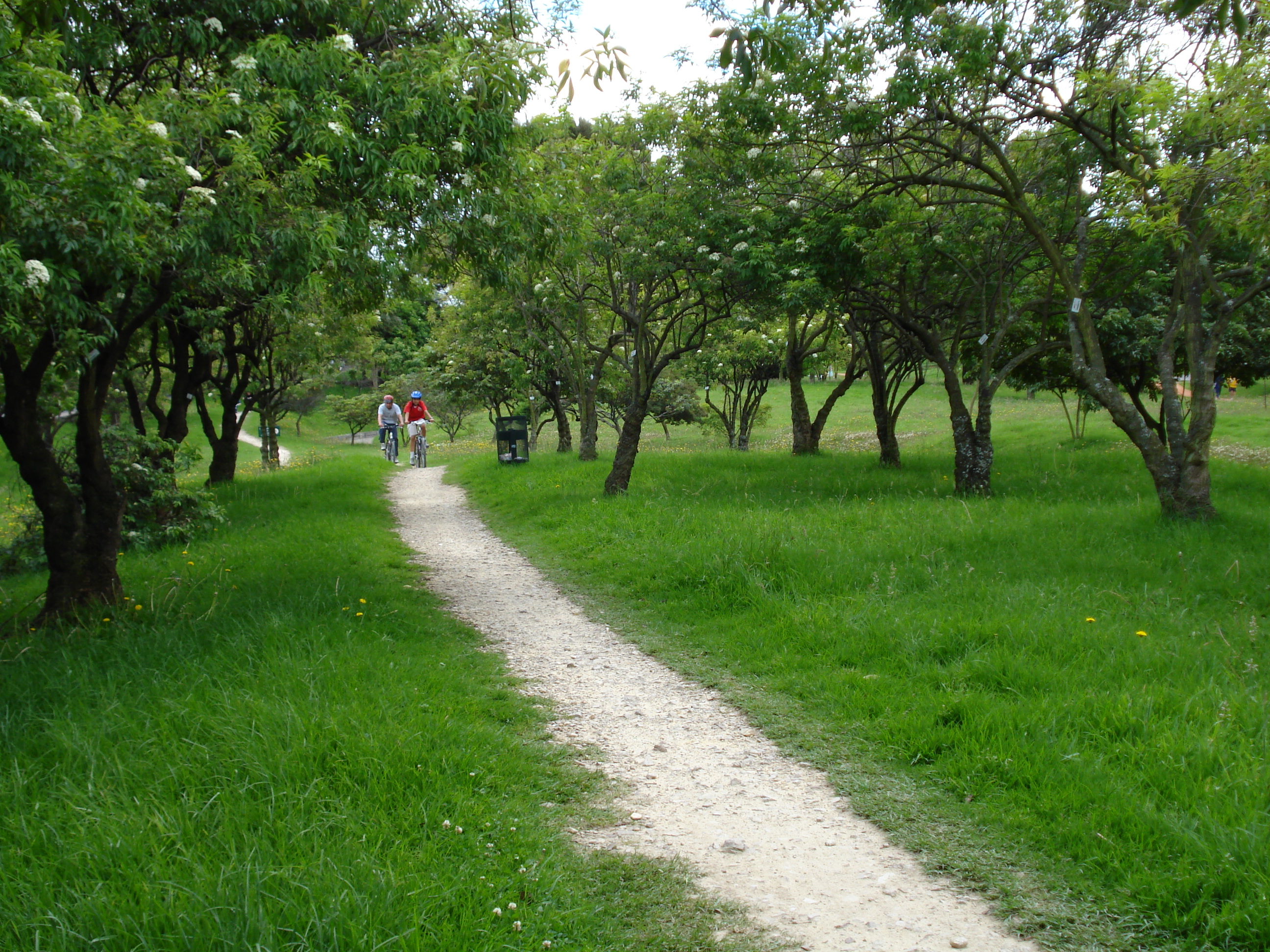
Simón Bolívar Park
On 2 May 1999, Metallica played to 100,000 people here on their first visit to Colombia - the largest single-show attendance in the park's history, a record the band would return and try to break against themselves. The concert happened on the same grass where, thirty-one years earlier, Pope Paul VI had celebrated Mass for the 39th International Eucharistic Congress. Over a thousand acres in the middle of Bogotá, larger than Central Park, this is the lung of the city and also its amphitheater. It has been both, by turns, for more than half a century.
A Lake That Was Already There
Construction started in 1966. The lake the city now uses for paddle boats had been there all along, a natural feature of the high plain. In 1968, with the Eucharistic Congress approaching, Bogotá built the first structure on the site - the Eucharistic Temple, to host Pope Paul VI. Eighteen years later, in 1986, a second temple went up for the visit of Pope John Paul II. By then, the park had been officially named in 1979 under Law 31, in commemoration of the bicentennial of the birth of Simón Bolívar - the Venezuelan-born Liberator whose armies freed five South American nations. The Colombian architect Arturo Robledo Ocampo drew up the plans for the modern park in 1982: the Events Plaza, the tree-planting schemes, the channels and walls that move water through the complex. In 1983 the plaza was finished and 3,300 new trees went in.
Not One Park but Many
What Bogotá calls Simón Bolívar Park is actually a system of adjacent green spaces covering roughly 970 acres. At its heart is the Central Park - 279 acres wrapped around a lake of more than 27 acres, with eleven miles of walking paths and an acoustic shell for concerts. Next door is Salitre Mágico, an amusement park famous for a Ferris wheel that offers a full panorama of the Andes on a clear day, three rollercoasters, and a covered water park. Los Novios Park - the Park of Lovers - has soccer fields, BMX and motocross tracks, nineteen barbecue kiosks, and smaller lakes where couples rent pedal boats. The Simón Bolívar Aquatic Complex, opened in 2004 for the National Games, holds an Olympic-sized pool, a training pool, and a diving pool kept at exactly 27 degrees Celsius by a boiler system hidden beneath two thousand square meters of basement. El Salitre Sports Unit is home to the Luis Carlos Galán velodrome, built specifically for the 1995 UCI Track Cycling World Championships.
The Concerts
Between 2005 and 2012, concerts were banned from El Campín stadium, and the Events Plaza became the only venue in Bogotá large enough to host international tours. The capacity is 100,000 - the largest single concert area in Colombia. The list of artists who have filled it reads like a slice of turn-of-the-century rock: Metallica three times (1999, 2010, 2014), Iron Maiden filming their Flight 666 documentary in front of 38,788 people, Aerosmith setting a speed record by selling 40,000 tickets in three hours and forty minutes on 19 May 2010, Depeche Mode during their Tour of the Universe in 2009 and again for Global Spirit in 2018, Gwen Stefani playing her only South American show of the Sweet Escape Tour to 30,000 fans, and Red Hot Chili Peppers opening their I'm with You Tour here on 11 September 2011. Britney Spears sold out a Meet and Greet in under a minute during her 2011 Femme Fatale visit. Pearl Jam came in 2015. Metallica's three shows together have drawn over 140,000 people - the all-time attendance record for a single artist at the venue.
The Virgilio Barco Library
The park is named for the Liberator, but the building that draws regular visitors to its edge is named for a late-twentieth-century Colombian president. The Virgilio Barco Public Library, designed by architect Rogelio Salmona and opened in 2001, sits on the park's northeast corner - a spiral of pink-red brick that Salmona curved to mirror the line of the surrounding hills. Salmona was Colombia's most celebrated architect, and the library is often cited as one of his masterpieces. From its upper terraces, the Bogotá savanna spreads flat in one direction and the Eastern Cordillera rises abruptly in the other. At 2,640 meters of elevation, the light is sharp. The air is thin. The park below, on ordinary weekdays, fills with joggers, picnickers, children on bicycles, students from the nearby National University, and the slow parade of Bogotanos walking the eleven miles of paths that wrap the lake.
The Lung
Residents call it the lung of the city, and in a literal sense they are right. Bogotá, at the altitude and population density it has reached, fights for its own air. The park's 970 acres of grass and tree canopy pull particulate matter and carbon out of the atmosphere above a metropolitan region of roughly eight million people. The Summer Festival runs in August; Rock al Parque, the free rock festival founded in 1995, draws hundreds of thousands to the Events Plaza every November. In between, it is simply the place where Bogotá exhales.
From the Air
Located at 4.66°N, 74.09°W in central Bogotá at approximately 2,625 meters (8,612 ft) elevation. El Dorado International (SKBO/BOG) is 7 km west; Guaymaral (SKGY) 15 km north serves general aviation. The park's elliptical shape and central lake are distinctive from 5,000-10,000 feet AGL. Visible landmarks: the pink-brick spiral of the Virgilio Barco Library, the Aquatic Complex's geometric roof, and the large Events Plaza on the park's east side. Bogotá's altitude affects density altitude calculations year-round.