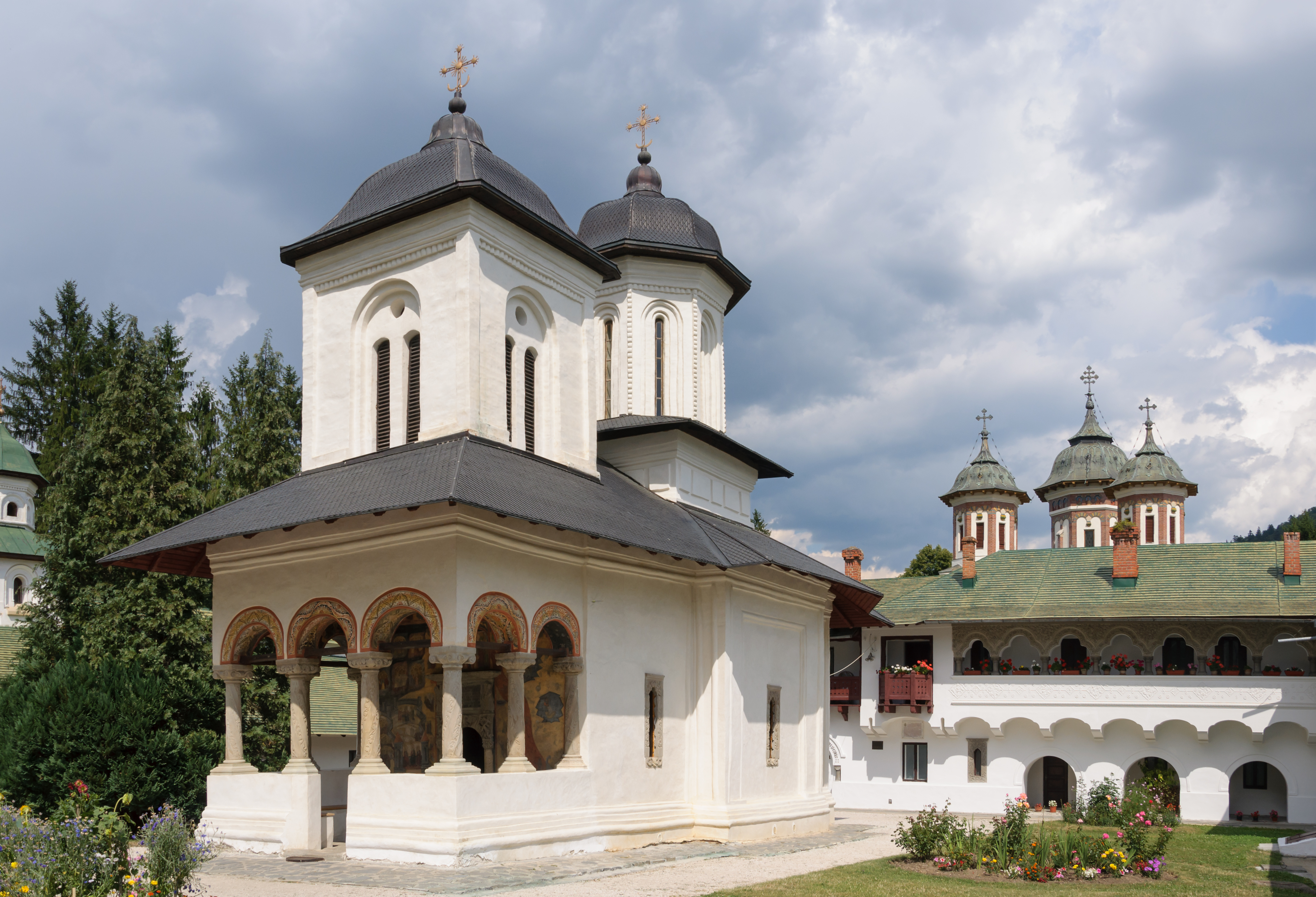
Sinaia Monastery
Before the ski resorts, before the royal castle, before the Orient Express station -- before there was even a town called Sinaia -- there was the monastery. Prince Mihail Cantacuzino founded it in 1695 after returning from a pilgrimage to Saint Catherine's Monastery on Mount Sinai in Egypt. He named his Carpathian foundation after the biblical mountain, and for the next 150 years, Sinaia was nothing more than this monastery and a scattering of huts. The town that eventually grew around it borrowed the monastery's name, which borrowed a desert mountain's name, which borrowed a biblical narrative stretching back three thousand years. Every layer of Sinaia rests on the one beneath it.
A Fortress on the Road to Brasov
Cantacuzino designed the monastery to serve a dual purpose. It was a house of prayer -- the initial plan called for exactly twelve monks, mirroring the Twelve Apostles -- but it was also a fortified stronghold on the route from Brasov to Bucharest. Thick walls enclosed two courtyards, each centered on a small church built in the Byzantine style. The first buildings were completed between 1690 and 1695, and the Old Church (Biserica Veche), still standing today, dates to that founding period. Its interior was painted by the renowned artist Parvu Mutu, and those original frescoes were first restored in 1795. The dual nature of the monastery proved prescient: during the Russo-Turkish War of 1735-1739, Ottoman forces attacked and breached the walls in two places, burning parts of the compound. Before fleeing, the monks had hidden the monastery's valuables inside a bell -- a desperate act of preservation that succeeded.
The Great Church and Its Golden Walls
The second church, the Great Church (Biserica Mare), was constructed between 1842 and 1846 under the leadership of Hegumens Ioasaf and Paisie. The Board of Civil Hospitals enlarged it between 1897 and 1903, giving it the appearance visitors see today. Architect George Mandrea blended the Moldavian style with the Brancoveanu style of Wallachia, and a belt of three green enamel lines encircles the building -- said to represent both the Holy Trinity and the unity of the three Romanian kingdoms. Inside, the gold mosaic paintings by Danish artist Aage Exner depict five notable figures: King Carol I shown as an officer with his hand on a broken pillar symbolizing Romania's missing territories; Queen Elisabeth of Wied, known as Carmen Sylva; the monastery's founder Mihail Cantacuzino; and others. Thanks to Carol I's patronage, the Great Church became the first church in Romania to use electric lights.
Treasures Behind Monastery Walls
The monastery library holds the earliest Romanian translation of the Bible, dated 1668, along with valuable jewels belonging to the Cantacuzino family. In 1895, the monastery opened Romania's first exhibition of religious objects, a museum displaying icons and crosses from the 17th century and the first complete Bible printed in Romanian, published in Bucharest in 1688. Two Russian icons of Saint Serghei and Saint Nicholas were gifted by Tsar Nicholas II in 1903, presented for the baptism of Prince Nicholae, son of King Ferdinand. The furniture in the Great Church was crafted by Constantin Babic and his students at the Bucharest Art School -- sycamore, maple, and oak carved into gold-plated thrones. The King's throne bears the royal emblem and the motto Nihil sine Deo: Nothing without God. A silk-and-gold epitaphios by Anna Roth, worked on a cotton base, took three years to complete, from 1897 to 1900.
The Bell from Bucharest
Under Hegumen Nifon Popescu, who led the monastery from 1888 to 1909, a large bell tower was added to the walls, completed in 1892. Its 1,700-kilogram bell was brought from the Coltea Tower in Bucharest, giving the mountain monastery a voice that had once rung over the capital. Take Ionescu, a former Prime Minister of Romania, is buried on the grounds -- one of several connections linking this seemingly remote mountain monastery to the centers of Romanian political life. In 1948, the communist government transferred the monastery from the Board of Civil Hospitals to the Archdiocese of Bucharest. Patriarch Justinian Marina restored the buildings between 1951 and 1957, fitting the entire complex with running water, electricity, and natural gas. Today, a small community of Orthodox monks continues to maintain the monastery, which sits just a short walk from Peles Castle and downhill from the Sinaia railway station.
From the Air
Located at 45.36°N, 25.55°E in Sinaia, Romania, in the Prahova Valley of the southeastern Carpathian Mountains. The monastery sits at approximately 800 m elevation, near Peles Castle. Sinaia railway station is immediately below. Nearest airports: LRBS (Bucharest Baneasa, ~120 km south), LROP (Bucharest Henri Coanda, ~130 km south). The Bucegi Mountains rise to the northeast.