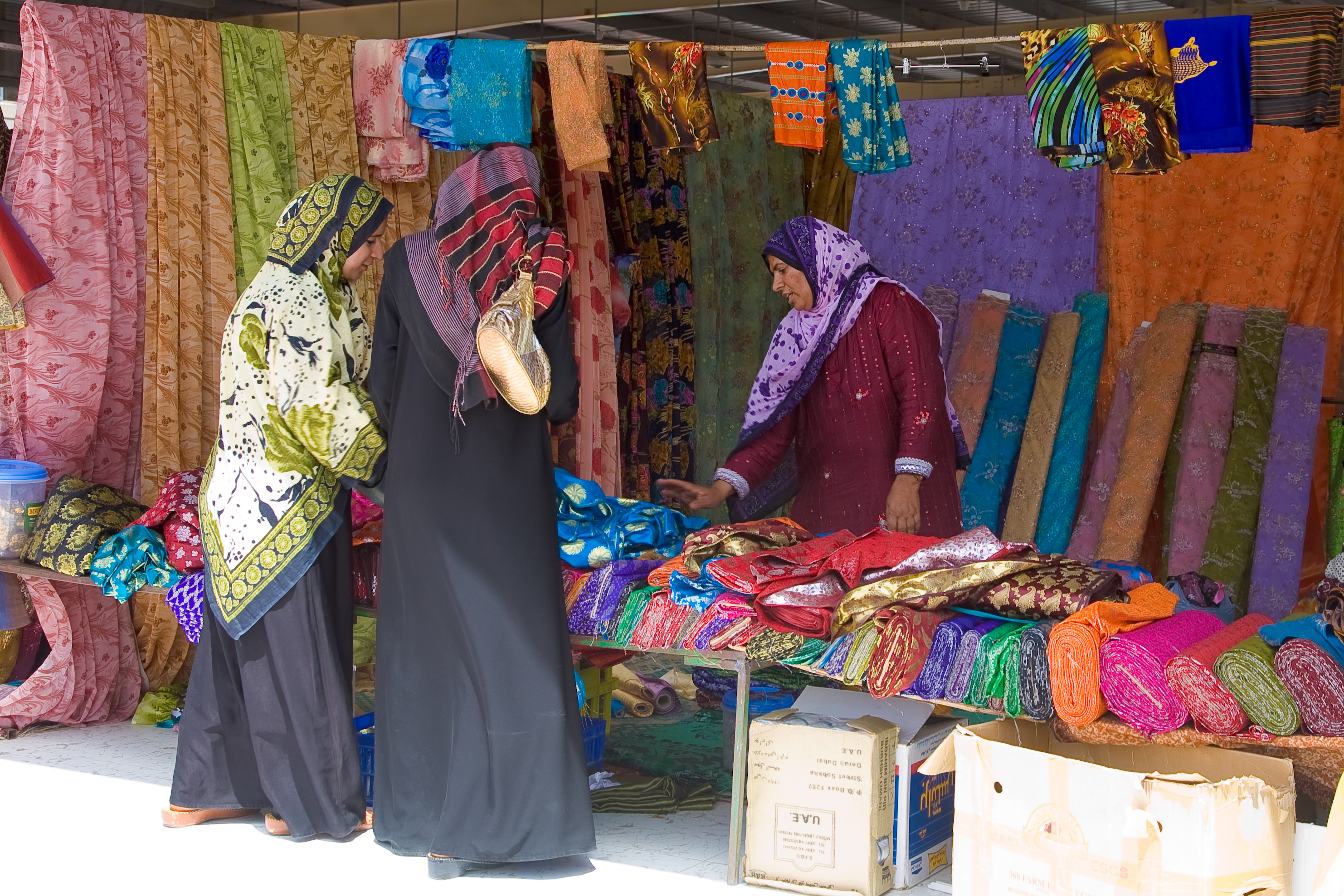
Sinaw
Every Thursday at dawn, Sinaw's market comes to life. Bedouin communities from the surrounding desert converge on the town, bringing livestock, handwoven textiles, and silver jewelry to trade alongside fish, vegetables, and dates. By one in the afternoon, the market will have emptied again, the desert families returning to their settlements with supplies for the week. The Saturday artisan market is quieter, focused on handicrafts: spinning, weaving, silverwork. But the Thursday gathering is the pulse of Sinaw, a weekly proof that this city at the edge of the desert has served as a crossroads between mountain agriculture and desert life for thousands of years.
The Warrior in the Grave
In the depths of the desert surrounding Sinaw, burial fields stretch for considerable distances, dating from the end of the fourth millennium to the first millennium BC. Among the most remarkable archaeological discoveries was a tomb from the end of the Iron Age, around 300 BC, containing the remains of a man who died at about fifty years of age. He was buried on his right side with an iron sword 88 centimeters long, its handle partially covered in ivory and shaped like an eagle's beak. Two daggers lay at his waist, one on each side, all three blades made of iron lined with steel. Near the body lay a bronze vessel. He wore leather shoes. His head rested on a pillow, with a conical woolen headdress placed beside him. Most remarkably, two camels -- a male and a female -- had been sacrificed and buried in stone-lined pits adjacent to the grave.
Steel Before Steel Was Common
The sword and daggers found in the Sinaw warrior's tomb were made of iron lined with steel, a manufacturing technique believed to have originated in India. If correct, this places Sinaw at a junction of trade routes connecting Arabia to the Indian subcontinent as early as 300 BC. The quality of the burial -- the ivory-handled sword, the sacrificed camels, the carefully arranged grave goods -- suggests the man was someone of high status, possibly a tribal leader. His burial tells a story that the desert surface does not: that Sinaw was not a marginal settlement but a place of wealth and connection, where goods and techniques from distant civilizations converged.
The Turquoise Jar of Silver
In September 1979, residents of Sinaw made another discovery. Inside a glazed pottery vessel, distinguished by its turquoise blue color and handles on both sides, they found 962 silver dirhams dating to the Sasanian and early Islamic eras. The Sinaw treasure, as it became known, is the largest coin hoard ever found in the Sultanate of Oman. Pre-Islamic coins in the collection bore resemblance to coins from the same era found as far away as Russia, testimony to the reach of ancient trade networks that passed through this unremarkable-looking desert town. The preservation team at Oman's National Museum has since restored the treasure, which now forms part of the museum's effort to document Omani cultural heritage.
Where Desert Meets Mountain
Sinaw's location explains its importance. It sits at the crossroads of trade routes connecting the agricultural regions of the Hajar Mountains to the desert communities of the interior. Water from mountain wadis reaches far enough into the desert here to make settlement possible. This combination of accessibility and water attracted human habitation for millennia. Today, Sinaw retains its dual character: part urban center with modern infrastructure, part gateway to the desert where Bedouin traditions endure. The Thursday market is not a tourist attraction staged for visitors. It is the continuation of an economic pattern that predates the Iron Age warrior and his ivory-handled sword by centuries.
From the Air
Located at 22.52N, 58.03E in the North Sharqiyah Governorate of Oman, at the transition between mountain and desert terrain. Nearest major airport is Muscat International (OOMS), approximately 130 km northwest. The terrain is flat to gently rolling desert with wadi channels visible from altitude. The Sharqiya Sands begin to the south.