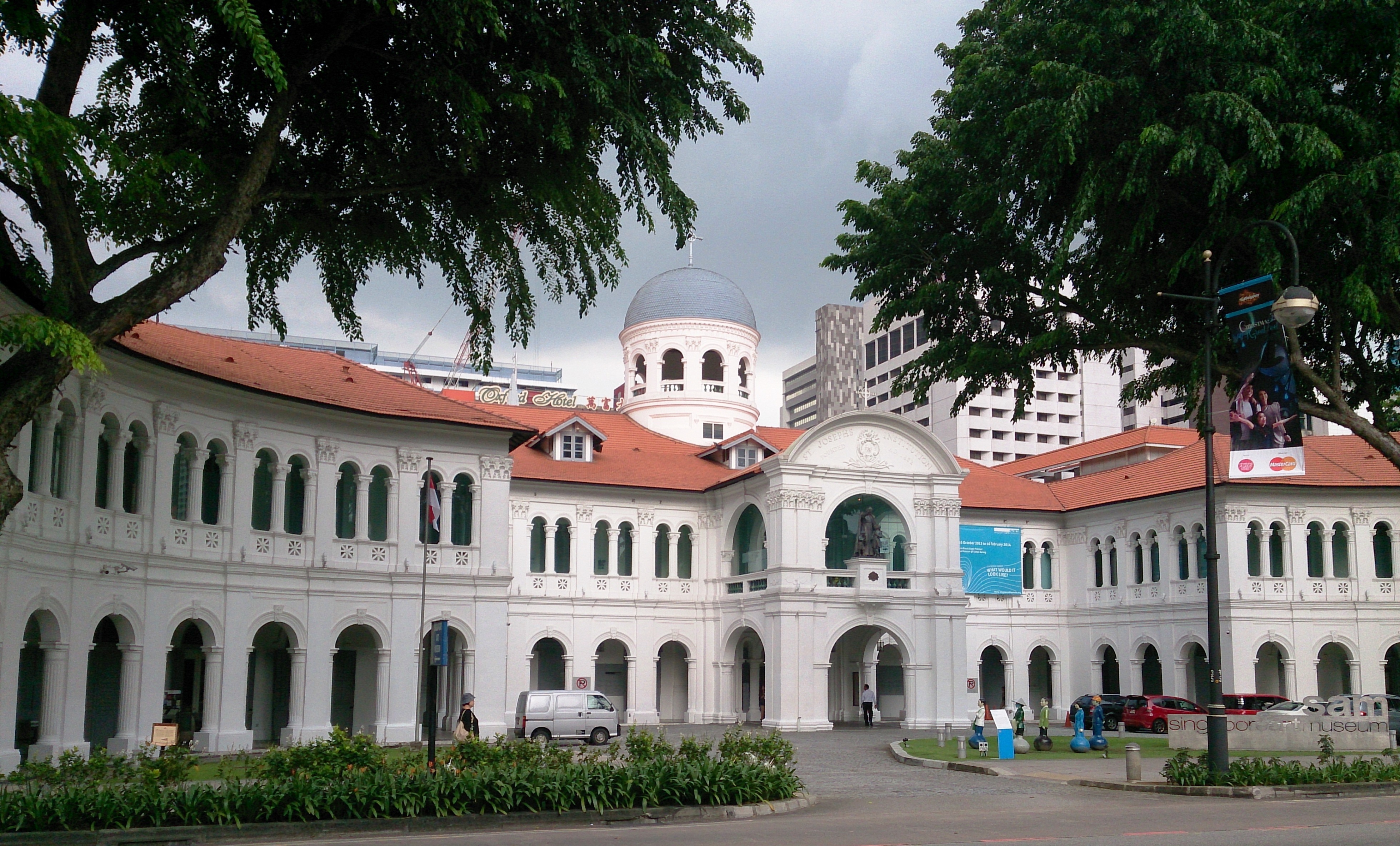
Singapore Art Museum
The first thing visitors saw when the Singapore Art Museum opened its doors in 1996 was a Swarovski crystal chandelier - 325 kilograms of glass suspended above the entrance of a building that had spent the previous 140 years as a Catholic boys' school. The juxtaposition was deliberate. Singapore was declaring itself a capital of contemporary art, and it intended to do so with a certain sparkle. What followed has been messier, more ambitious, and more interesting than any chandelier could suggest.
From Schoolboys to Southeast Asian Masters
The main building on Bras Basah Road was once Saint Joseph's Institution, a school founded by the De La Salle Brothers in the mid-nineteenth century. By the early 1990s, Singapore's National Museum had envisioned a five-museum precinct in the civic district, and the old school building - a national monument by then - was earmarked for fine art. The restoration took more than two years and cost S$30 million. Artist and surgeon Earl Lu was appointed to lead an eleven-member board in 1992, tasked with acquiring works by notable Southeast Asian and East Asian painters. When Prime Minister Goh Chok Tong officially opened the museum on 20 January 1996, he described it as part of Singapore's bid to reprise its historic role as an entrepot - not just for goods, but for arts, culture, and ideas across Asia.
Two Buildings, Then Three
The museum soon outgrew its original home. An annexe at 8 Queen Street, a former Catholic High School building, became SAM at 8Q, providing additional space for contemporary and newly commissioned works. The two heritage buildings sat in the heart of Singapore's arts district, surrounded by institutions like LASALLE College of the Arts and the Nanyang Academy of Fine Arts. Then, in 2019, both heritage buildings closed for a second major redevelopment - this one designed to preserve the colonial architecture while modernizing the museum infrastructure. Rather than go dark entirely, SAM adapted. In January 2022, it opened a new contemporary art space at Tanjong Pagar Distripark, a converted port warehouse in a historic waterfront district. Spread across two floors, the Distripark venue houses galleries, residency studios, and a food-and-beverage space, placing contemporary art alongside working galleries like Gajah Gallery.
A Regional Eye
From 2001 onward, SAM began building one of the most important public collections of Southeast Asian contemporary art in the world, acquiring works by artists like Vietnamese-American Dinh Q. Le, Thai painter Natee Utarit, and Singaporean sculptor Suzann Victor. The museum's ambition extended beyond its own walls through international partnerships: co-curated exhibitions with the Yokohama Museum of Art, the Museum of Contemporary Art Tokyo, and the Pompidou Center brought works by Yayoi Kusama, Bill Viola, and Jean-Luc Godard to Singapore audiences. Since 2010, SAM has sharpened its focus on Southeast Asian contemporary practice, organizing exhibitions like Time Passes in 2020 - featuring thirteen emerging Singaporean artists - and The Gift in 2021, which brought together regional voices including Ho Tzu Nyen and Korakrit Arunanondchai.
Where Art Meets the State
A museum in Singapore inevitably navigates the relationship between artistic expression and government authority. In 2008, during the Artists' Regional Exchange, staff removed Hong Kong caricaturist Zunzi's work Lee's Garden from the walls without consulting or notifying the artist. The piece depicted Prime Minister Goh Chok Tong wielding pest-control gear while former prime minister Lee Kuan Yew patted him on the back. The removal sparked a diplomatic and media incident. Three years later, Japanese-British artist Simon Fujiwara's work Welcome to the Hotel Munber was pulled from a Singapore Biennale exhibition after conservative groups objected to its homoerotic content - again without the artist's knowledge. These episodes sit alongside the museum's otherwise expansive programming, a reminder that contemporary art's power to provoke is not always welcomed, even by the institutions that exhibit it.
The Biennale and Beyond
SAM has organized the Singapore Biennale since 2011, establishing the event as a recurring anchor for the city-state's contemporary art calendar. The biennale brings international curatorial perspectives and draws attention to the region's artistic production in a way that permanent collections alone cannot. Meanwhile, the museum's residency program, formally operational since 2021, has hosted artists from across Asia, providing studio space and institutional support at the Tanjong Pagar Distripark venue. The program represents a shift in SAM's identity - from a museum that collects and displays to one that actively incubates new work. When the heritage buildings reopen after their redevelopment, SAM will operate across multiple sites, each with a distinct character: colonial schoolrooms for the permanent collection, a waterfront warehouse for the experimental edge.
From the Air
Located at 1.297°N, 103.851°E on Bras Basah Road in Singapore's arts and heritage district. The heritage building complex is visible near Fort Canning Hill and the National Museum cluster. SAM at Tanjong Pagar Distripark is located approximately 2.5 km south at the waterfront. Nearest airports: Singapore Changi Airport (WSSS) approximately 17 km east, Seletar Airport (WSSL) approximately 12 km north. Best viewed at 2,000-3,000 feet for civic district context.