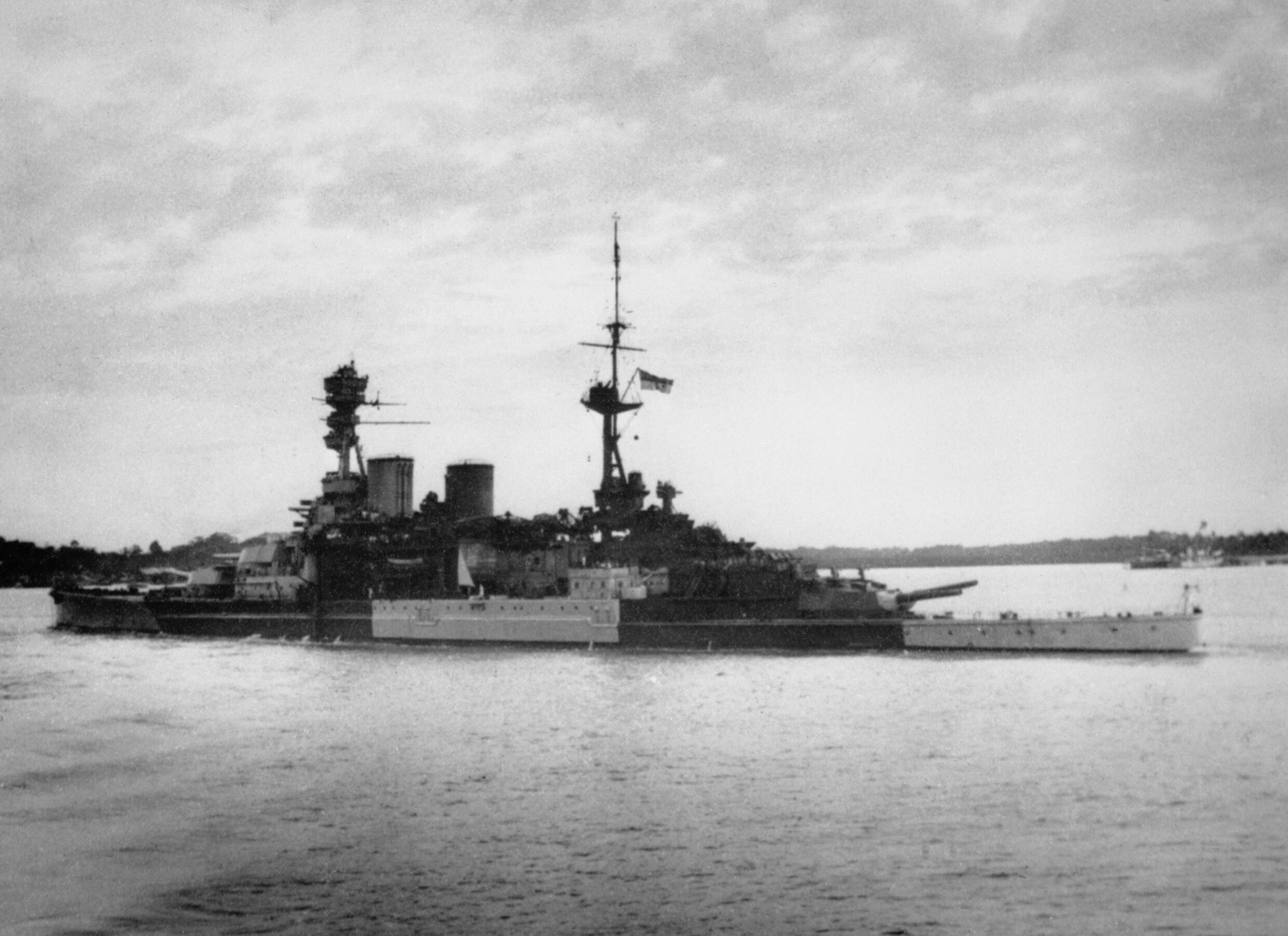
Sinking of Prince of Wales and Repulse
In all the shock of early December 1941, no single loss stung Winston Churchill quite like this one. "In all the war I never received a more direct shock," he wrote after learning that HMS Prince of Wales and HMS Repulse had been sent to the bottom of the South China Sea by Japanese aircraft on 10 December. The two capital ships were supposed to deter Japan from attacking Malaya. Instead, they became the first warships actively fighting back to be sunk exclusively by air power while under way in open water, a distinction that rewrote naval doctrine overnight and haunts the seabed off Kuantan to this day.
A Deterrent That Arrived Too Late
The plan had been Churchill's own. Send a powerful naval force to Singapore, and the mere presence of British battleships would give Japan pause. Force Z, as the squadron was designated, consisted of the brand-new battleship Prince of Wales and the veteran battlecruiser Repulse, escorted by four destroyers. What Force Z lacked was an aircraft carrier. HMS Indomitable, originally assigned to the group, had run aground in Jamaica during working-up exercises and was unavailable. Admiral Sir Tom Phillips, commanding from Prince of Wales, pressed ahead without her. Phillips was a staff officer who had spent much of the war behind a desk in London, and he held firm to the old conviction that well-armed warships could defend themselves against air attack. Repulse carried experience from convoys across the Atlantic, while Prince of Wales bore scars from her engagement with the Bismarck only months earlier. Both ships were fast, both were crewed by seasoned sailors, and both were sailing into a trap.
Eighty-Eight Minutes
On 10 December, the Japanese 22nd Air Flotilla launched wave after wave of Mitsubishi G3M and G4M bombers from bases in Indochina. Phillips had been tracked by a submarine the night before and shadowed by reconnaissance aircraft at dawn, yet he refused to break radio silence to request fighter cover from RAF Sembawang in Singapore. The first bombs struck Repulse shortly after 11:00 local time. Then the torpedo bombers came in low, flying through a curtain of anti-aircraft fire to release their ordnance at close range. Prince of Wales took a torpedo to her port propeller shaft early in the attack, a hit that jammed her rudder and flooded her steering compartment, leaving the great battleship circling helplessly. Repulse fought brilliantly, dodging nineteen torpedoes through aggressive maneuvering before five struck her almost simultaneously. She rolled over and sank at 12:33. Prince of Wales, crippled and listing, followed twenty minutes later. Of the two ships' combined complement, 842 men died, including Admiral Phillips and the captain of Prince of Wales, John Leach. The destroyers pulled 2,081 survivors from the oil-slicked water. The entire action, from the first bomb to the final capsizing, lasted eighty-eight minutes.
The End of the Battleship Era
What made the sinking so profound was not the death toll, devastating as it was, but the implications. At Pearl Harbor three days earlier, American battleships had been caught at anchor, stationary and surprised. Prince of Wales and Repulse were at sea, maneuvering at speed, their anti-aircraft guns firing. Prince of Wales carried some of the most advanced fire-control systems in the Royal Navy. None of it mattered. The lesson was merciless: without air cover, surface warships were fatally vulnerable. RAF pilots sitting in their cockpits at Sembawang, ready to scramble, received the distress call only after Repulse's captain broke radio silence as his ship went down. It was the captain of Repulse, not Admiral Phillips, who finally called for help. By the time the fighters arrived, they found only oil, wreckage, and lifeboats. The age of the battleship as the queen of naval warfare ended that morning in the South China Sea.
A Seabed Memorial
The wrecks lie roughly 50 nautical miles east of Kuantan, Malaysia. Repulse rests in 56 meters of water, Prince of Wales in 68 meters, both nearly inverted. Buoys mark the propeller shafts, and Royal Navy ensigns are attached to the lines and regularly replaced by divers. As Crown property, the wrecks are protected under British law, though enforcement at such a distance has proven difficult. In 2002, an authorized team of Royal Navy and civilian divers recovered the bell of Prince of Wales after concerns that unauthorized salvagers would steal it; the bell now resides at the Merseyside Maritime Museum in Liverpool. A 2007 marine forensic survey documented the torpedo damage in detail for the first time, confirming the catastrophic nature of the shaft hit that doomed Prince of Wales. More troubling reports followed in 2014, when The Daily Telegraph revealed that both wrecks were being damaged by scrap-metal dealers using explosives. Every passing Royal Navy vessel still conducts a remembrance ceremony over the site, honoring the 842 sailors who remain entombed below.
Remembered in Two Hemispheres
A memorial park stands near Kuantan on the Malaysian coast, where local fishermen were among the first to witness the aftermath. In the United Kingdom, a memorial was dedicated on 10 December 2011 at the National Memorial Arboretum in Alrewas, Staffordshire, seventy years to the day after the sinking. A handful of surviving crew members attended the ceremony. For Britain, the loss of Force Z was the opening blow of a catastrophic few months that culminated in the fall of Singapore in February 1942, the largest surrender in British military history. For the Japanese, the victory confirmed the supremacy of carrier-based aviation and emboldened the advance southward through Southeast Asia. And for the families of the 840 men who never came home, the calm waters off Kuantan remain a grave, marked only by buoys, ensigns, and the occasional rumble of a warship's engines overhead, pausing in remembrance.
From the Air
The wreck site lies at approximately 3.56N, 104.48E in the South China Sea, roughly 50 nautical miles east of Kuantan, Malaysia. Best viewed from 5,000-10,000 feet over open ocean. The nearest major airport is Sultan Haji Ahmad Shah Airport (WMKD) at Kuantan. Singapore Changi (WSSS) is approximately 150 nautical miles to the south. Conditions are typically tropical with afternoon convective buildup; morning flights offer better visibility over the featureless sea.