Sinking of the MS Estonia
"Todella paha, todella pahalta nayttaa nyt tassa kylla." Really bad, it's looking really bad right now. These were the last words radioed from the MS Estonia at 01:50 on September 28, 1994, moments before the cruiseferry vanished from radar screens and plunged to the bottom of the Baltic Sea. Within one hour, 852 people died in water measuring just 10 degrees Celsius, making this the deadliest peacetime maritime disaster in European waters since the Titanic. The wreck now rests 80 meters below the surface, south of the Finnish island of Uto, a protected grave site that has generated more conspiracy theories than any other shipwreck in modern history.
A Routine Crossing Gone Wrong
The Estonia departed Tallinn at 19:15 on September 27, running slightly behind schedule on what should have been an overnight voyage to Stockholm. The ship carried 989 people: 803 passengers and 186 crew, mostly Swedish and Estonian nationals. The weather that night was what Baltic mariners call 'normally bad,' a typical autumn storm with significant waves and gusts exceeding 40 miles per hour. The ferry had sailed through worse. Shortly after 01:00, passengers reported strange metallic banging sounds from the bow. Minutes later, the ship developed a severe list. The mayday call at 01:22 was garbled and failed to follow international formats, costing precious time. By 01:50, the Estonia had capsized completely. About 650 people were still trapped inside when she sank. Of the few hundred who made it into the freezing water, only 138 were pulled alive from the sea by rescue helicopters and nearby ferries. Seven of the survivors were over 55 years old. No child under 12 survived.
The Fatal Flaw
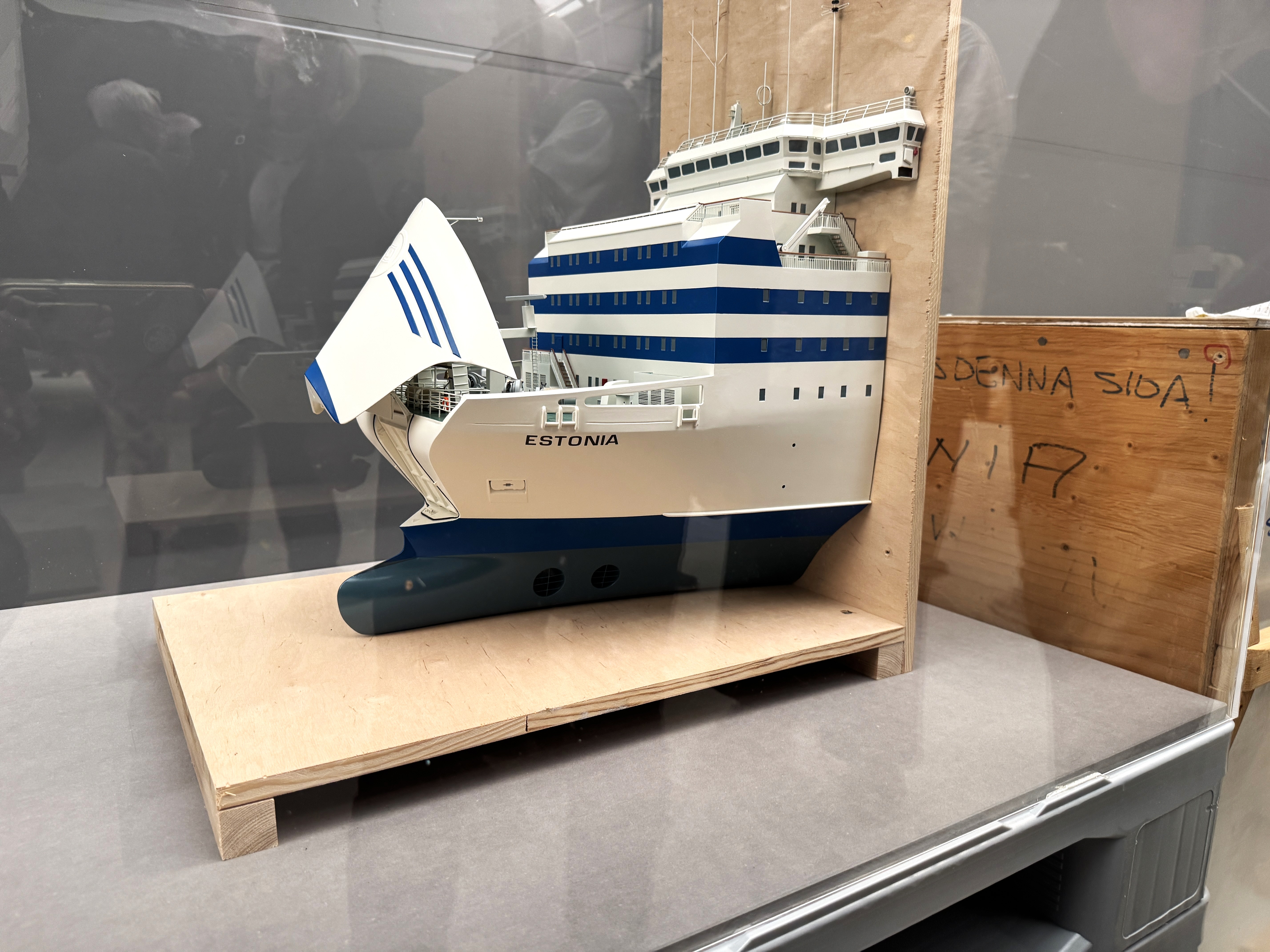
The official investigation revealed a design vulnerability that had haunted roll-on/roll-off ferries for years. The Estonia's bow visor, the hinged door that allowed vehicles to drive directly onto the car deck, failed in the rough seas. When it tore away, seawater flooded the vast, open car deck. Unlike compartmentalized ships, ro-ro ferries have no internal barriers to slow flooding on their vehicle decks. The free-flowing water created what engineers call the 'free surface effect,' rapidly shifting the ship's center of gravity. The same vulnerability had sunk the MS Herald of Free Enterprise seven years earlier, killing 193 people off the Belgian coast. A 2023 investigation confirmed the Estonia was not seaworthy when she sailed. Had proper inspections been conducted, investigators concluded, 'the vessel would not have been trading the Tallinn-Stockholm route' and 'the accident would probably not have occurred.'
Unanswered Questions
Few disasters have spawned as many conspiracy theories. In 2020, a Swedish documentary team sent underwater cameras to the wreck and discovered a four-meter hole in the hull that previous investigations had missed. The head of the Estonian investigation publicly suggested the damage pointed to a submarine collision. Other theories have alleged secret military cargo, nuclear material, even deliberate sabotage. A mysterious 10-page document that surfaced in the early 2000s, apparently from the Swedish Maritime Administration, claimed an explosion caused the sinking. It was proven to be a forgery in 2025. Swedish, Estonian, and Finnish authorities conducted extensive surveys between 2021 and 2023, using 3D laser scanning and sonar to map the wreck in detail. Their intermediate report found no evidence of collision with any vessel or floating object, and no indication of an explosion. The bow visor failure, exactly as originally determined, appears to have been the cause.
A Sea of Memory
Sweden is so small, survivor Rolf Sorman reflected, that basically everyone knew someone who drowned. In Estonia, the disaster became a generational touchstone. Mart Luik, an Estonian who lived through that night, said: 'I think all Estonians of a certain age remember where they were when they heard about the Estonia.' The Swedish newspaper Aftonbladet ran a single-word headline: 'Varfor?' Why? In 1995, Sweden, Finland, and Estonia declared the wreck a protected grave under international treaty. Thousands of tons of pebbles were dropped onto the site to discourage divers. The Finnish Navy monitors the location on radar to this day. Memorials stand in both Tallinn and Stockholm. In 2008, a monument called 'Dying Soldier' was erected at the Yli-Lemo Manor house to commemorate the victims. The disaster inspired Finland's most expensive television drama series ever produced, released in 2023, along with multiple documentaries, books, and haunting choral works including Veljo Tormis's 'Incantatio maris aestuosi.'
Changed Forever
The Estonia's sinking transformed maritime safety much as the Titanic had 82 years earlier. New International Maritime Organization regulations mandated automatic deployment of emergency position beacons, stricter ferry design standards, and enhanced crew training for passenger vessels. The accident was instrumental in requiring Voyage Data Recorders, the maritime equivalent of aircraft black boxes, on all passenger ships. New liferaft designs emerged specifically for rescue operations in rough seas from listing ships. The SOLAS 90 regulations, which came into effect in 2010, require all passenger ferries in Northwest European waters to maintain stability even with water flooding their car decks. The 'citadel concept' of ship design, inspired by the Estonia, aims to ensure damaged vessels have enough built-in buoyancy to stay afloat. But cost remains a barrier. The Estonia lies in 80 meters of cold Baltic water, a protected grave and an eternal warning about the price of cutting corners with safety at sea.
From the Air
The wreck site lies at 59.38°N, 21.68°E in international waters south of the Finnish island of Uto. From cruising altitude, you're looking at open Baltic Sea approximately 40 nautical miles southwest of Turku, Finland (EFTU). The nearest major airports are Helsinki-Vantaa (EFHK) to the northeast and Stockholm Arlanda (ESSA) to the west. The water here is deceptively calm in summer, but September storms can build rapidly. The wreck is not visible from the surface; only the coordinates on your navigation display mark where 852 people rest beneath the waves.