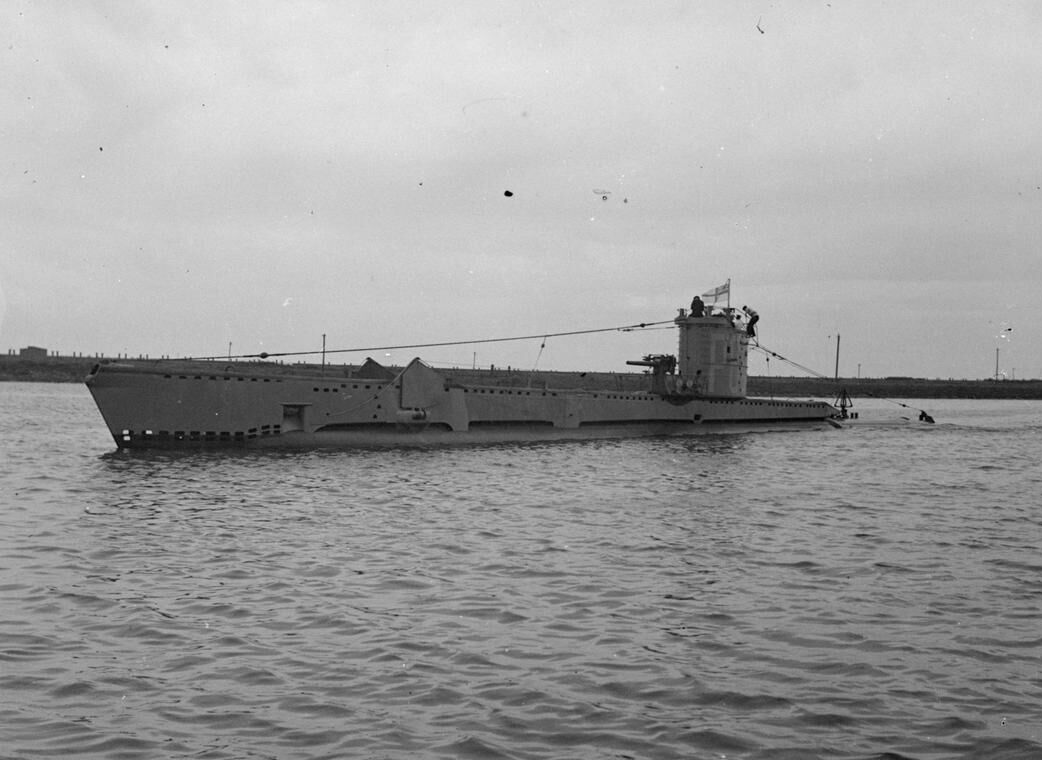
Sinking of U-864
It had never been done before and has never been done since. On February 9, 1945, HMS Venturer sank the German U-boat U-864 in the waters off Fedje Island, Norway, while both submarines were fully submerged. Standard naval doctrine held that the calculations required to hit a submerged, moving, zigzagging target from another submerged vessel were simply too complex to perform in combat. Lieutenant Jimmy Launders performed them anyway, firing four torpedoes at staggered depths with 17.5-second delays between each pair. The first three missed. The fourth did not.
Operation Caesar
U-864 was no ordinary submarine on a routine patrol. The Type IX U-boat, commanded by Korvettenkapitan Ralf-Reimar Wolfram, was on a clandestine mission called Operation Caesar, carrying secret cargo to the Empire of Japan. The British were reading German Enigma cyphers and knew what U-864 carried. The Royal Navy feared the cargo might enable the Japanese to extend the duration of the Pacific War. On February 6, 1945, U-864 passed through the waters off Fedje without being detected, but a diesel engine began misfiring. The sound was a death sentence in waters swarming with Allied anti-submarine patrols. Wolfram made the decision to turn back to the submarine pens at Bergen for repairs.
Hunting by Sound Alone
Venturer was already patrolling near Fedje when the Admiralty, armed with Enigma decrypts, ordered her to intercept and destroy U-864. The ASDIC operator aboard Venturer detected a faint hydrophone effect -- the sound signature of another vessel -- which faded and returned forty minutes later, louder. A thin mast was briefly spotted. To avoid revealing its own position, Venturer relied entirely on passive hydrophone tracking rather than active sonar. Launders and his crew tracked U-864 for approximately three hours, plotting its course by sound alone. The plot revealed a problem: the German submarine was zigzagging, a defensive maneuver that contemporary naval thinking considered an effective defense against underwater attack.
The Impossible Shot
Launders faced a decision with no good options. His batteries were draining -- he could not track the target indefinitely. In a conventional torpedo attack, the target was visible through the periscope, its angle and bearing observed, its range measured by a built-in rangefinder, its speed calculated, and a mechanical computer used to offset the aiming point. Here, none of that applied. The target was invisible, its depth unknown, its zigzag pattern only approximately predictable. Launders had to estimate everything: distance, bearing, speed, depth, and the timing of the target's defensive turns. He ordered all four bow torpedo tubes fired, each at different depths, with a 17.5-second delay between pairs. Then Venturer dove immediately to avoid retaliation.
Into the Path of the Fourth
U-864 heard the incoming torpedoes and attempted to evade. But the submarine lacked quick manoeuvrability -- retracting the snorkel, disengaging the diesel engine, and starting the electric motors all took precious time. The crew avoided the first torpedo. Then the second. Then the third. Each evasive turn, however, shifted U-864's position in ways Launders had anticipated. The submarine unknowingly steered into the path of the fourth torpedo. The explosion split U-864 in two. The boat sank with all hands, coming to rest on the sea floor off the Norwegian coast. Every member of the crew was lost.
The Only Time
Launders was awarded a bar to his Distinguished Service Order, and several crew members received honors. The sinking of U-864 remains the sole instance in the entire history of naval warfare of one submarine destroying another while both were submerged. The feat required not just skill and nerve but a willingness to attempt what doctrine explicitly deemed impossible -- calculations too complex for real-time combat, against a maneuvering target at an unknown depth. The wreck of U-864 still lies on the sea floor near Fedje, its cargo intact, a monument to a moment when a young British lieutenant decided the impossible was worth trying and was right.
From the Air
Located at 60.77N, 4.62E in the waters west of Fedje Island, off the Norwegian coast in the North Sea. Bergen Airport Flesland (ENBR) is approximately 80km to the southeast. The sinking site is in open water near the small island of Fedje, which is visible from altitude as part of the island chain along Norway's western coast. The wreck lies on the sea floor and is not visible from the surface. Best viewed at 3,000-5,000 feet to see Fedje and the surrounding Norwegian coastal waters. Bergen is to the southeast.