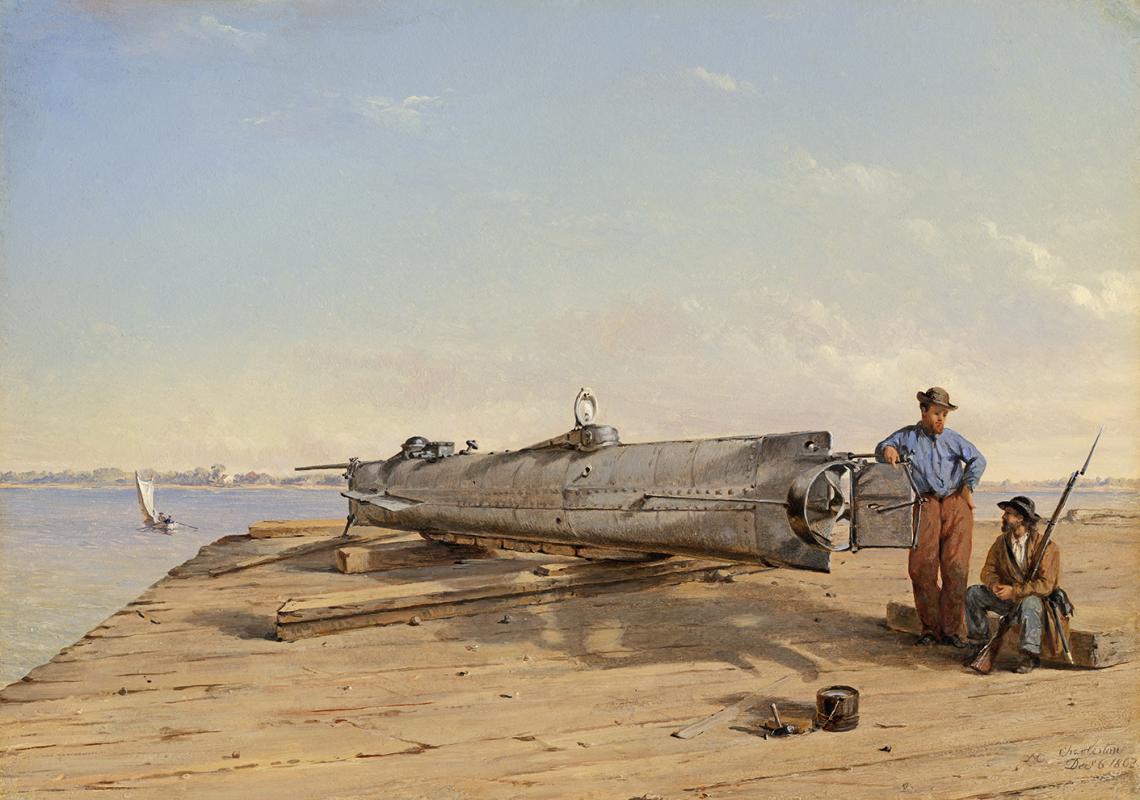
Sinking of USS Housatonic
Eight men sealed themselves inside a metal tube forty feet long and barely four feet wide. There was no engine - just a hand crank connected to a propeller. No periscope, no torpedoes in the modern sense - just a barbed spar bolted to the bow, tipped with 135 pounds of black powder. On the night of February 17, 1864, the Confederate submarine H.L. Hunley crept across Charleston Harbor toward the USS Housatonic, riding so low in the water that only its conning tower broke the surface. What happened next changed naval warfare forever and killed every man on both sides of the encounter who was close enough to feel the blast.
A Weapon Born of Desperation
By early 1864, the Union naval blockade was strangling Charleston. The Confederacy's fourth-largest city and one of its most important ports had been sealed off by a fleet of warships stationed at the harbor entrance. Breaking the blockade with conventional ships had failed. The H.L. Hunley was a radical alternative: a submarine built from an old iron boiler, fitted with ballast tanks and a hand-cranked propeller, designed to slip beneath the warships and destroy them with a spar torpedo. The concept was audacious. The execution had been deadly. During testing, the submarine had already sunk twice, drowning thirteen men in two separate accidents, including its namesake, Horace Lawson Hunley. The Confederate command raised the vessel each time, recruited new volunteers, and tried again. First Lieutenant George E. Dixon, who commanded the final crew, carried a gold coin in his pocket that had once stopped a bullet at the Battle of Shiloh. He would need every bit of that luck.
Eighty Minutes of Darkness
The USS Housatonic was a 1,240-ton sloop-of-war armed with twelve large cannons and manned by 150 sailors under Captain Charles W. Pickering. She was anchored off the coast at the entrance to Charleston Harbor, a sentinel of the blockading fleet. At approximately 8:45 p.m., the H.L. Hunley began its approach. The harbor was calm. The submarine moved just beneath the surface, its low profile almost invisible against the dark water. A lookout on the Housatonic spotted something unusual - a ripple, a shape - in the final moments before impact. The alarm sounded, but there was no time to bring the heavy guns to bear on a target sitting at the waterline. Crewmen fired small arms at the approaching shadow. The Hunley drove its spar torpedo into the Housatonic's starboard hull near the stern, then reversed to pull away before detonating the charge. The explosion was strangely quiet - first-hand accounts say the crew of the Housatonic heard no blast. But the ship began sinking immediately, stern first, listing to port. Within five minutes, the Housatonic was partially submerged. Five men - two officers and three crewmen - went down with the ship.
The Blue Light That Never Returned
The H.L. Hunley had done what no submarine had ever done: sunk an enemy warship in combat. But the victory was Pyrrhic. The submarine never returned to its base on Sullivan's Island. The commander of Fort Moultrie reported seeing prearranged signals from the submarine after the attack - a pyrotechnic flare known as a "blue light," a standard U.S. Navy signal of the era. A lookout clinging to the Housatonic's rigging also reported a blue light moving across the water. Then nothing. For over a century, the fate of the Hunley remained one of the Civil War's enduring mysteries. The prevailing theory held that the submarine was destroyed by its own torpedo blast. But the signal sighting suggested the crew survived the attack, at least briefly. The truth lay buried in the sand and silt of Charleston Harbor.
Raised from the Deep
In 1995, a team led by novelist Clive Cussler located the Hunley on the harbor floor. The submarine was raised in 2000 and brought to a conservation laboratory in North Charleston. Inside, archaeologists found the skeletal remains of all eight crew members at their stations along the crank shaft, with no signs of panic or attempt to escape. George Dixon's lucky gold coin was recovered from the sediment. New evidence announced in 2017 revealed that the Hunley was much closer to the point of detonation than previously believed. Researchers theorized that the blast itself killed the crew instantly through concussive force - a finding consistent with the crew's undisturbed positions. The submarine drifted and settled to the bottom with its dead crew still inside, a sealed tomb that preserved the story of their final mission for 136 years.
Where the Water Remembers
The waters off Charleston's coast look unremarkable from the air - flat, tidal, a muted green stretching toward the Atlantic. But beneath the surface, this harbor holds one of the most significant naval battlefields in American history. The Housatonic's wreck site was designated as the first federally protected underwater archaeological site. The Hunley itself, after years of painstaking conservation, remains one of the most studied artifacts of the Civil War. The attack lasted only minutes. The submarine was lost the same night. But the consequences rippled forward through every naval conflict that followed. Every submarine that has ever put to sea carries the DNA of what eight men accomplished in a hand-cranked iron tube on a cold February night off Charleston.
From the Air
Located at 32.72N, 79.80W in the waters off Sullivan's Island at the entrance to Charleston Harbor, South Carolina. The attack site is approximately 4 miles southeast of the Charleston peninsula in open water. From the air, the harbor mouth is defined by Sullivan's Island to the north and Morris Island to the south, with Fort Sumter visible on its shoal between them. Fort Moultrie on Sullivan's Island is where the Hunley launched its mission. Charleston Executive Airport (JZI) is approximately 8 miles to the west; Charleston International Airport (KCHS) is 14 miles northwest. Best viewed at 1,500-3,000 feet to appreciate the harbor geography and the distances involved in the attack.