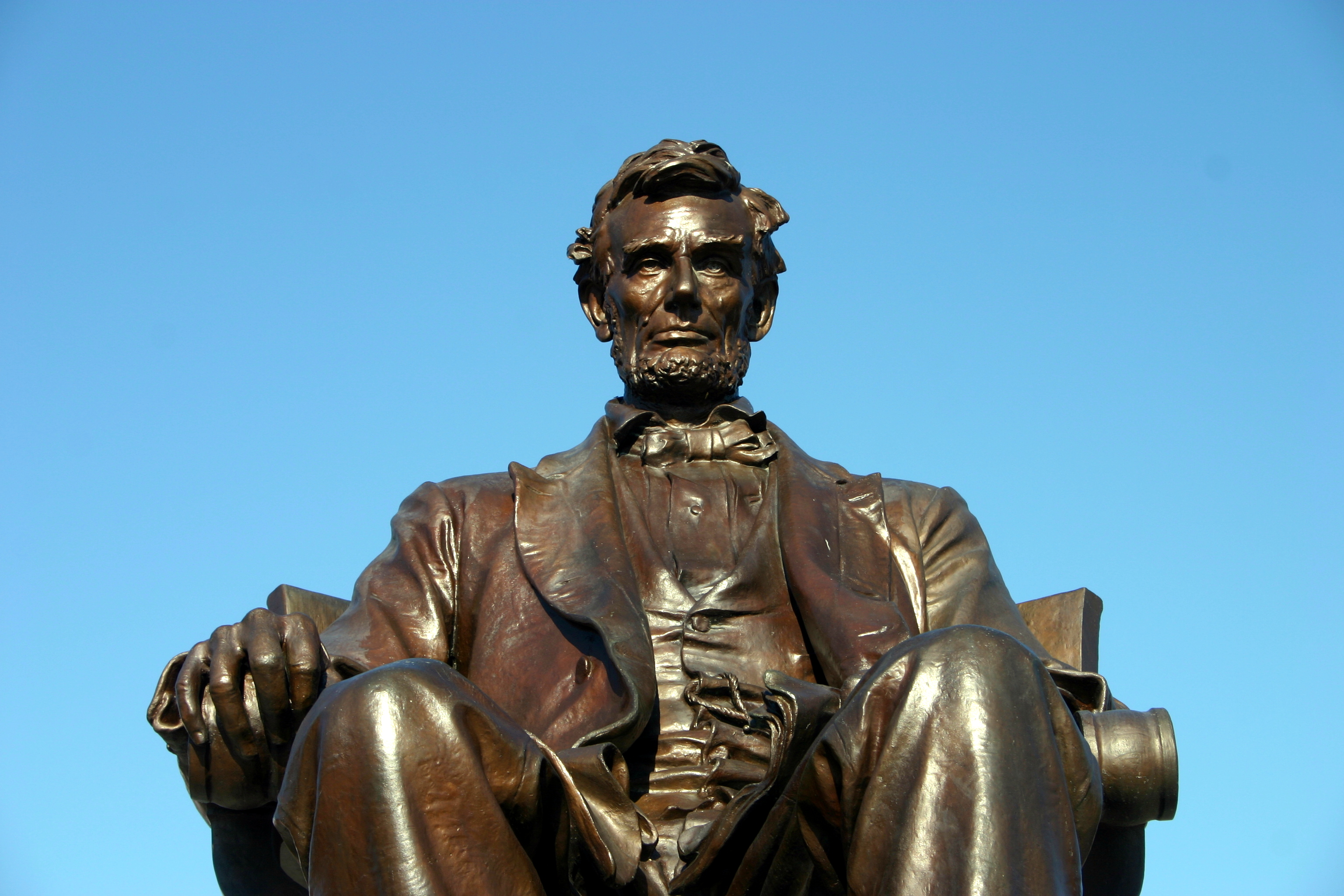
Abraham Lincoln Birthplace
Fifty-six steps lead up to a Beaux-Arts temple of pink Connecticut granite and white Tennessee marble standing on a Kentucky hillside. One step for each of Lincoln's years. Inside the temple, under sixteen rosettes for the sixteenth president, lit from sixteen windows for the same reason, sits a small one-room log cabin. The National Park Service calls it the Symbolic Birth Cabin, and the careful word matters - because the cabin is not the one Lincoln was born in. The original almost certainly burned or rotted in the 1860s. The cabin under the marble was hauled around the country as a circus exhibit, mixed at some point with logs from Jefferson Davis's birthplace eight miles away, and finally shrunk to fit inside the building meant to honor it. None of this is a secret. The Park Service tells you all of it, in careful curatorial language, right there in the gift shop. The temple does not enshrine a cabin so much as a story about America - that greatness can emerge from anywhere, that the rough log of frontier origins can be made monumental by national will. The architectural irony stares right back at every visitor: a granite temple over twelve by seventeen feet of borrowed wood. Lincoln himself would probably have laughed.
Sinking Spring Farm
On February 12, 1809, Nancy Hanks Lincoln gave birth to a son in a one-room log cabin on three hundred acres of poor Kentucky soil. Thomas Lincoln, the boy's father, had bought the property the previous December. The farm took its name from a peculiar local feature: a cold limestone spring that emerges directly from the mouth of a small cave at the base of a knoll. The spring still flows. You can walk down a short path from the memorial and drink from it, more or less as the Lincolns did. The water is the only thing on the site that hasn't been built, rebuilt, sold, or argued over. The Lincolns themselves did not last long here. Thomas's title to the land was tangled in a Kentucky property dispute - the state's pre-statehood land records were notoriously bad - and by 1811, the family had moved a few miles north to Knob Creek, then onward to Indiana when Abraham was seven.
The Traveling Cabin
What happened to the original birth cabin after 1811 is genuinely unknown. The most honest answer is that it probably collapsed and was used as firewood. In November 1894, a New York businessman named Alfred W. Dennett bought the Lincoln farm and reassembled a one-room log cabin on the spot, using old logs - some perhaps from the original cabin, many certainly not. Dennett then took the cabin apart and toured it as a paid exhibit, like a freak-show feature: the cabin where Lincoln was born, ten cents to view. When the Lincoln Farm Association acquired the cabin from Dennett's bankruptcy in 1906, they tried to reassemble it and ran into a problem worth pausing on. The logs would not fit together correctly. They had been mixed at some point with logs from a different cabin - the one used to exhibit Jefferson Davis's birthplace, eight miles to the south. The Civil War's two presidents had been born inside the same geological neighborhood, and at some point a careless promoter had shuffled their walls together.
Building a Temple
The Lincoln Farm Association, by 1906, included a long roll of the era's progressive establishment - Mark Twain among them, and the publisher Robert Collier driving the fundraising. Over a hundred thousand Americans donated to build a national memorial; the campaign raised nearly $350,000. John Russell Pope, who would later design the Jefferson Memorial, was hired for the architecture. Pope chose the Beaux-Arts vocabulary of civic temples: classical columns, granite steps, marble walls, symbolic numerology. Construction ran from 1909 to 1911. On November 9, 1911, President William Howard Taft dedicated the memorial in front of a crowd of three thousand. There was just one small problem with installing a frontier log cabin inside a classical temple. The cabin Dennett had assembled was sixteen by eighteen feet. The interior chamber of Pope's building was smaller than that. So workers cut the cabin down to twelve by seventeen feet. The Symbolic Birth Cabin is symbolic in part because pieces of it were sawed off to fit.
What's Honest About the Site
The strange power of the Lincoln Birthplace comes from how openly the National Park Service handles all of this. The official literature uses the word symbolic without flinching. Rangers will tell you the cabin's provenance is questionable and that some of its logs may have come from Jefferson Davis's birthplace. The Park Service does not pretend. What they preserve instead is the more durable artifact: the idea that Lincoln's origins were humble, the idea that American democracy can lift a one-room cabin to the presidency, the idea that monuments to greatness do not require literal relics. The Sinking Spring, after all, is unquestionably real. Lincoln's mother carried water from it. The knoll is the same knoll. The Kentucky earth he was born on is exactly where he was born. The temple holds a story rather than a thing, and the story is the part that mattered.
Visiting the Birthplace
Abraham Lincoln Birthplace National Historical Park is on Highway 31E near Hodgenville, Kentucky, roughly fifty miles south of Louisville. The memorial building, the cabin inside it, and the Sinking Spring are all accessible by short walks from the visitor center, which screens a fifteen-minute film on the family's frontier years. Eight miles up the road, the park's Knob Creek Farm unit preserves the second Kentucky farm where the Lincolns lived from 1811 to 1816 - the site Abraham himself recalled in adulthood, since he was old enough to remember it. Louisville International Airport (SDF) is the closest major airport, fifty miles north on I-65. Hodgenville itself hosts a downtown Lincoln statue and an annual February 12 birthday observance. Plan a half day; the contemplative pace of the site rewards it more than a quick stop does.
From the Air
Located at 37.53°N, 85.73°W in LaRue County, Kentucky, fifty miles south of Louisville. From altitude, the birthplace site appears as a small green park set into rolling farmland of central Kentucky's Pennyroyal region. The white memorial building is visible on a low knoll above the Sinking Spring. The surrounding landscape - small farms, hardwood patches, low wooded ridges - looks much as it did in Lincoln's time. The Knob Creek unit lies eight miles northeast. Louisville (SDF) is the nearest major airport; Bowling Green-Warren County (BWG) lies sixty miles southwest. Bardstown and the Kentucky Bourbon Trail are a short flight northeast.