Sint Eustatius
The Dutch called it Nieuw Zeeland before they renamed it after a Christian martyr. The British called it a nest of villains. The Americans owed it their revolution. Sint Eustatius, known locally as Statia, is a volcanic island of just 21 square kilometers in the Leeward Islands, and for a brief, extraordinary period in the 18th century, it was the wealthiest trading post in the Caribbean. Today about 3,270 people live on the island that once held 10,000, and most of the world has forgotten the role this tiny rock played in the birth of a nation.
Emporium of the World
Statia's golden age defied logic. The island had no natural resources to speak of, no great fortifications, and no army. What it had was neutrality. As a Dutch free port, it operated outside the jealously guarded trade monopolies of the British, French, and Spanish empires, and every nation found it useful to keep things that way. Edmund Burke described it in 1781: 'Its utility was its defence. The universality of its use, the neutrality of its nature was its security and its safeguard.' Warehouses lined the waterfront along what is now called Lower Town, and the harbor teemed with ships from every colonial power. The island earned its nickname, 'the Golden Rock,' not from minerals in the ground but from the commerce that flowed across its docks. At its peak, the harbor might hold over a hundred ships on any given day.
The First Salute
On November 16, 1776, the American brig Andrew Doria sailed into the harbor of Sint Eustatius carrying a copy of the Declaration of Independence and a request for munitions. As the ship fired a thirteen-gun salute announcing its arrival, Governor Johannes de Graaff ordered Fort Orange to answer with eleven guns. It was the first formal acknowledgment of the United States by a foreign official. The moment's significance was not lost on anyone. An earlier copy of the Declaration had been intercepted by the British; its wrapping papers, written in Yiddish for a merchant in Holland, had been mistaken for a secret cipher. In 1939, President Franklin D. Roosevelt sailed to Statia aboard the USS Houston to present a brass plaque commemorating the event. It still hangs at Fort Orange today. The historian Barbara Tuchman made the episode the centerpiece of her 1988 book, The First Salute.
Layers Beneath the Golden Rock
The wealth that made Statia famous was built on suffering. The island served as a transit point in the transatlantic slave trade, and the Dutch West India Company built a two-story depot at the Waterfort to hold 400 to 450 enslaved Africans awaiting transshipment to British, French, and Spanish colonies. Plantations of sugarcane, cotton, tobacco, coffee, and indigo covered the island's slopes, worked by enslaved people. By 1790, the census recorded 8,124 inhabitants, the majority of them enslaved. In 1848, a group of free and enslaved Africans gathered before the lieutenant governor's home to demand liberty. The militia opened fire, killing two and wounding several. The six leaders were exiled to Curacao. Thomas Dupersoy, a free African, is remembered as the chief leader. Slavery was formally abolished in the Dutch territories in 1863, among the last colonial powers to do so.
Merchants of the Diaspora
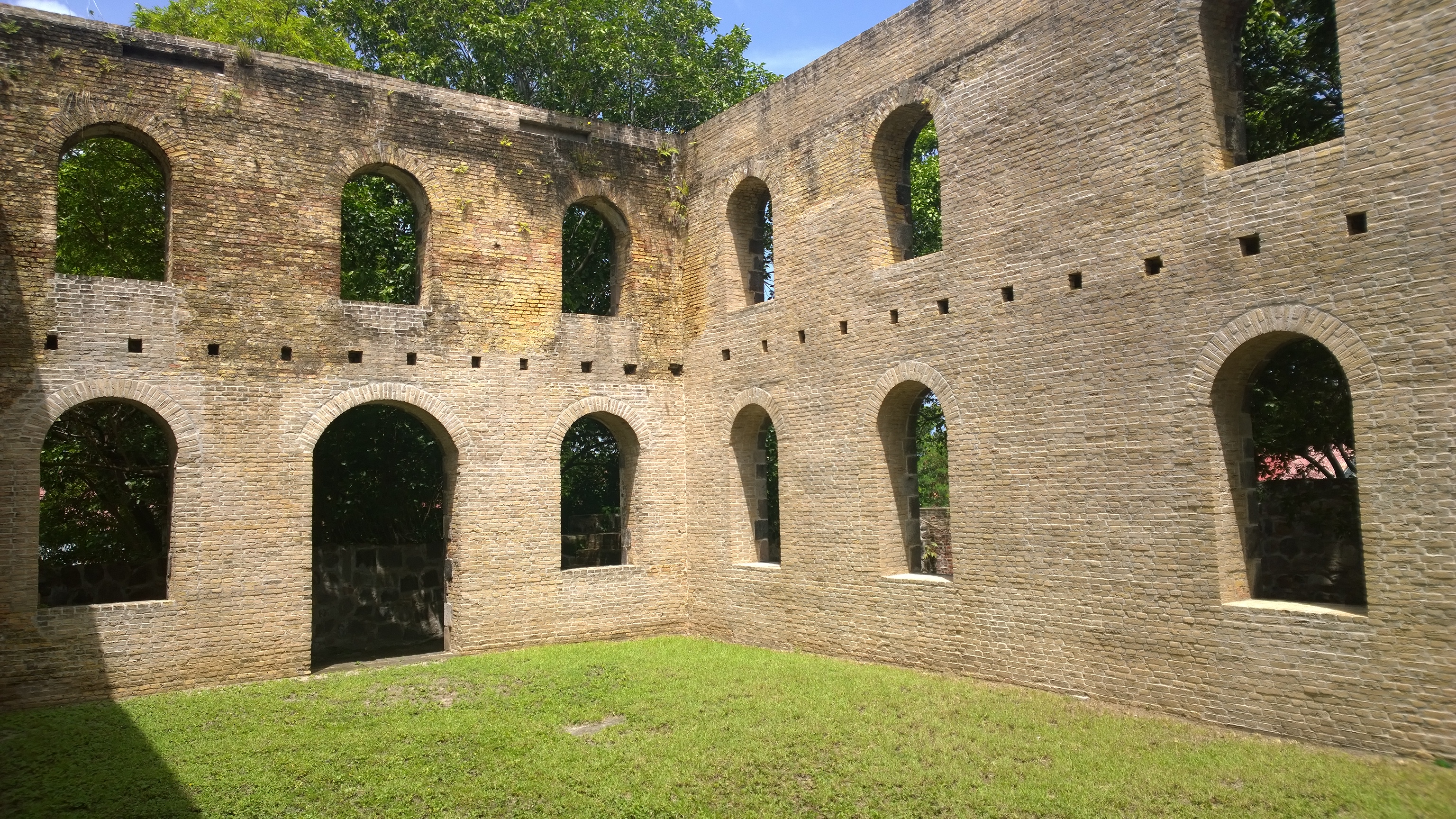
The Jewish community of Sint Eustatius was central to the island's commercial network. The first Jews arrived by 1660, and by 1750 they comprised more than half of the island's free population, with over 450 individuals among 802 free citizens. They served as ship captains, merchants, and plantation owners, their trading connections spanning the Atlantic. In 1737, the community built a synagogue called Honen Dalim, meaning 'He who is charitable to the Poor.' When Admiral Rodney captured the island in 1781, he singled out the Jews for especially harsh treatment, deporting families with 24 hours' notice, imprisoning 101 men, and even digging up the cemetery in search of hidden treasure. The community eventually returned, but never fully recovered. The synagogue fell into ruin after 1815; its walls were restored in 2001, and today the Jewish cemetery at the top of Oranjestad is respectfully maintained as a memorial to the community that helped build the Golden Rock.
Statia Today
The island that changed hands twenty-one times between the Netherlands, Britain, and France finally settled under permanent Dutch control in 1816, and became a special municipality of the Netherlands in 2010. The boom was long over. The population dropped to 921 by 1948 before slowly recovering to its current 3,270. What remains is archaeologically extraordinary: nearly 300 documented sites, giving Statia one of the highest concentrations of archaeological sites per square kilometer anywhere in the world. The dormant volcano known as the Quill dominates the southern end of the island, its crater now lush with rainforest. Three nature parks protect the land and surrounding waters, and Statia is home to one of the last remaining populations of the critically endangered Lesser Antillean iguana. The Golden Rock is quiet now, its harbor empty of the hundred-ship days, but the ruins of warehouses and fortifications still line the waterfront, monuments to an age when this speck of land helped redraw the map of the world.
From the Air
Sint Eustatius lies at 17.48°N, 62.97°W in the northern Leeward Islands. The island's dominant feature from the air is the Quill, a dormant volcano at the southern end rising to 601 meters. The runway at F.D. Roosevelt Airport (TNCE) is visible along the northern coast. Fort Orange and the historic Lower Town waterfront are on the western shore. Saba (TNCS) is visible 16 nm to the northwest, and St. Kitts (TKPK) lies about 8 nm to the southeast. Approach from the west for the best view of the harbor where the First Salute was fired.