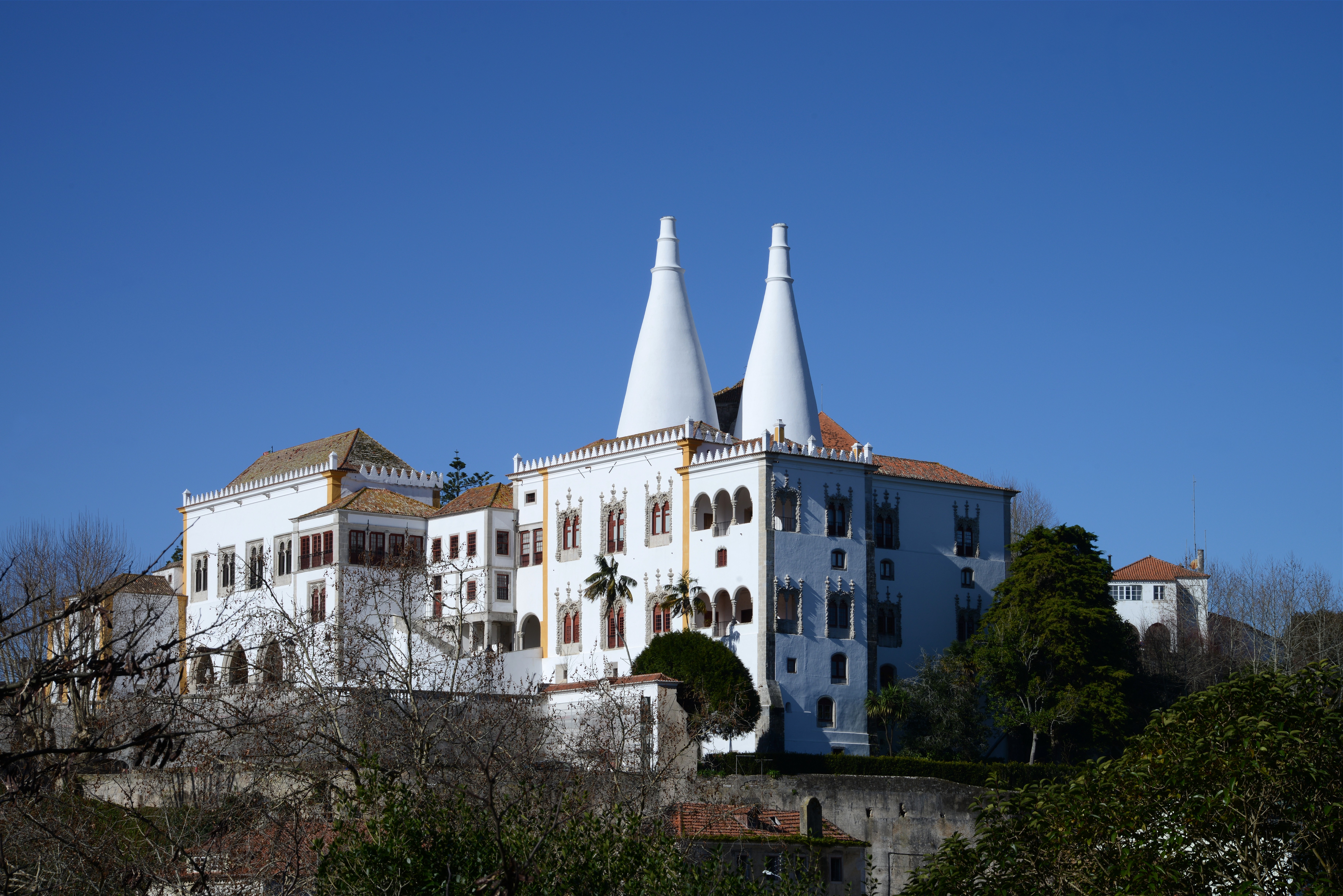
Sintra National Palace
Two enormous white chimneys rise above the town of Sintra like a pair of wizard's hats. They belong to the kitchen of the Sintra National Palace, and they have been the town's most recognizable feature for six hundred years. The palace beneath them is the best-preserved medieval royal residence in Portugal, inhabited more or less continuously from the early 15th century to the late 19th — a span that left it layered with the architectural preferences, political dramas, and domestic secrets of more than a dozen Portuguese monarchs. Unlike Portugal's grander palaces, this one was lived in. The rooms smell of use, not ceremony.
From Al-Andalus to Aviz
The palace's origins lie in the Moorish period. During the centuries when this region belonged to Al-Andalus, following the Umayyad conquest of Hispania in the 8th century, two fortifications stood at Sintra: the hilltop Castelo dos Mouros and a lower residential palace for the Taifa of Lisbon's rulers. The Arab geographer Al-Bakri provided the earliest written mention. When King Afonso Henriques conquered the village in the 12th century, he took the lower palace for his own. Nothing from the Moorish era survives in the current structure, but the building's character — its intimate scale, its courtyards with Islamic-style water pools, its blend of Gothic, Manueline, Moorish, and Mudéjar styles — remembers a time when this hillside looked south toward Cordoba rather than east toward Rome.
Magpies, Swans, and Royal Gossip
King John I launched a major building campaign around 1415, creating the rooms that give the palace its personality. The Swan Room features a Manueline ceiling painted with swans — thirty of them, matching the age of Infanta Isabel at her marriage to Philip the Good of Burgundy. More entertaining is the Magpie Room, where painted magpies hold the motto 'por bem' (for honor) in their beaks. According to palace tradition, John I was caught kissing a lady-in-waiting by Queen Philippa of Lancaster, and to silence the gossip, he had the room decorated with as many magpies as there were women at court. Whether the story is true or merely well-told, it captures the palace's domestic character — this was a place where kings got caught misbehaving and queens had opinions about it.
Manuel's Tiles and the Coat of Arms Room
King Manuel I, flush with the wealth of the Age of Discoveries, added the Manueline Wing and the Coat of Arms Room between 1497 and 1530. The Sala dos Brasões, built from 1515 to 1518, is the palace's crown jewel: a magnificent wooden coffered dome ceiling decorated with 72 coats of arms of the King and the principal Portuguese noble families. One coat of arms is conspicuously absent — the Távora family's heraldry was removed after their conspiracy against King Joseph I, a deletion that speaks as loudly as any of the surviving emblems. Manuel also redecorated most rooms with polychrome azulejo tiles specially made in Seville, their Mudéjar motifs transforming the palace's surfaces into geometric fields of color. The Arab Room features a Moorish-style fountain at its center, a quiet survival of the building's earliest cultural layer.
A Prisoner King and an Enduring Monument
The palace's saddest chapter belongs to Afonso VI, who was deposed by his brother Peter II and confined here from 1676 until his death in 1683 — seven years pacing rooms that had once hosted coronations. The 1755 Lisbon earthquake damaged the building, and the tower above the Arab Room collapsed, but restoration preserved the palace's essential character. During the 19th century, Sintra became fashionable again, and the palace saw frequent royal use. Queen Amélie of Orléans was particularly fond of the building, making drawings of its interiors. After the 1910 revolution, it became a national monument. Architect Raul Lino restored it in the 1940s, furnishing it with period pieces from other palaces. Today, part of the UNESCO Cultural Landscape of Sintra, the palace stands as a rare example of a medieval royal home that retained its domestic scale while the world around it grew ever more monumental.
From the Air
Located at 38.798°N, 9.391°W in the town center of Sintra. The palace's two massive conical kitchen chimneys are its most distinctive aerial feature — white cone shapes rising above the rooftops that are visible from considerable distance. The palace sits in the valley below the Pena Palace (hilltop) and the Castle of the Moors (ridge-top ruin). Recommended viewing altitude: 2,000-4,000 ft. Nearest airport: Lisbon/Humberto Delgado (LPPT) approximately 30 km southeast. The Sintra Mountains to the south and west create orographic effects; approach from the east for clearest views of the town and palace.