Siong Lim Temple
When Low Kim Pong was sixty years old, he dreamed of a golden light rising from the west over the sea. The wealthy Hokkien merchant took this as an omen and went to the coast the following evening. At dusk, he encountered a family arriving by boat - Buddhist pilgrims returning to Fujian province after visiting Sri Lanka, every member having taken monastic vows. Moved by their devotion, Low made them a promise: stay in Singapore, and I will build you a temple. That promise, made in the late nineteenth century, became Lian Shan Shuang Lin Monastery - the Twin Grove of the Lotus Mountain - Singapore's oldest Buddhist monastery and one of its most remarkable survivors.
A Merchant's Promise
Low Kim Pong was not merely wealthy; he was devout. The 40,000-square-metre site he donated for the monastery reflected both his fortune and his faith. Construction began in 1902, five years after the temple's founding in 1898, and was completed in 1907. The head of the pilgrim family, Hsien Hui, became the monastery's first abbot. Funding came from Low and Yeo Poon Seng, a sawmill pioneer whose timber connections likely proved practical as well as financial. The name Shuang Lin - Twin Grove - refers to the sala trees at Bodh Gaya in India, where Buddhists believe the Buddha attained enlightenment. From the beginning, the monastery was meant to carry the weight of that reference: not a neighborhood shrine but a place of serious monastic practice, modeled after Xi Chan Si, a renowned temple in Fuzhou, Fujian province.
Layers of Forest, Layers of Craft
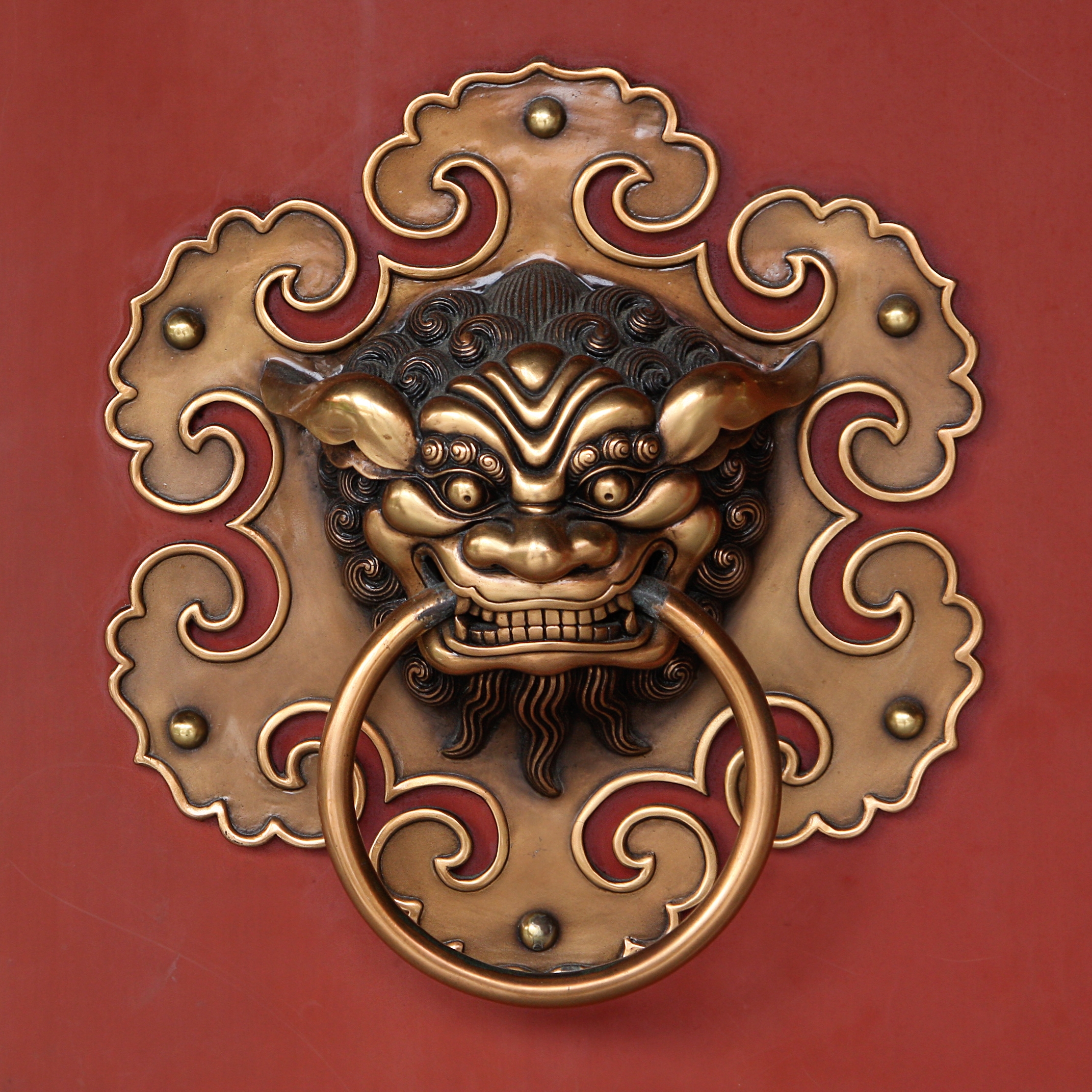
The temple's architectural style is called cong lin - literally "layers of forest" - a Chinese Buddhist tradition in which buildings follow a standardized layout and monks maintain a strict daily routine of scripture study and meditation. Chinese craftsmen built the original structures using materials imported from Fujian, and the details reveal the diversity of southern Chinese building traditions. Fuzhou-style square beams and Quanzhou-style round beams support the upper and lower tiers of the Da Xiong Bao Dian, the main hall, while intricate Zhangzhou-style wood carvings crown the roof of the Tian Wang Dian, the Hall of Celestial Kings. Teochew artisans contributed porcelain mosaic ornamentation called chien nien to the roof ridges. The main gate, or Shan Men, rises over nine meters tall, its stone pillars inscribed with Chinese calligraphy and its central door fitted with a bronze knocker gripped by a creature representing one of the nine sons of the dragon.
Shrinking Ground, Enduring Presence
Tropical weather, termites, and the steady wear of worshippers began degrading the buildings as early as 1910. Major restorations followed in 1918-1919 and again between 1950 and 1954. But the greater threat came from Singapore's postwar housing crisis. In the 1950s, the Singapore Improvement Trust acquired half the temple's land for public housing, reducing the grounds from 40,000 to roughly 20,000 square metres. Today, the monastery sits in Toa Payoh, one of Singapore's earliest public housing estates, its ornate rooflines and gold-topped pagoda rising among ranks of utilitarian HDB apartment blocks. The contrast is striking - ancient carved timber against poured concrete - yet the temple has become an integral part of the neighborhood rather than an anachronism within it.
A Decade of Restoration
Gazetted as a national monument on 17 October 1980, the monastery soon revealed the cost of that distinction. A structural safety check uncovered cracks in the timber roofs and walls, prompting the formation of the Shuang Lin Restoration and Preservation Committee in 1990. Planning began the following year, with experts consulted in China, Hong Kong, and Taiwan on how to restore the buildings without sacrificing authenticity. Approximately eighty carpenters, sculptors, and artisans were brought from China to perform the work. The restoration stretched across a full decade, as the team painstakingly preserved original elements wherever possible. When the final phase was completed in 2001, roughly S$40 million had been spent - a sum that reflected both the complexity of the work and the cultural value Singapore placed on this particular piece of its immigrant heritage.
Between Expressway and Eternity
The monastery stands today beside the Pan Island Expressway, its seven-storey gold-topped pagoda - a replica of the 800-year-old Shanfeng temple pagoda in Fujian - visible above the rooftops and highway noise. The temple includes a columbarium where families visit during the Qing Ming Festival to honor their ancestors. Monks still observe the cong lin tradition of ordered monastic life. The name that locals have used for over a century, Siong Lim Temple, is the Hokkien pronunciation; the Mandarin name, Lian Shan Shuang Lin, appears on official signage. Both names coexist, much as the temple itself coexists with modern Singapore - a 19th-century monument to immigrant faith, surviving expressway construction, land acquisition, and termites, still marking the spot where a merchant's dream and a pilgrim family's journey happened to intersect.
From the Air
Located at 1.330°N, 103.858°E in the Toa Payoh district of central Singapore, adjacent to the Pan Island Expressway. The seven-storey gold-topped pagoda is a distinctive visual landmark, rising above the surrounding HDB residential blocks. Nearest airports: Singapore Changi Airport (WSSS) approximately 16 km east, Seletar Airport (WSSL) approximately 8 km north. Best viewed at 1,500-2,500 feet where the pagoda contrasts with the surrounding housing estate grid.