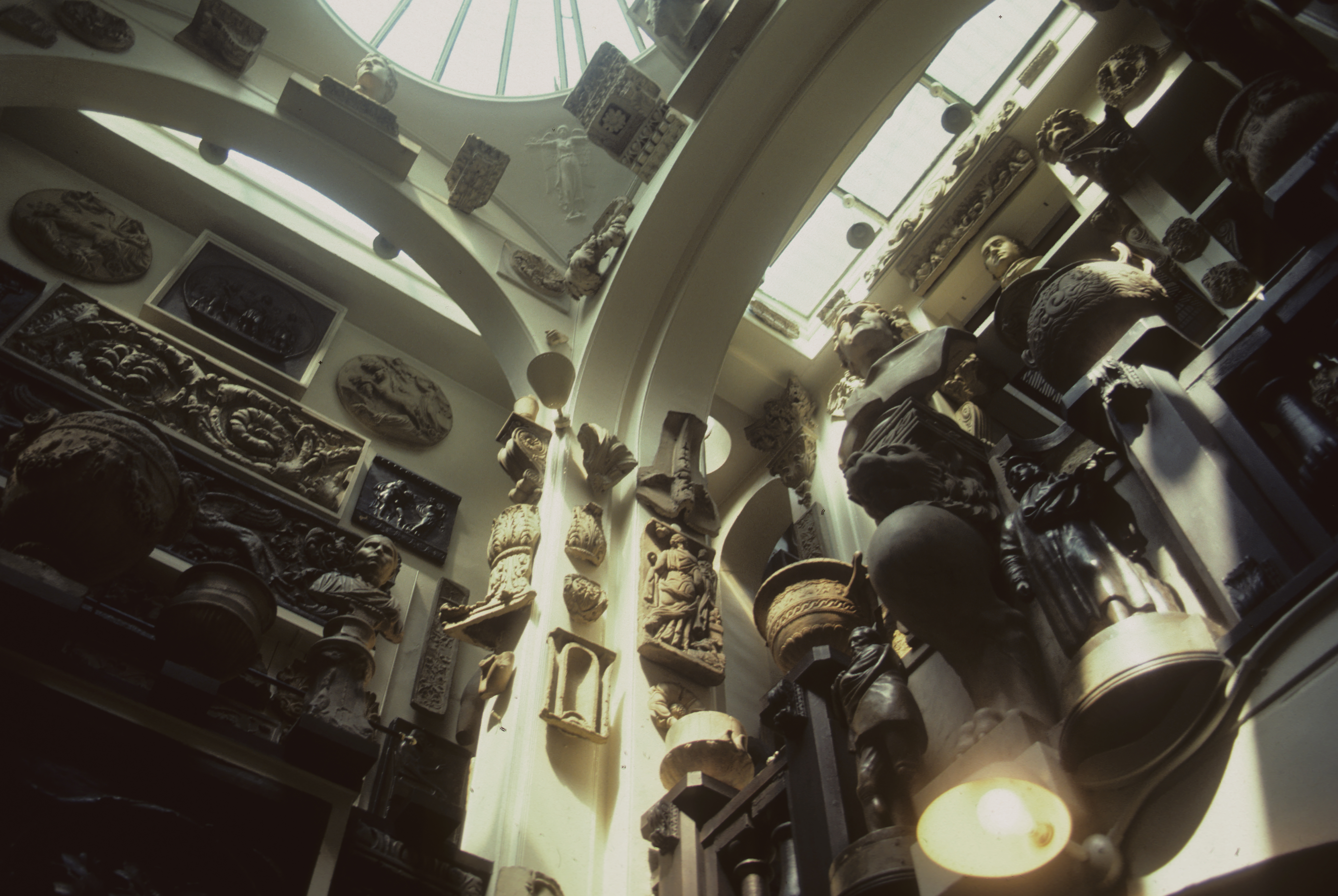
Sir John Soane's Museum
Sir John Soane hated his son so intensely that he persuaded Parliament to pass a law ensuring the boy would never inherit the house. The Sir John Soane's Museum Act of 1833 stipulated that upon the architect's death, his home at Lincoln's Inn Fields -- crammed floor to ceiling with antiquities, paintings, architectural models, and curiosities -- would pass to a board of trustees, to be preserved "as nearly as possible" in the state it was in when he died. Soane died in 1837. Nearly two centuries later, the house remains almost exactly as he left it, a single architect's obsession frozen in amber.
A Mind Made Visible
The museum occupies three adjoining townhouses at numbers 12, 13, and 14 Lincoln's Inn Fields, which Soane progressively acquired and rebuilt between 1792 and 1824. Walking through them is less like visiting a museum and more like entering someone's mind. Rooms are layered with objects in ways that seem chaotic until you realize every placement was deliberate. Soane designed ingenious architectural devices to maximize the display space within the Georgian townhouse footprint: hinged walls in the Picture Room swing open to reveal hidden paintings behind paintings, tripling the hanging area. Mirrors, skylights, and coloured glass create shifting plays of light that transform the rooms throughout the day. A model of the Bank of England, which Soane designed, sits in one room. An Egyptian sarcophagus occupies the basement crypt. The collection is simultaneously intimate and overwhelming.
The Hogarths and the Sarcophagus
Among the museum's most celebrated holdings is the complete set of William Hogarth's A Rake's Progress and The Election series, displayed in the Picture Room on those ingenious folding wall panels. Soane acquired the Rake's Progress at auction in 1802 for 570 guineas. The Egyptian sarcophagus of Pharaoh Seti I, dating to approximately 1279 BC, was Soane's most dramatic acquisition -- he purchased it in 1824 after the British Museum declined to buy it, and celebrated with a three-day party to which nearly a thousand guests were invited. The collection also includes casts of ancient sculptures, architectural fragments from demolished London buildings, medieval manuscripts, and over 30,000 architectural drawings, including works by Robert Adam and Christopher Wren.
The Architecture of Display
Soane was one of the most innovative architects of his generation, responsible for the original interiors of the Bank of England and Dulwich Picture Gallery, among other commissions. His house is itself his most personal work of architecture -- a laboratory where he tested ideas about light, space, and the relationship between old objects and modern structures. The Monk's Parlour, a Gothic fantasy in the basement, was designed as an atmospheric contrast to the neoclassical elegance of the upper floors. Soane created fictional backstories for the rooms, inventing a character called Padre Giovanni to inhabit the cloister and ruins. The house blurs the line between architecture, theatre, and obsession. Only 90 visitors are allowed inside at a time, preserving the sense of stumbling upon a private world that was never meant to accommodate crowds.
Preserved by Spite
The museum's survival in its original state is largely a consequence of family dysfunction. Soane's relationship with his son George deteriorated badly after George published anonymous attacks on his father's architectural work. The resulting bitterness drove Soane to the extraordinary step of securing a private Act of Parliament to ensure the house would become a public museum rather than pass to his heir. The act's stipulation that the collection be preserved unchanged has meant that curators have operated under restrictions no other museum faces. Objects cannot be rearranged to suit modern display conventions. Rooms cannot be repainted. The museum received no government funding until 1947, surviving on Soane's original endowment for over a century. Today it remains one of London's most unusual and intimate museums, a place where the boundary between house and collection has dissolved entirely, exactly as its vindictive, visionary creator intended.
From the Air
Located at 51.517N, 0.117W at 13 Lincoln's Inn Fields in Holborn, central London. The museum is a Georgian townhouse indistinguishable from its neighbours from the air, but Lincoln's Inn Fields -- London's largest public square -- serves as a reference point. Nearest airports: EGLC (London City, 6nm E), EGLL (Heathrow, 14nm W). Best viewed at 2,000-3,000 ft AGL.