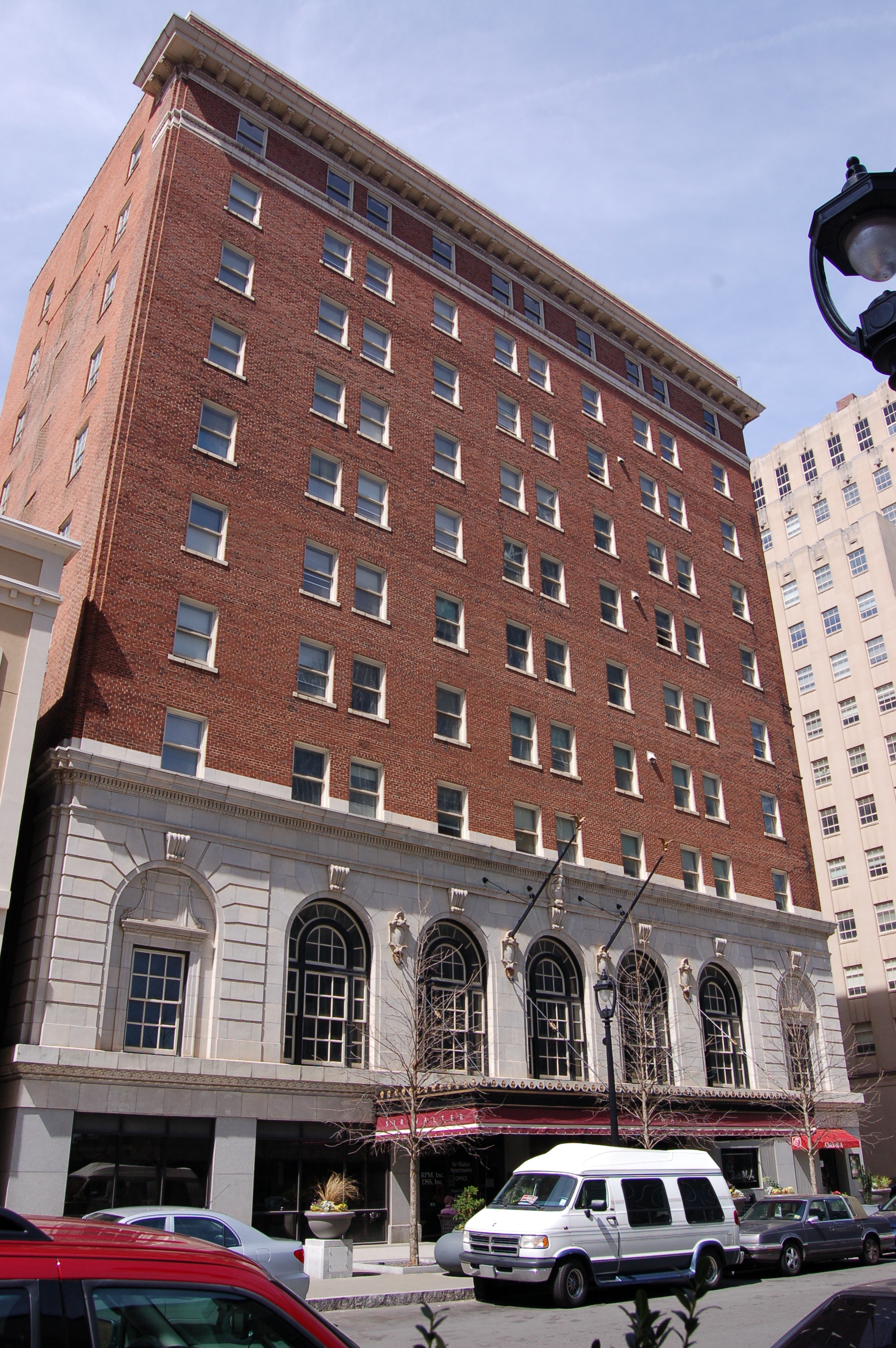
Sir Walter Hotel
Every week, nine cases of bourbon were delivered to Room 215. The liquor lobbyists who rented it would then slip bottles to state legislators in brown paper bags, a ritual so routine that nobody much bothered to pretend otherwise. U.S. Senator Sam Ervin, who would later preside over the Watergate hearings, called the Sir Walter Hotel "the most politically saturated inn in America." He was not exaggerating. From its opening in January 1924 through the 1960s, this ten-story brick building on Fayetteville Street in downtown Raleigh functioned as North Carolina's unofficial third house of government, a place where more deals were struck in the lobby and the dining room than on the floor of the General Assembly two blocks away.
Built to Steal Convention Traffic
The Sir Walter exists because Raleigh was losing. In the early 1920s, the state capital watched conventions drift to Greensboro and Durham, cities with better hotel accommodations. The Capital Construction Company formed in 1923 with a single goal: build something big enough to bring that business back. The result was the Hotel Sir Walter, named after the Elizabethan adventurer for whom the city itself was named. When it opened in January 1924, it was the largest building in the southern portion of Raleigh's business district. The hotel became the unofficial headquarters of the North Carolina Democratic Party, at the time the dominant political force in the state. By 1925, over 80 percent of the state legislature lived at the Sir Walter. Lobbyists, aides, jurors, newspapermen, and businessmen filled the remaining rooms. The hotel was not merely a place to sleep. It was the place where North Carolina governed itself.
Depression, Expansion, Dominance
The Great Depression forced the building's owners into bankruptcy in 1934. The North State Hotel Company leased and fully renovated it the following year. In 1938, the company added 50 rooms, making the Sir Walter the largest hotel in the state and cementing its reputation as North Carolina's premier convention destination. For the next two decades the hotel sat at the center of state power. Political operatives ran campaigns from its rooms. Judges held court in its restaurant. Journalists filed stories from its lobby. The building's L-shaped design, with classical stone ornamentation at the street and roof levels, became one of Raleigh's most recognizable silhouettes. The 10-story brick structure, typical of American hotels of the 1920s, was imposing enough to suggest permanence. That impression would prove misleading.
A Slow Unraveling
In 1956, the Robert Meyer hotel chain purchased the Sir Walter. But the 1960s brought changes the building could not absorb. Suburban motel development pulled travelers away from downtown. The completion of the new state Legislative Building gave legislators offices of their own, ending the tradition of governing from hotel rooms. General downtown decline did the rest. The Meyer chain sold in 1964. The hotel passed through a dizzying series of owners: a university that used its profits for student scholarships, a brief stint as the Sheraton-Sir Walter Hotel starting February 13, 1968, then a sale to Plaza Associates in early 1969 for $1.84 million. Plaza traded the hotel to developer Kidd Brewer on March 28, 1969 in exchange for the land on which Crabtree Valley Mall would be built. The hotel left the Sheraton chain and returned to its original name, but the damage was done. By 1975, the majority of the building had been converted to offices for the North Carolina Department of Transportation.
The Afterlife of a Political Inn
The Sir Walter was placed on the National Register of Historic Places on August 11, 1978, the same year Goldsboro developer David Weil purchased it. The designation preserved the building but could not restore its former life. The hotel evolved into senior apartments, a quiet reinvention for a building that once shook with the backroom energy of a one-party state. In 2017, an Ohio-based developer bought the property and announced plans to restore it, possibly returning it to hotel use. It changed hands again on January 2, 2019, selling for $16.8 million to Capital Realty Group, which committed to renovation while keeping the building as senior housing. The Sir Walter endures on Fayetteville Street, its classical stone details still catching the afternoon light, its lobby still echoing with the kind of history that most buildings never accumulate. The bourbon deliveries to Room 215 ended long ago, but the walls remember.
From the Air
The Sir Walter Hotel is at 35.775N, 78.640W on Fayetteville Street in downtown Raleigh, just south of the North Carolina State Capitol. The 10-story L-shaped brick building is visible among the downtown Raleigh skyline. Raleigh-Durham International Airport (KRDU) is approximately 12 nautical miles northwest. Best viewed at 2,000-3,000 feet AGL. Look for the classical stone ornamentation at the roofline along Fayetteville Street's corridor.