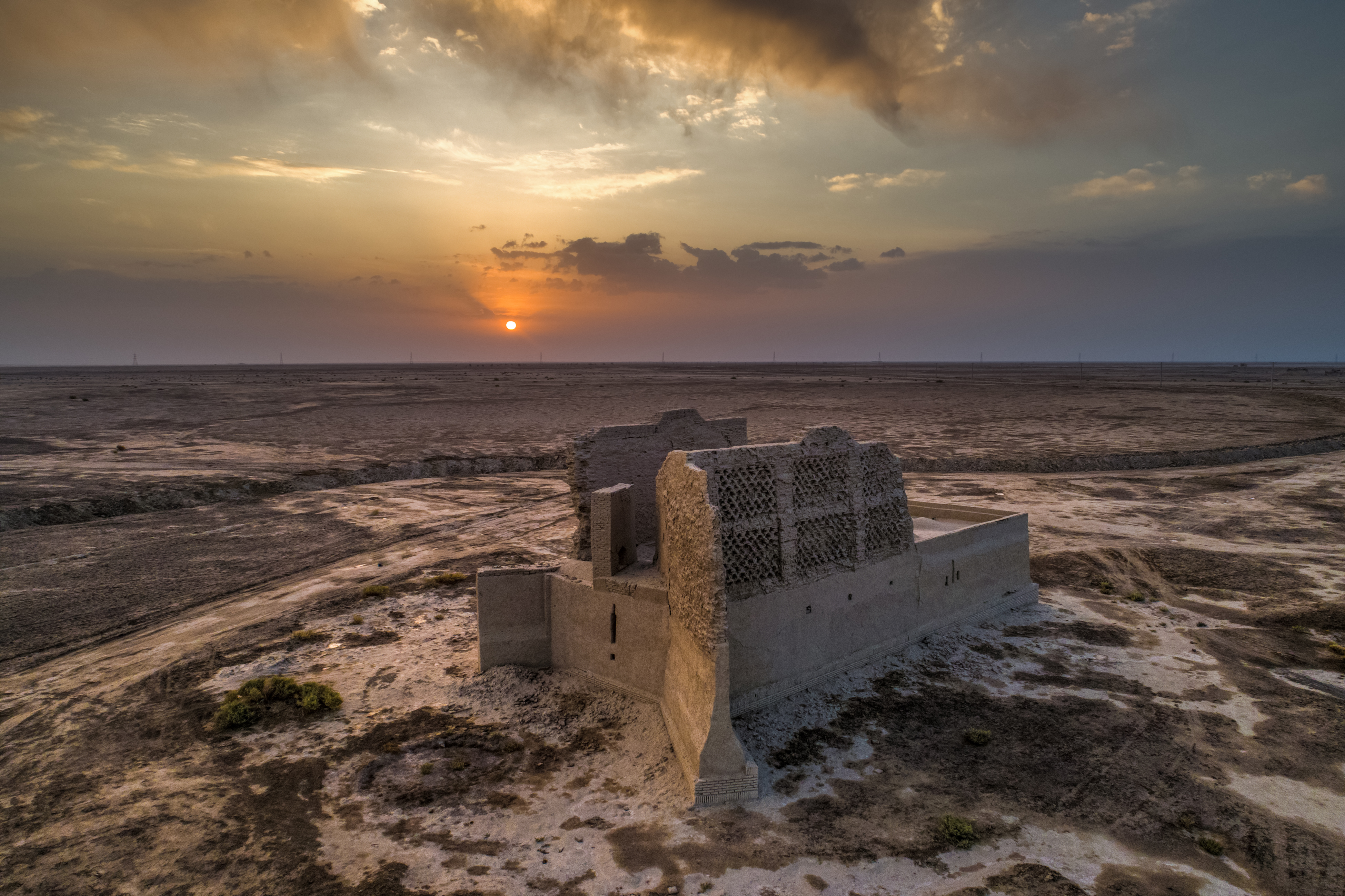
Sistan
The name means "land of the Saka." Those Scythian warriors rode down from the Central Asian steppe in the 2nd century BC, carved out a kingdom on the Iranian Plateau, and gave their name to a region that has outlasted every empire that tried to hold it. Sistan stretches across southeastern Iran into southwestern Afghanistan and Pakistan, a largely desert expanse bisected by the Helmand River, which empties into the shallow, seasonal Hamun Lake on the Iran-Afghanistan border. In the Shahnameh -- the great Persian epic -- this is the homeland of Rostam, the legendary hero whose feats define Iranian mythology. In the archaeological record, it is something equally remarkable: a crossroads where Bronze Age city-builders, Achaemenid administrators, Greek colonists, and Arab conquerors all built on top of one another's ruins.
The Burned City and the Bronze Age
Before the Saka arrived, before even the Persians, a massive city flourished here. Shahr-e Sukhteh -- the "Burned City" -- dates to the third millennium BC and belongs to what archaeologists call the Jiroft Civilization. Covering parts of Sistan and Kerman Province, this culture left behind a settlement so extensive that excavations have continued for decades without exhausting its layers. Nearby, the site of Nad-i Ali in present-day southwestern Afghanistan features a monumental Bronze Age platform. The archaeological site of Dahan-e Gholaman later served as a major Achaemenid center. These are not isolated outposts. They are evidence that Sistan was densely connected to networks of trade and administration long before Alexander the Great arrived in the 4th century BC and founded Alexandria in Arachosia, adding a Greek colony to a region already ancient.
Empires Stacked Like Sediment
To list Sistan's rulers is to recite the history of inner Asia in compressed form. The Medes governed parts of the region by 600 BC. The Achaemenids absorbed it in 550 BC. Alexander conquered it in the 330s BC, and his Seleucid successors traded it to the Mauryan dynasty of India in 305 BC. The Greco-Bactrians took it around 180 BC, followed by the Indo-Greeks, the Indo-Parthians under Gondophares, and then the Saka themselves, whose arrival gave the region its lasting name. The Parthian Empire incorporated Sakastan around 100 BC, lost it briefly to Suren vassals, and watched the Kushans rise and fall before the Sasanian Empire absorbed everything in the mid-3rd century AD. When the Rashidun Caliphate arrived in the mid-640s, even the Arab conquerors found a governor, Aparviz, who was effectively independent. What horrified Aparviz into surrendering was not military defeat alone -- it was the sight of the Arab commander Rabi ibn Ziyad using the bodies of two dead soldiers as a chair during peace negotiations.
The Saffarids and the Forge of Dynasties
Sistan did not merely absorb conquerors; it produced them. In the 860s, the Saffarid dynasty emerged from this province and proceeded to conquer most of the Islamic East until checked by the Samanids in 900. When Mahmud of Ghazni ended Saffarid rule in 1002, the people of Sistan revolted the following year. Mahmud's response was brutal: his troops sacked the mosques and churches of Zarang, massacring the Muslims and Christians inside. But the Saffarid bloodline persisted. The Nasrid dynasty, founded in 1029, was a Saffarid branch that survived as vassals to the Ghaznavids, Seljuks, Ghurids, and Khwarezmians in turn. When the Mongols sacked Sistan in 1222, even that did not end the lineage -- the Mihrabanid dynasty, yet another Saffarid offshoot, emerged in 1236 and endured under Mongol, Timurid, Uzbek, and finally Safavid overlordship until 1537. Five centuries of dynastic continuity, rooted in a single desert province.
Where Zoroaster's Seed Waits
Sistan's connection to Zoroastrianism runs deeper than political history. During the Sasanian era, Lake Hamun was one of two major pilgrimage sites for followers of the faith. Zoroastrian tradition holds that the lake is the keeper of Zoroaster's seed, and that just before the final renovation of the world, three maidens will enter its waters, each giving birth to a saoshyant -- a savior of humanity. The Helmand River valley appears by name in the Avesta, the Zoroastrian scripture, as Haetumant, identified as one of the early centers of the faith in pre-Islamic Afghan history. Some Vedic scholars have gone further, arguing that the Helmand corresponds to the Sarasvati River mentioned in the Rig Veda as the homeland of the Aryan tribes before their migration into the Indian subcontinent around 1500 BC. Whether or not that identification holds, the theological weight the region carries is unmistakable.
A Border Drawn Through Sand
Between 1747 and 1872, Persia and Afghanistan contested Sistan without resolution. The British intervened. General Frederick Goldsmid led the first Sistan Boundary Mission, awarding most of the region to Persia while granting Afghanistan the right bank of the Helmand. Neither country was satisfied. A second commission under Arthur McMahon from 1903 to 1905 attempted to draw a more precise line, though he faced the fundamental problem that deserts lack natural boundaries. The Persian portion was folded into Balochistan Province, later renamed Sistan and Baluchestan in 1986, with its capital at Zahedan. The Afghan side became part of Nimruz Province after a 1964 administrative reorganization, with its capital at Zaranj. Today the Helmand River still bisects the region, still empties into Hamun Lake, and the lake still rises and falls with the seasons -- a body of water that has drawn pilgrims, conquerors, and boundary commissions for millennia, and satisfies none of them permanently.
From the Air
Located at approximately 31.0N, 62.0E, spanning the border region of southeastern Iran and southwestern Afghanistan. The Helmand River and Hamun Lake system are the most visible features from the air -- the lake appears as a large shallow body of water (or dry lakebed, seasonally) near Zabol, Iran. Nearest airports: Zabol Airport (OIZB) on the Iranian side, Zaranj Airport on the Afghan side. Best viewed at 5,000-10,000 feet AGL for the full scope of the river-lake system. The terrain is flat desert with sparse vegetation along the Helmand corridor.