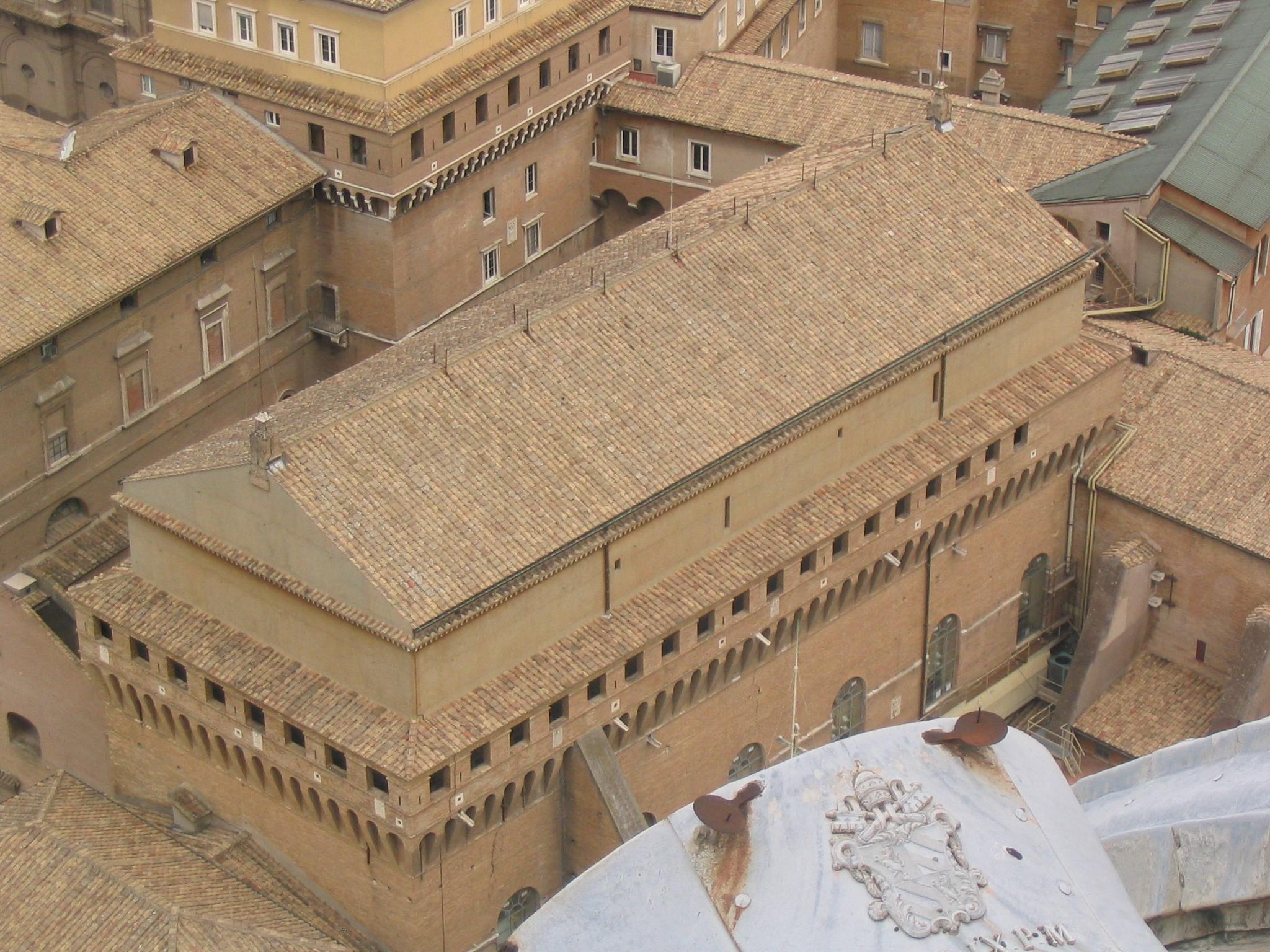
Sistine Chapel
Michelangelo did not want the job. When Pope Julius II commissioned him in 1508 to repaint the ceiling of the Sistine Chapel, the sculptor protested that he was no painter. He suspected his rivals had engineered the commission to humiliate him. Four years later, working largely alone on scaffolding he designed himself, he had produced one of the most extraordinary achievements in the history of Western art: over 300 figures across 500 square meters of vaulted ceiling, culminating in the image of God's finger reaching toward Adam that has become the single most recognized gesture in art.
Before Michelangelo
Pope Sixtus IV built the chapel between 1473 and 1481, and the building takes his name. Its exterior is deliberately plain, as is common in Italian churches of the era, and there is no grand facade because the entrance has always been through the interior rooms of the Apostolic Palace. The dimensions are significant: roughly 35 meters long, 14 meters wide, with the ceiling rising about 20 meters above the floor. These proportions intentionally mirror Solomon's Temple as described in the Old Testament. In 1481 and 1482, a team of Renaissance masters including Sandro Botticelli, Pietro Perugino, Domenico Ghirlandaio, and Cosimo Rosselli painted two complementary fresco cycles on the walls: the Life of Moses and the Life of Christ. The ceiling above them was simple: blue paint studded with gilt stars. Sixtus IV consecrated the chapel on August 15, 1483, dedicating it to the Virgin Mary.
A Sculptor's Ceiling
Julius II's architect Donato Bramante proposed suspending the scaffolding from ropes drilled into the ceiling. Michelangelo laughed at the plan, which would have left holes in the vault, and designed his own freestanding platform instead. He then spent the years from 1508 to late 1512 painting the ceiling, developing a scheme far more ambitious than the Twelve Apostles originally proposed. The central panels depict nine scenes from Genesis, from the Separation of Light and Darkness through the Drunkenness of Noah. Around these, he painted prophets and sibyls, ignudi (nude figures), and the ancestors of Christ. The work was physically brutal: Michelangelo stood with his head tilted back for hours, paint dripping into his eyes, his body permanently twisted by the effort. He wrote a poem about the misery, describing his stomach pushed toward his chin and his brush dripping onto his face "making a rich pavement." When the ceiling was unveiled, it stunned Rome.
The Wall of Judgment
Twenty-three years after finishing the ceiling, Michelangelo returned. Pope Paul III Farnese commissioned him to paint the Last Judgment on the entire altar wall, a project that consumed the years from 1535 to 1541. The interval between the two works had not been kind. The Sack of Rome by imperial mercenaries in 1527 had shattered the city's confidence, and the theological upheaval of the Reformation was tearing Christendom apart. The Last Judgment reflects that darker world. Christ appears not as a gentle savior but as a muscular judge, his raised arm sweeping the damned downward into hell. Saints display their instruments of martyrdom like evidence at a trial. The dead claw their way from their graves at the bottom while demons drag sinners into the underworld. Michelangelo included his own face in the painting, not on a figure but on the flayed skin held by Saint Bartholomew, a self-portrait as an empty husk.
Covered and Uncovered
The nudity in The Last Judgment provoked immediate controversy. Before Michelangelo was even dead, the Council of Trent decreed that the figures should be covered, and his student Daniele da Volterra was hired to paint draperies over the offending areas, earning the nickname "Il Braghettone" (the breeches-maker). Centuries of candle smoke, incense, and accumulated grime then dulled the frescoes to near-illegibility. When a major restoration began in 1980 and concluded in 1994, the cleaning revealed colors so vivid that some critics feared the restorers had gone too far. The deep blues, bright greens, and luminous skin tones that emerged challenged the long-held assumption that Michelangelo worked in a somber palette. The debate continues, but the chapel that emerged from restoration was startlingly different from the murky interior visitors had known for generations.
The Conclave Room
Beyond its role as an art monument, the Sistine Chapel remains a working space of enormous consequence. It is here that the College of Cardinals gathers to elect each new pope in a process called the conclave, from the Latin cum clave, meaning "with a key," because the cardinals are locked inside until they reach a decision. A temporary chimney is installed to carry smoke signals to the waiting crowd in St. Peter's Square: black smoke means no pope has been chosen, white smoke announces a new leader of the world's 1.3 billion Catholics. The cardinals deliberate and vote beneath Michelangelo's ceiling, under the gaze of the prophets and sibyls and the outstretched hand of God giving life to Adam. Every papal election since the chapel's completion has unfolded in this room, surrounded by images of divine creation and final judgment.
From the Air
The Sistine Chapel (41.903N, 12.454E) is located within Vatican City, immediately north of St. Peter's Basilica. The chapel itself is not visible from the air due to its plain roofline integrated into the Apostolic Palace complex, but Vatican City and the basilica's dome are unmistakable landmarks. Rome Fiumicino Airport (LIRF) is 28km southwest; Ciampino (LIRA) is 16km southeast. Mediterranean climate.