Sita Ramachandraswamy Temple, Bhadrachalam
Kancherla Gopanna had a problem. As the tax collector of Bhadrachalam under the Golconda Sultan Abul Hasan Qutb Shah -- known as Tana Shah -- his job was to send revenue to the Sultanate treasury. Instead, he spent it rebuilding a temple to Rama on the banks of the Godavari River. Six hundred thousand rupees of the Sultan's money went into stone, mortar, and devotion. The Sultan, understandably, was not pleased. Gopanna spent the next twelve years in prison, composing the bhakti songs that would make him immortal. The temple he built with stolen taxes still stands. The songs he wrote in chains are still sung inside it.
Where Rama Kept His Promise
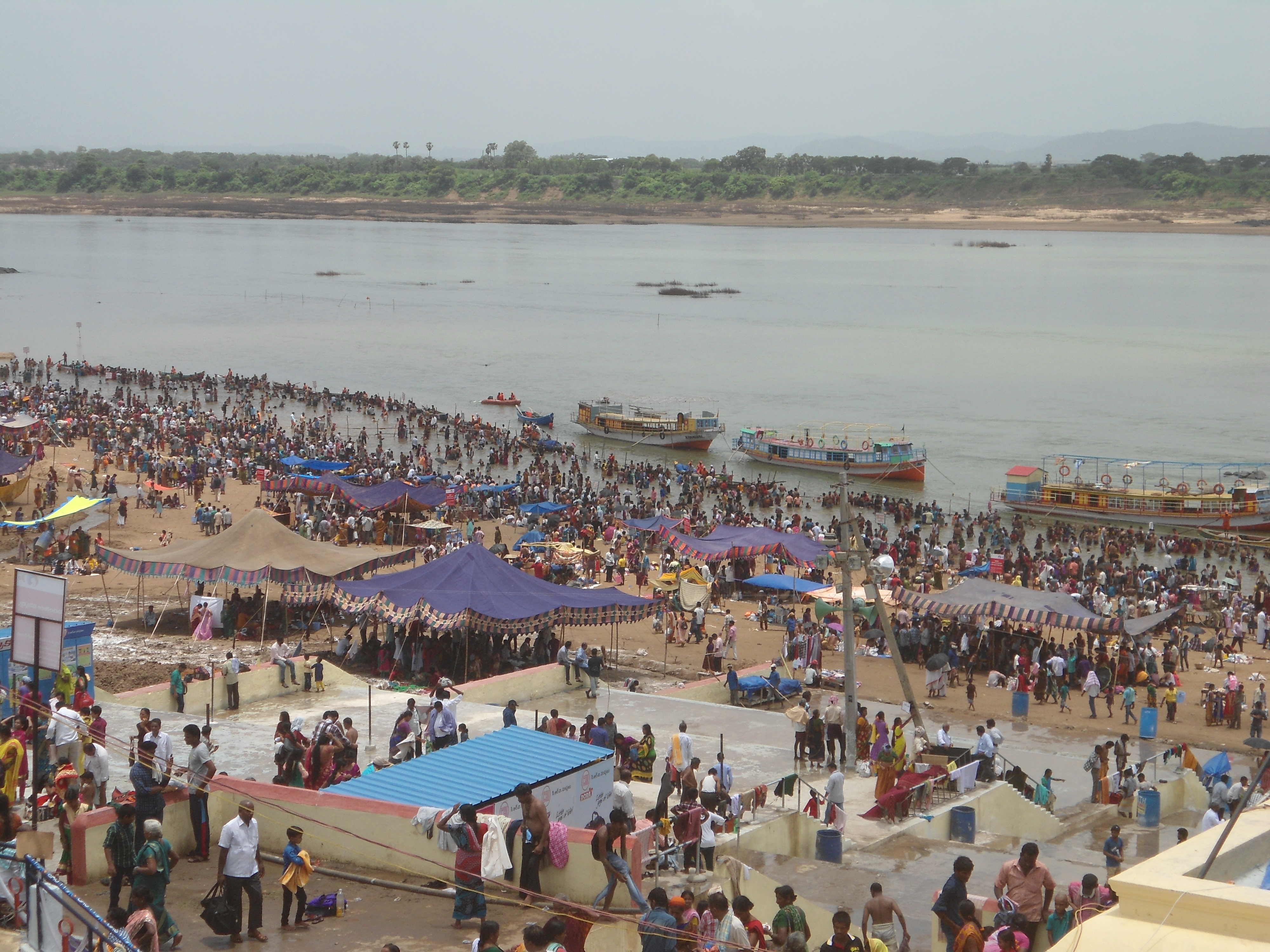
The temple sits on the banks of the Godavari in eastern Telangana, in the town that takes its name from the legend that gives the site its sanctity. According to tradition, during the events of the Ramayana, a devotee named Bhadra meditated on the Godavari's banks for ages, chanting the Rama Taraka mantra after receiving instruction from the sage Narada. Rama had promised to return to Bhadra after rescuing Sita from the demon king Ravana, but failed to do so during his mortal lifetime. Later, Vishnu appeared to fulfill his avatar's promise -- but arrived in such haste that he forgot to shed his celestial form. Instead of the two-armed mortal Rama, Bhadra beheld a four-armed figure: conch and Sudarshana Chakra in the upper hands, bow and arrow in the lower. Sita sat on his left thigh, Lakshmana stood beside him, and all three faced west toward the Godavari. This is the image that still occupies the sanctum -- the Vaikuntha Rama, the cosmic form of a god who almost forgot a promise.
The Tax Collector's Gamble
Gopanna was born in Nelakondapalli village in Telangana, into a Niyogi Brahmin family. His maternal uncle Akkanna served as a minister in the Golconda Sultanate court, and it was through this connection that Gopanna received the appointment as tahsildar of the Palvoncha region sometime after 1672. When he arrived in Bhadrachalam and saw the temple's condition, something shifted in his priorities. He began diverting land revenue to fund reconstruction. The villagers, according to some accounts, encouraged him, promising to repay the money after harvest. The harvest came and went. The money did not return to the treasury. Gopanna completed the temple renovation -- and then faced the consequences. Tana Shah had him arrested and imprisoned in Golconda Fort. The charge was straightforward: embezzlement of state funds for religious purposes. By the standards of any government, ancient or modern, the charge was accurate.
Songs From a Prison Cell
What happened next belongs partly to devotional legend and partly to documented literary history. During his twelve years of imprisonment, Gopanna -- now called Bhadrachala Ramadasu by his growing following -- composed devotional songs to Rama that would become foundational works of Telugu bhakti literature. The keertanalu follow the classical Pallavi, Anupallavi, and Charanam structure, composed primarily in Telugu with passages in Sanskrit and occasional Tamil. They are not the abstract meditations of a comfortable theologian. They are the prayers of a man in a cell, addressing a god he spent a fortune to honor and who had not yet intervened to save him. The tradition holds that Rama himself eventually appeared at the Sultan's court with Lakshmana, bearing the gold coins needed to secure Gopanna's release. Whether the release was divine or political -- the Golconda Sultanate was collapsing under Mughal pressure by that point -- Gopanna walked free and returned to his temple.
Dakshina Ayodhya
The temple is known as Dakshina Ayodhya -- the southern Ayodhya -- placing it in direct spiritual lineage with Rama's legendary capital in northern India. It follows the Vaishnavite Pancharatra Agama tradition, with its worship system modeled on the great Ranganathaswamy Temple in Srirangam. The Rajagopuram tower rises at the northern entrance, called the Vaikuntha Dwaram -- the gateway to Vishnu's paradise. Inside, sub-shrines and mandapams unfold around the central sanctum. The temple's annual Brahmotsavam festival draws enormous crowds, peaking with the Sri Sitarama Thirukalyana Mahotsavam on Rama Navami eve -- a ceremonial reenactment of the marriage of Rama and Sita. During Vaikuntha Ekadashi, devotees believe the northern gateway opens a direct path to Vishnu's celestial realm. The Godavari flows past it all, the same river on whose banks Bhadra once chanted and Gopanna once gambled his freedom. The water does not remember, but the temple does.
From the Air
Located at 17.667°N, 80.883°E on the banks of the Godavari River in Bhadradri Kothagudem district, eastern Telangana. The temple and town of Bhadrachalam are visible along the Godavari's course through a region of forested hills transitioning from the Eastern Ghats to the Deccan Plateau. Rajahmundry Airport (VARG) is the nearest significant airport. The Godavari River serves as a prominent visual landmark from altitude, winding through the landscape. The area receives heavy monsoon rainfall and is subject to periodic flooding.