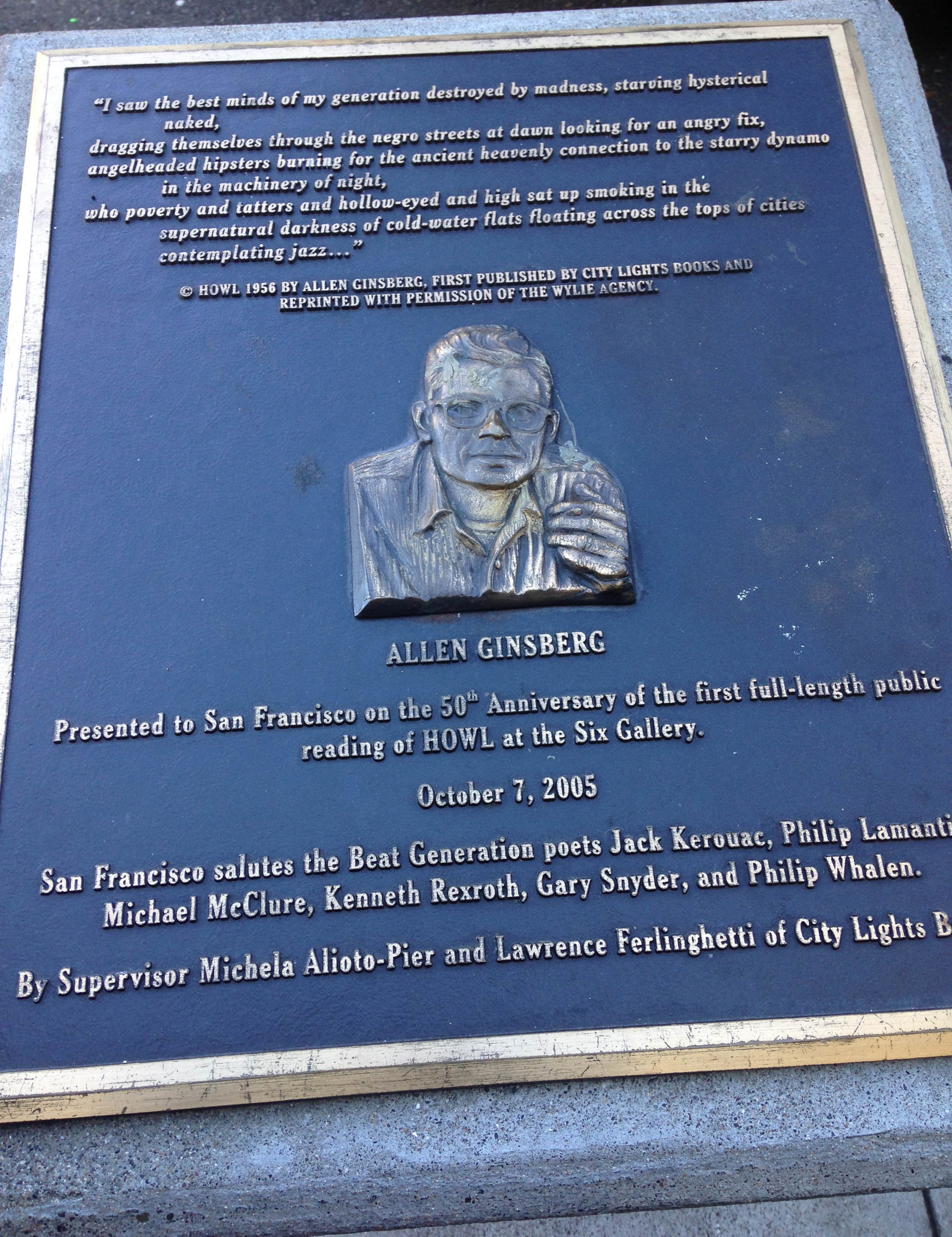
Six Gallery Reading
A plywood numeral "6" wrapped in fairy lights hung outside the door. Inside, the gallery measured just 20 by 25 feet, with a dirt floor and room for maybe 125 people. It was Friday, October 7, 1955, and by eight o'clock that evening, the small space at 3119 Fillmore Street in San Francisco was packed. Nobody in attendance could have known they were about to witness one of the most consequential literary events of the twentieth century -- the night Allen Ginsberg first performed "Howl," and the Beat Generation announced itself to the world.
A Gallery Born from Bohemia
The address had already lived several lives. In 1952, it housed the San Francisco Community Theater before artists Jess Collins and Harry Jacobus, along with poet Robert Duncan, transformed it into the King Ubu Gallery -- named after Alfred Jarry's anarchic 1896 play. King Ubu lasted a year. Ten months after it closed, six friends took over: five painters and a poet named Jack Spicer, who taught at the nearby California School of Fine Arts. Deborah Remington suggested calling it "the 6 Gallery," using the numeral rather than the word, because there were six founders. They held fundraisers to buy plasterboard, hosted poetry readings and nude dances, and generally made the place a magnet for San Francisco's avant-garde. When Robert Duncan stripped naked at the end of his play Faust Foutu, attended by a young Allen Ginsberg, the gallery acquired what one historian called "an aura of notoriety."
The Night Everything Changed
The reading came together almost casually. Painter Wally Hedrick asked Kenneth Rexroth, an elder statesman of San Francisco poetry, if he knew any poets willing to perform. Rexroth pointed him toward Ginsberg, who agreed to organize the evening and mailed out a hundred postcards announcing "6 Poets at 6 Gallery." Philip Lamantia, Michael McClure, Philip Whalen, Gary Snyder, and Ginsberg himself would read, with Rexroth serving as master of ceremonies. For both McClure and Ginsberg, it was their first public reading ever. Jack Kerouac was there too, though he refused to read his own work. Instead, he collected donations for jugs of cheap wine, which circulated through the crowd all night. As each poet performed, Kerouac shouted encouragement from the audience -- "Yeah! Go! Go!" -- his enthusiasm fueling the room's electric atmosphere.
The Birth Cry of a Generation
When Ginsberg stepped up to read, the room shifted. "Howl" was unlike anything the audience had heard -- raw, incantatory, furious, tender. The poem's opening line, with its vision of "the best minds of my generation destroyed by madness," hit the crowd like a detonation. Rexroth reportedly wept. The energy in that tiny dirt-floored gallery became something almost physical, a collective recognition that American poetry had just cracked open. Within months, "Howl" would be published by City Lights Books, seized by U.S. Customs, and tried for obscenity -- a trial that became a landmark for free speech. But the poem's real power had already been proven in that room, where it moved a hundred strangers to tears and shouts in equal measure.
Echoes on Fillmore Street
Kerouac immortalized the evening in his 1958 novel The Dharma Bums, renaming Ginsberg "Alvah Goldbrook" and the poem "Wail." His fictionalized account helped cement the Six Gallery reading as the founding myth of the Beat Generation, a movement that would reshape not just literature but American culture at large. The gallery itself continued for a few more years before closing. The Fillmore Street addresses were eventually renumbered, and the original 3119 disappeared from maps entirely. When a writer visited the site in 1995, he found a store called Silkroute International, its rugs and pillows spilling onto the sidewalk. The building that housed the dirt-floored gallery where American poetry was reborn had moved on, indifferent to its own history -- which, in a deeply San Francisco way, feels appropriate.
From the Air
Located at 37.798N, 122.436W in the Cow Hollow / Pacific Heights neighborhood of San Francisco. The former gallery site is on Fillmore Street, visible from low altitude approaches. Nearest airports: KSFO (San Francisco International, 11nm south), KOAK (Oakland International, 10nm east). Best viewed at 1,500-2,500 ft AGL on clear days.